CREATIVE WRITING

at the Ruth Asawa School of the Arts in San Francisco

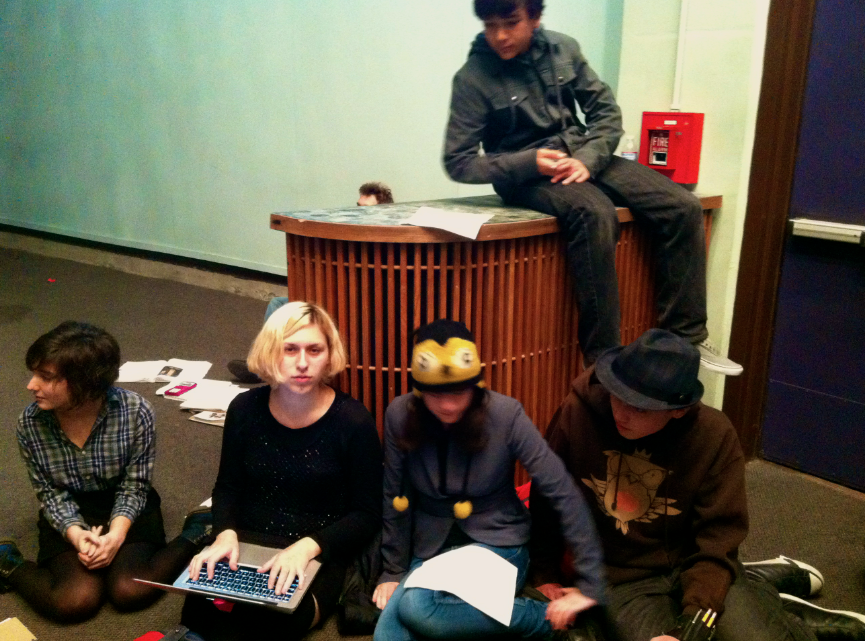
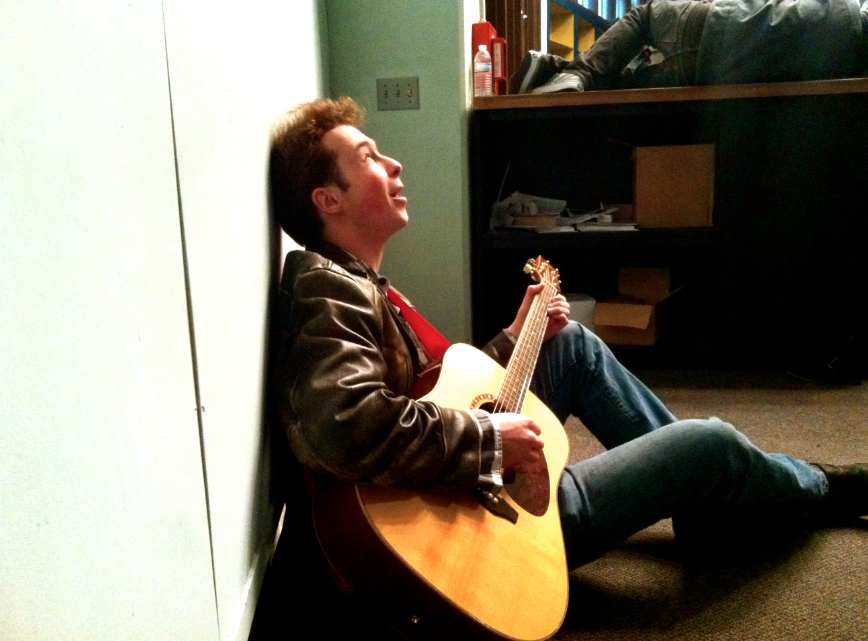
Welcome! CW develops the art and craft of creative writing through instruction, collaboration, and respect. This blog showcases STUDENT WRITING and how to APPLY to Creative Writing.

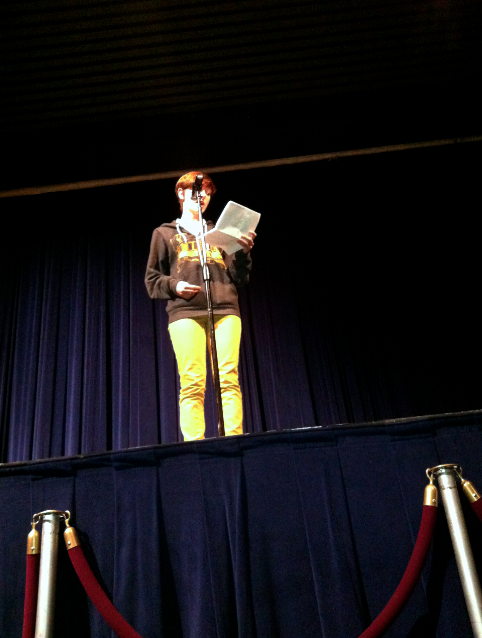
  • What is there to look forward to in the Poetry Café this Friday and Saturday @ 7:30? Well. . . 

    – Feminine energy flowing from the stage, and not the awkward, intense, liberal, all talk “equal rights” feminism, but a celebration of what femininity means to all of us.

    – The last Poetry Cafe of the senior girls of CW!

    – Amazing poetry in amazing places, written and read aloud by an amazing community of writers!

    – All the intensity, personality, energy, dark hushed rooms, and intimacy of a poetry reading. 

    – Two experiences completely like and unlike each other, each featuring different poetry written by the same people. 

    Come to the Creative Writing Show(s) this weekend!

  • After a brief hiatus, we are rebuilding our Facebook page. So come on over, like us, post a poem on our wall, or whatever…

    Creative Writing on Facebook

    Facebook Page

  • Friday, January 25th, 7:30PM @ SOTA Mainstage

    Saturday, January 26th, 7:30PM @ Café Flore

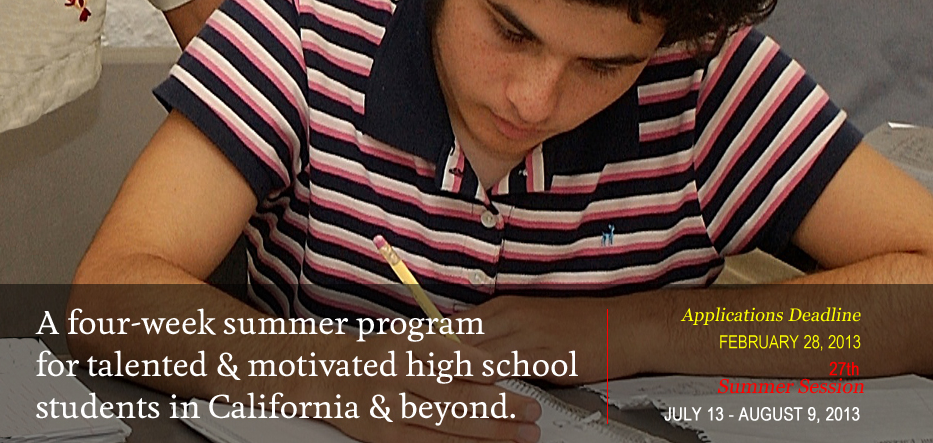
  • Anyone I’ve known who has ever attended the CSSSA program has LOVED it.  Just loved it.  I was talking to a SOTA parent whose daughter attended the Films Studies program and he said that she was so ecstatic about the experience that she didn’t want to return a second summer because she didn’t want to tarnish her perfect memory.  Another student I knew was having one of those infamous “Sophomore Boy Syndrome” years where his grades dropped, he missed tons of school, and just didn’t seem to care much about anything. Somehow, though, he made it into the program (he does have extraordinary talent).  He returned energized and had a stellar Junior Year.

    CSSSA stands for California State Summer School for the Arts, located in Valencia California (where awesomeness lives).  It’s a competitive pre-college program that offers a full-range of arts programming, including Creative Writing.  The application deadline is February 28th.

    CSSSA

  • One of the most popular, well-attended events of the year at SOTA is Media Night.  If you missed the show last night, it’s not too late.  Arrive early as it often sells-out. See SOTA students from a variety of disciplines up on the big screen at the Dan Kryston Memorial Theatre.

    Media night

    Media Department

    Media Night

    Dan Kryston Memorial Theater
    Ruth Asawa San Francisco School of the Arts
    Thursday, Jan 17, 2013 at 7:30 PM; Friday, Jan 18, 2013 at 7:30 PM

    Adults: $15; Students/Seniors: $7

    The latest offerings in narrative, experimental, and documentary film from the students of SOTA’s Media Department
  • One of the earliest units Creative Writing delved into this semester was an “art unit” taught by Ronald Chase, where he helped us understand the changing landscape, subject, and techniques of art, and taught us ways in which we communicate about art. Why use, “I just don’t like it very much,” when you can go much deeper into the composition and specify? “This blank canvas may attempt to communicate a blank and slightly saturated view of what art has fallen into, but fails because it is, in effect, a blank canvas.”

    The unit concluded with an essay contest in which we were to enter: the 2012 Tarkovsky Essay Contest, involving a short essay on any of the Art & Film movies we had seen and wanted to write about. The lucky winners were: Abigail Schott-Rosenfield, 11th grade, Tarkovsky Prize winner; Frances Saux, 11th grade, 2nd Place; Midori Chen, 11th Grade, 3rd Place; and Bailey Lewis Van, 10th Grade, runner-up.

    A link to all of their essays can be found here. Congrats to the winners and all other C-Dubs who entered!

  • by Hosanna (’14)

    The thing no one wants to be is a lone wolf. When do we ever hear about a wolf not belonging to a pack? Who’s the wolf supposed to hunt with? Who’s the wolf supposed to howl at the moon with, chase down white rabbits with, scare off predators with? It is all about being comfortable with yourself. It is all about being able to be alone. Being by yourself doesn’t necessarily mean running away from home to live in a crack-infested forest. Nor does it mean hiding in dark, moist, potato-growing closet corners reading a book you can barely see. I feel being alone is being able to walk down the street, see some annoyingly social kid from your school, and not wanting to find a stranger to talk to. It is being able to sit on the ground while waiting for a bus. It is being able to hear yourself cry and then laugh at yourself. It is being able to heal yourself. I’ve been a lone wolf since the beginning of time. The reason I started writing was because I felt left out. In elementary school I would listen to Amy Winehouse, type until I had to do homework, and read. Now, I’m plugged up, listening to Tupac, crying when I get too frustrated to deal with anyone, singing when a song is too good to be silent. If Chuck Norris can be a lone wolf and still sit in the corner of a circular room, why can’t anyone else? If you can’t deal with yourself, how can you deal with anyone else?

    True stories.
  • by Abigail (’14)

    On December 16, Mykel, Midori and I went to a reading from Carville Annex. It was held in the Arboretum, in the redwood grove, which is difficult to find. I showed up early at the entrance and met some of the readers. None of them were sure about how to get to the redwoods. “We were hoping Sarah knew.”

    Sarah Fontaine showed up. “Hey, where are we going?” we asked her. “Well…I don’t really know,” she said. So we started wandering. I noticed a sign that said, “Redwood Grove,” with an arrow, but nobody else seemed to. I was walking behind them, and they were too far away for me to mention it… Since they had they the map, I figured they knew what they were doing. Not really, but whatever. Someone said, “Even if nobody figures out where the reading is, they’ll have a great time walking around with the plants!”

    “Yeah!”

    “This place is rad, right? I love the weather!”

    “Yeah!”

    The entire reading had, in some ways, the tone of this conversation. Everybody was happy to be there, and everybody liked and trusted everybody else. The readers were all young—two were high school students, the rest were maybe twenty to twenty-eight. Many of the pieces were about not knowing how to be a good adult, or not knowing what the author’s place in the world was, but the readers were figuring it out… they were getting there. They were enjoying themselves along the way.

    the halcyon bird, or Kingfisher

    One of the pieces, a “sermon” for the holidays—“’Tis the goddamn season,” it began—explained (convincingly and hilariously) the importance of paying attention to one thing at a time. Apparently, “the ancients” believed that, for a few days during the holiday season, birds called Halcyons floated in nests on the sea, keeping it calm so people could celebrate. The author said that, this year, she’d celebrate the season by not multitasking— she’d try to live some halcyon days.

    Her fellow readers seemed to be living halcyon days, too. They were all calm and appreciative and earnest and fully present. Which you don’t get often at your average reading.

    It was nice to hear my friend Annakai read (I hadn’t in a long time) and it was also nice to sit with Midori and Mykel, listening, in such a pretty spot. Birds kept popping out of the surrounding bushes, flying past the readers’ faces, then disappearing again. There were more great things about it, but it would make a very long blog post to talk about them all. Midori said it was the best reading she had ever gone to, and Mykel and I agree, so keep an eye out for more.

    The title of the reading was “What a Few People Want to Say to the World.” I wish I could quote the first piece read, which was Sarah’s, but the gist of it seemed to be that self-promotion is only gross when it’s egotistical—when it’s just because you want to tell people about yourself, it’s helpful, and bigger than yourself, and necessary. The readers were all happy to be included in the “few people,” and they were confident that they were talking to a larger audience than just the people in the redwood clearing.

  • by Giorgia (’14)

    Capoeira is a Brazilian martial arts that was created by African slaves during the colonial era. It ties together dance, music, and martial arts, as well as containing a strong life philosophy. Individual capoeira practices vary from school to school. I’ve been playing capoeira since I was six years old, at summer camp, and began training at ABADÁ with Instrutores Estrela Vesper, Sereia, and Corrente, and Mestranda Marcia Cigarra. Capoeira has been important to me since I was small, and has had a massive influence on my life, and in the last year I have entered the adult system and it has become one of my strongest passions (Find out more about ABADÁ Capoeira here).

    The sudden rush of hot air, muffled voices, and the smell of hardwood and sweat hits me as I climb the last step of the flight leading up to the studio. It’s Thursday night, T – 3 days until the Batizado and the studio is flooded with white pants; at least eighty people are gathered on the floor, all in the uniform, a wider array of cord levels than I have seen in my entire life at ABADÁ, natural to orange, a full spectrum of graduados, instrutores, professores, and at the top of it all, Mestre Camisa himself, the founder of our school, based in Rio de Janeiro.

    I could give a play by play of our three days of workshops, a description of our menu each day, bogged down with Portuguese vocabulary and technical descriptions that would mean nothing to you, the reader, and leave you confused and weary of ever trying capoeira or much less reading my contributions to this blog.

    So I won’t.

    Rather, I will talk about my feelings, or my experience, or what I have learned, because that’s what blogs are for, right? Feelings?

    Not a day goes by that I’m not grateful for capoeira, for ABADÁ. As much as my temporary departure from 2010-2011 pains me, I needed to leave for that time to be where I am now, to truly understand and be aware of how much it matters to me, and the role it is meant to take in my life—fellow CDubs I am sure would laughingly respond to this with “You mean all of it!” —but that wouldn’t be an exaggeration. Capoeira is my life, and many times I am made to feel irrational or insane for saying that, or thinking it, and that is what our four days of workshops and Batizado taught me the most, I think, more than benguela techniques, or entradas, or new songs. It taught me, truly, from the catch in Marcia’s voice when she introduced the Batizado and Mestre Camisa, “This is my life”; to the way we all say the word “family” effortlessly to and about one another; the abundance of food and smiles and overabundance of warmth the entire weekend; the meaning of the phrase “Capoeira is life,” because it is.
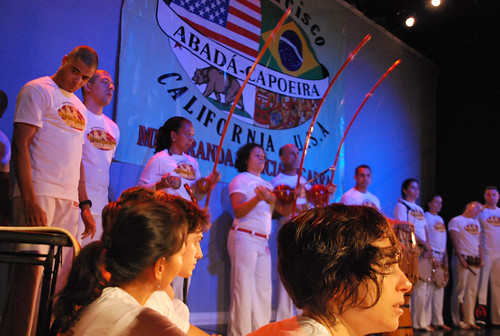
    On Thursday night, when the first workshop was over, Mestre Camisa beckoned us with the berimbau, and we sat, all almost-hundred of us, in a cluster at his feet, and for a moment I could feel the legacy tangible in the air, in the rasp of his voice shaping around the rolling consonants and vowels of Portuguese, in Professor Furaçao’s NYC-thick translation. He spoke about life and capoeira interchangeably, his answers to questions about capoeira were about his own life, and his answers to questions about life were about capoeira, his and that of others. We all sat, steeped in awe, and listened to his words, and took them with us, back to our own cities and homes and lives, when the weekend came to an end with a night of songs and candlelit dinner.

    His words, already resonant in the brimming caverns of my chest, became real to me on Sunday afternoon, prickling at the corners of my eyes before being wiped away as Mestranda called out my name, “Amendoim,” a freshly dyed blue-yellow cord in her hand. I got to my feet and did my del mundos, palm to palm around the circle, meeting the smiles of the people I call my family with my own, the special grin I reserve for them, for the bright, sparking light of the roda, for my home, my life, my always. I could write infinitely about this, and never say anything close to what I mean, so I will stop now, while the length is bearable, and keep going, full of questions and of hope, of capoeira and of life, all one and the same, because its motion is my articulation of what I mean.

    The RAY Project Teen and Youth Students with ABADÁ Capoeira founder, Mestre Camisa

    photos courtesy of Samambaya of ABADÁ Capoeira

  • The WordPress.com stats helper monkeys prepared a 2012 annual report for this blog.

    Here’s an excerpt:

    4,329 films were submitted to the 2012 Cannes Film Festival. This blog had 15,000 views in 2012. If each view were a film, this blog would power 3 Film Festivals

    Click here to see the complete report.