CREATIVE WRITING

at the Ruth Asawa School of the Arts in San Francisco

Welcome! CW develops the art and craft of creative writing through instruction, collaboration, and respect. This blog showcases STUDENT WRITING and how to APPLY to Creative Writing.

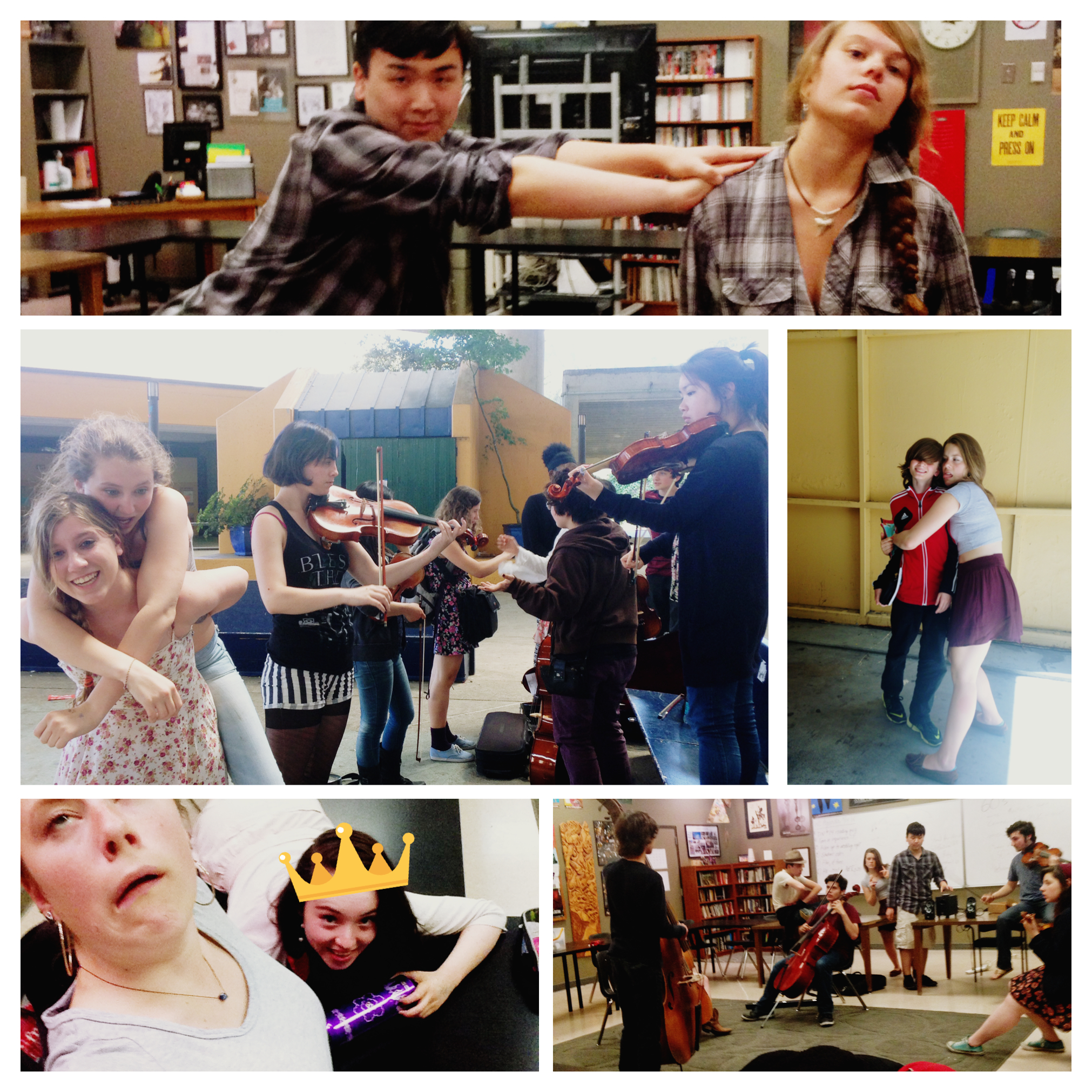
  • Well, it took us a couple minutes to learn to love it. When the always adventurous Maia told us that today we would be working alongside another department, most of us were a little reluctant. It’s not that we don’t thoroughly appreciate the talents of the Instrumental Music department or the merits of working together, but I (and I’m sure many other CWers can attest to this) experienced a sudden onset of social anxiety. It meant we would have to SPLIT UP and it’s so HOT OUT WHY would they make us MOVE out of the CW room and what if they DIDN’T LIKE US and what if they JUDGED our poetry?? But, with the urging of the always wise seniors and Maia, all fourteen of us trudged on over to Orchestra room. We were then split up into groups (one or two CWers alongside three to five musicians), and assigned decades from which to compose a musical piece and a written piece to accompany it. My group, assigned the 1920s, wrote a short piece that begins: “Speakeasy, hold my secrets….” So you know there’s going to be some pretty good flapper drama going on in ours. Anyway, as I looked around to all the other CWers and musicians, working side by side to create their own beautiful, original pieces of art, I realized something: collaboration is scary, but its rewards enormously outweigh those few seconds of social anxiety. Interdisciplinary collaboration is so valuable and important in instituting a real feeling of community in the school and an appreciation for other art forms outside of your department, and I really hope that this day sets us on a path for collaboration between all departments in the future.

    Below are pictures of our collaboration day:

    Image

  • Recently we visited the school farm. Part of this adventure was visiting the chickens they keep on the farm, something I, personally, was very excited about. See, I like to think of animals as my friends, and I wrongly assumed that these chickens would feel a similar love for me. 

    Maybe I should have stayed out of the chicken coup. When you go into a dangerous zone like that, you have to understand the risks. Of course, I was just excited to pet their soft, feathery heads and did not consider the possibility that they were not as eager to be petted. 

    Maybe I should have just patted one or two on the back, watched them run in circles for a while, and gone home unharmed. That’s not the kind of person I am though, and after seeing Olivia Weaver pick up a chicken and give it a big hug I decided that there was nothing stopping me from doing the same. 

    When I grabbed the hen, she seemed at least partially content, and I was so exhilarated by the knowledge that I was holding the chicken and had therefore made a friend that I did not notice that I was being crapped on until it was too late. Fortunately, chicken feces are mostly grass and don’t smell too bad, but the whole experience was tarnished by that one traitorous chicken.

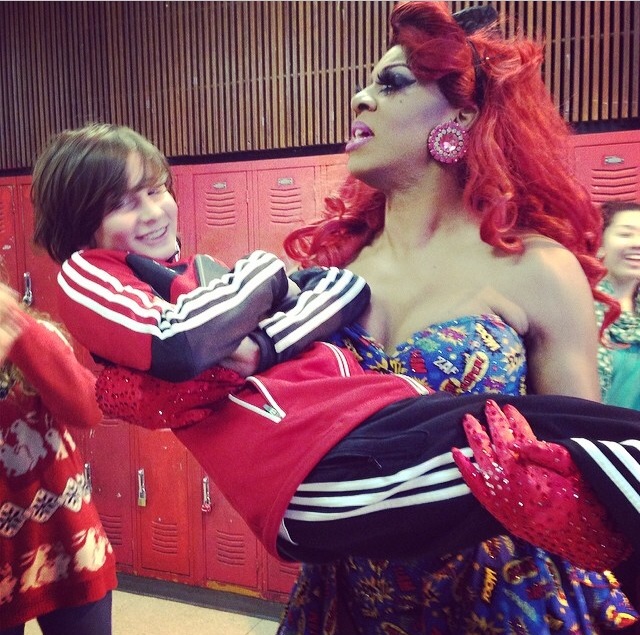
  • At this time of year most schools have a Winter Formal. School Of The Arts has a Drag Ball. I learned about this when a Drag Queen in flamboyant colors and excessive makeup stormed our classroom, arbitrarily picking me up in the process. Dances aren’t large events at SOTA, and the student government is looking to change that. After what I am sure was a long and arduous process, they decided to stay close to our core values, and start what I predict will become a tradition.
    Image

    The image, in its absurdity, seems symbolic of SOTA and San Francisco. In Sochi, Russia gay propaganda is illegal, despite it hosting the Olympics: a symbol of worldwide unity. I wonder what they would think of the Drag Queen there.

  • In the spirit of Doing What We Want (which is the name of our 3 day unit in which we explore a list of Things We Want To Do More Of In Creative Writing), we hopped on a bus and went to the botanical gardens. Magnolia leaf hats were worn, leaves were licked, and birds and airplanes were listened to.

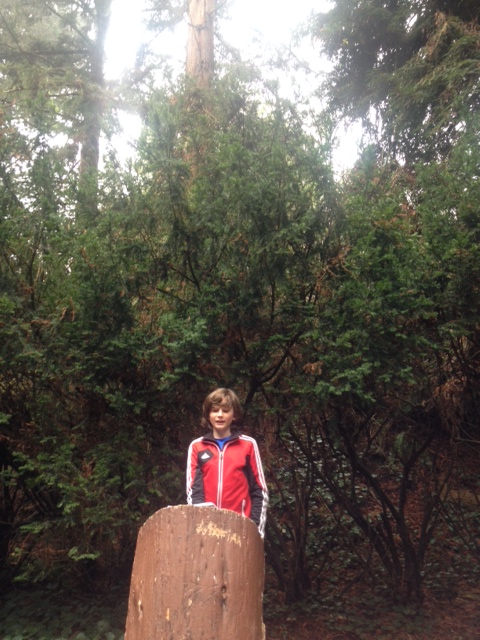
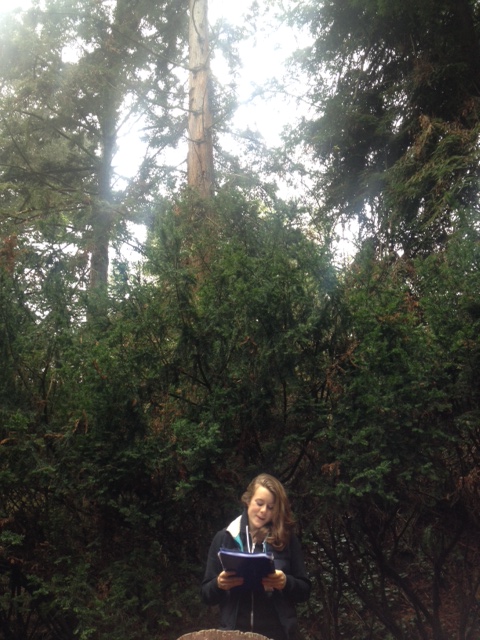
    We almost didn’t go because of the weather. It was damp and gray, and we were worried about getting cold. But we decided by popular vote to go anyways and get our butts wet. We went to the redwood grove, where there is a log podium and some benches. We took turns going up to the podium and standing on the wobbly stump to read short pieces we’d written.

    I’ve recently been in a bit of a writing rut, but listening to the diversity of voices in our department riff on mysteriously similar themes never fails to inspire me. I filled up a page of my notebook with poetic odds and ends instead of the lists of facts/responsibilities that it’s been filled up with over the past few weeks.

    Just as we confronted the cold to go out and have an adventure, a lot of us confronted feelings of inadequacy in order to step up to the podium and say, “Hey guys, this is my art. It’s worth your time and attention.”

    I’m thinking about the how incredibly lucky we were to be somewhere damp today when our state is in the middle of a drought. And I wonder how that connects to the feelings we have to confront to share our art with each other. Anyways, I loved our non-judgemental sharing space. I leave you with these thoughts and an assertive moo, which is apparently how I express deep appreciation for writing now.

    Image

    Image

    Image

  •     We began the first day of Sarah Fontaine’s mini-unit with a prompt to write about how we, as both humans and writers, connect to other people. This got me to thinking about my most recent favorite poem, “In Blackwater Woods” by Mary Oliver. I don’t usually read poems and then proclaim them my “favorite,” but for some reason this poem really appealed to me. I think it’s because I made a strong connection with the message (that I interpreted) of the poem and the circumstances of my life right now. What I love about the poem is that, although I identified strongly with it, I don’t think that Mary Oliver wrote the poem for anybody but herself. I think that she, like I hope to someday do with my writing, wrote the poem to express a feeling and a message that she wanted to understand for herself (not for any potential reader or critic), which also happened to convey a message that many readers, like myself, could relate to. I don’t think that the sole purpose of writing is to connect the writer to other people—at least for me, writing is a very introverted and personal activity— but I do think that, like I recently experienced with Oliver’s poem, if the writer choses to put their ideas out into the world, their personal thoughts and feelings and struggles could deeply connect with and impact somebody else.

  • Come to our show this Friday! 7:30 @SOTA Mainstage, free for students, $15 for adults!

  • This past Monday, Creative Writing welcomed a very special guest, photography writer Pete Brook. In Brook’s own words: “I am not a photographer. I stick to looking and commenting. I work as a freelance writer.” Brook, an avid blogger and curator of photographic images, came to speak about his work with images taken in and of the prison system. Originally from Lancashire, England, and now living in Portland, Oregon, Brook works for Wired Magazine on their ‘Raw File’ photography blog as well as actively maintaining his own blog, prisonphotography.org. He showed Creative Writing an inspiring slide show of photos taken within prison walls, and shared with us his thoughts on why prisons, prisoners, and images thereof can be an important and uniquely revealing look into this group of American citizens. 

     Brook first became interested in the prison system back in 2004, when he was, in his words, looking for an excuse to stay in California. At the time, he was finishing up a master’s course in museum studies at the University of Manchester in England. He wanted to stay and do research in California, but what would be his subject? Brook discovered that the San Quentin Prison had a prison museum, which became the center-point of his thesis. The 2.3 million people in the prison system fascinated him as well as the human rights abuses they suffered. Brook started prisonphotography.org six years ago, after moving to Seattle. He did it to show people a different side of prison photography. As he states in an interview with the New York Times in 2011, “When you deal with prisons, you’re dealing with closed systems. These are effectively disciplined spaces. And that discipline attends to the imagery that is released.” 

    One of the first slides in Brook’s presentation was a compilation of prison clip art, the kind of stereotypical pictures a simple Google search produces. I thought this laid a good foundation because he started with the most basic, simple, unrealistic pictures of prison and then delved into emotional photography, which depicted prisons from all kinds of angles, even the outside. For me, the clip art symbolized the media’s portrayal of prisons. This got me to thinking that I never question prisons or what goes on inside of them. I always assumed that the people handling criminals weren’t criminals themselves. This is one reason I appreciated Brook’s presentation, because it offered a fresh perspective on a topic I am not familiar with and have not thought a lot about. As writers, we always need new experiences and new ideas to inspire our writing. 

    Brook showed us many different photographers that have either spent time volunteering in prisons and taking pictures, or have fixated their photography on prisons. Two that interested me the most were Stephen Tourlentes and Cheryl Hanna-Truscott. Tourlentes photographs the outsides of prisons. One of his pictures was of a large penitentiary at night, all lit up. Brook told us a story of how Tourlentes was driving along the road at night in the middle of nowhere and saw these bright lights, as if there were a city in the far distance. When he went to investigate, Tourlentes found that it was in fact a bright prison, and he took a picture. I thought about the architecture of prisons and how so simple they are yet in a sense they are their own cities: A complex jungle of cell blocks and lights.

    Cheryl Hanna-Truscott took pictures of incarcerated mothers with their newborn babies. Brook talked about how if the mother is stable, charged with a non-violent crime and has good behavior then some prisons let them stay with their babies up until they are seven years old. The picture Brook showed us was of a prison mid-wife holding a newborn baby in a prison cell. Brook shared with us that he thought more prisons should have programs where mothers are allowed to stay with their babies.  I found myself conflicted on this topic, which made it so intriguing. Is it fair to keep babies in a cell for the first years of their life? How will that affect them emotionally? How will that change their upbringing? On the other hand, Brook said that research has shown that it is crucial for a baby’s development to be with her/his mother in those early stages. These questions, and the profound photograph, inspired me to write. This got me thinking that inspiration for a Creative Writer’s writing does not only come from a prompt, but the ability to go beyond the prompt and look at it from every view point. Brook’s presentation has me thinking still, and I continue to analyze my own thoughts on the prison system through my writing. 

    Although he describes himself as not an activist, Brook has inspired me to use my writing, and my camera, as a tool for activism and reform. He said that during the Vietnam War, newscasters and politicians were telling the people their version of what was happening in Vietnam. Photographers who went there and took pictures of what was really going on were showing the people something completely different. I want to use my writing to show the world something new. I want to be truthful in my writing and show all perspectives. I want my writing to inspire reform. I attribute these recent revelations to Pete Brook and his insightful presentation. 

    For more information, visit Pete Brook’s blog: http://prisonphotography.org/pete-brook/ and check out his twitter account, @Brookpete (All Pete’s tweets are written, very proudly, by him) Also, check out Wired Magazine’s ‘Raw File’ blog: http://www.wired.com/rawfile/  And, lastly, Pete’s interview with the New York Times (which can be found on his blog): http://lens.blogs.nytimes.com/2011/09/19/focusing-on-prison-photography/?_php=true&_type=blogs&_r=1 


  • On Saturday, Abigail, Frances, Mykel and I piled into the Schott-Rosenfield minivan and drove down to UC Santa Cruz, where the annual National High School Ethics Bowl was being held.

    This is only the second year since its inception, but competition was intense. Schools from across the Bay Area sent one or two teams— Bentley, Kirby, Hillsdale. Competing teams were given fifteen cases to prepare for before hand, each with its own ethical dilemma to consider. The day of the competition, two teams went head-to-head, giving a five-minute presentation, a three-minute response to the rival team’s rebuttal, then ending in a ten-minute section for judges’ questions. We were scored on presentation, depth of argument, and cordialness to our opposing teams.

    There was talk of starting an Ethics Bowl team in SOTA since the end of last year. Jerry Pannone, SOTA’s previous Orchestra director, led the charge in November; we had two months to prepare. SOTA managed to put out three teams, so three graduate students at SF State coached us in the cases regarding argument and presentation. The team of CW Seniors (we actually didn’t plan it? It just ended up that way? Maybe?) got Matthew (or Professor Howery, in his classes), aaaand…

    We got to semifinals! I’m typing with a stupid grin on my face. We won against three out of four teams and went to semifinals!

    So philosophy has this reputation of being all, “So what is the meaning of life?” with bitter old men and wine, and there were concerns going into this that Ethics Bowl would be like that. It’s not that at all, thank the powers that be. We take very real, very contemporary situations (Frankenburger, Indian Child Welfare Act, One Child Policy, Trayvon Martin, just to name a few) and determine the essential ethical conflict, then decide on a stance to take. I’ve found that often times, I would discuss a situation and immediately have a gut feeling about it being right or wrong— the case that comes to mind is “Political Sex Scandals,” in which the question is whether or not it’s moral to reinstate a politician who conducted sexual indiscretions back into office. My gut feeling told me No, that’s just bad. However, Matt then told us to redefine the question, specifically where “sexual indiscretions” mean “a breaking of a sexual contract between the politician and his or her partner(s).” Given that the politician does not misuse public funds or violate another person’s autonomy/cause them harm, the question becomes a little bit harder. Ultimately, it was an argument that Mykel gave in favor of “Yes, we should reinstate the politician, if his/her previous track record proves his/her competence” that solidly changed my mind— that it was the duty of the voters to be rational and get over that gut feeling if the politician produces good results. This is just one case in which my ethical intuition (as it were) became more fleshed-out.

    Competition day was intense. I’ve never done anything like debate before, so I was shaking, and I had a stomachache, and I was dizzy, and I could hear my heart pounding in my ears… It started out somewhat dreadful. As the day went on, though, my confidence in and love for my team grew more and more— gosh they’re so cool. Bee-Gail had this stately, austere way about her (as she often does), Frances was precise and eloquent, and Mickel was a boss on articulating snap responses. My favorite moment was when Matt was, I guess, so happy with one of our responses (I think it’s when Frances shot down someone’s attempt to draw a Hitler analogy) that he put on his shades in the middle of the relatively dim competition room. In that moment, I could feel my confidence sky-rocket.

    Conclusion of this story: ethics is a ton of fun. Our team wants to begin building next year’s team now, as to better prepare them (as we found out, meeting once a week for eight weeks was not enough time). Also we just want to keep debating ethics. An interesting topic to possibly have in Creative Writing— questions such as the ethics of writing fiction (misrepresentation of reality?), or even a character exploration exercise in developing how they respond to the ethical dilemmas proposed in our cases. I’m already writing one for a character in my thesis. Matt is super cool— our team talked for hours during celebratory dinner on Tuesday night, and we’d love to share his brain and person with the rest of CW. (He’s even a cat person. Wow.)

  • The first round of Creative Writing auditions were conducted today! Hooray! Though I had to wake up at 7 on a Saturday, the applicants’ beautiful words, faces, and laughter at our jokes knocked hours off my sleep debt.

    Heather told me to say something in this post to frighten the applicants because we know some of you read the blog. Here’s something scary: you were probably surrounded by mice all day. We heard squeaking from the walls.

    Today raised a lot of questions for me:

    -Why didn’t it sink in for me until today that the mice are real?
    -Do they swarm like the leeches in A Series of Unfortunate Events?
    -Are they omnivorous?
    -Has someone already patented multi-player Chopsticks?

    Our school is great, but it can’t teach you everything you need to know. Or rather, it refrains from teaching you the things that will terrify you into sitting cross-legged in your chairs.

    One time a mouse ran through my psychology class and each person in the room was convinced it was hiding in his or her backpack. It was hilarious—especially seeing the people with the longest legs huddled up on their chairs, still taking notes on a lecture.

    I love my school, and I really hope you do too.

  • Recently I have been looking for a book to read. I know this seems like an odd thing; there are hundreds of thousands of books out there in the world that I’ve never read. Yet, finding a book that intrigues me and keeps my attention is hard.

    I like books about nature, and real life, and cowboys. So I searched: who fits into this category? There are those old cowboy books about the Wild West but they don’t seem as special and sacred as I thought they would be. As I pondered the choices at the library, one book caught my eye. Collecting dust on the far shelf, tucked in a dark nook, was Edward Abbey’s The Brave Cowboy. It was about cowboys, nature, and real life. His imagery jumps out like a 3D movie, capturing my attention and submersing me in a world of the Arizona desert. For anyone out there looking for a good read, I highly suggest Edward Abbey. Since that day in the library, I have read several of his books. My favorite is Black Sun, about a fire lookout who falls madly in love. He is quite easily my favorite author and has inspired me to write!