CREATIVE WRITING

at the Ruth Asawa School of the Arts in San Francisco

Welcome! CW develops the art and craft of creative writing through instruction, collaboration, and respect. This blog showcases STUDENT WRITING and how to APPLY to Creative Writing.

  • Watching “Sonny’s Bridge” by Teya Cooksey-Voytenko

    It was quiet, except for the occasional squeak of someone’s sneaker, and the low hum of people muttering to one another, discussing ideas and thoughts on different pieces. One out of a pair of headphones was lazily hanging from my shirt neck, the other was tucked into my ear playing some version of a slow song. I was sitting on a bench having angled myself to face “Sonny’s Bridge,” one of Faith Ringgold’s quilt canvas pieces, which was quietly tucked into a back corner of the second exhibition room. The piece caught my eye the moment I noticed it. The colors with the bridge had made such an interesting connection, and my heart almost sang with inspiration when I got a good look at it. 

    I could see the outlines of all the other people surrounding me in my peripheral vision. I couldn’t care to pay attention to them though, I was mesmerized, watching my pencil move up and down scratching its lead into the paper, seeing the steady motion, watching as it formed letters and later words. Slowly crafting every piece of the poem, glancing up at the art piece every so often to see if I could glimpse more insight into where to take my writing; trying to fit the meaning of Faith Ringgold’s work into my work. Trying to find the connection between the two worlds. Working to weave the colors, take the strands of cotton, and sew them into my story, tell my thoughts, my journey through the poem. It became a sort of carpal vision: just me and “Sonny’s Bridge.” For the moment in time, it was just us. The whole world revolved around us. 

    I sat for twenty minutes, writing, just me and my thoughts. At this point I had put in my other earphone, completely tuning out the world. It was just me and my writing, just me trying to figure out the connection between my thoughts. Trying to think and put it down on paper, where it was just me and my writing. My writing and my thoughts.

  • Sea-Glass Window into Kirby Cove by Hazel Fry

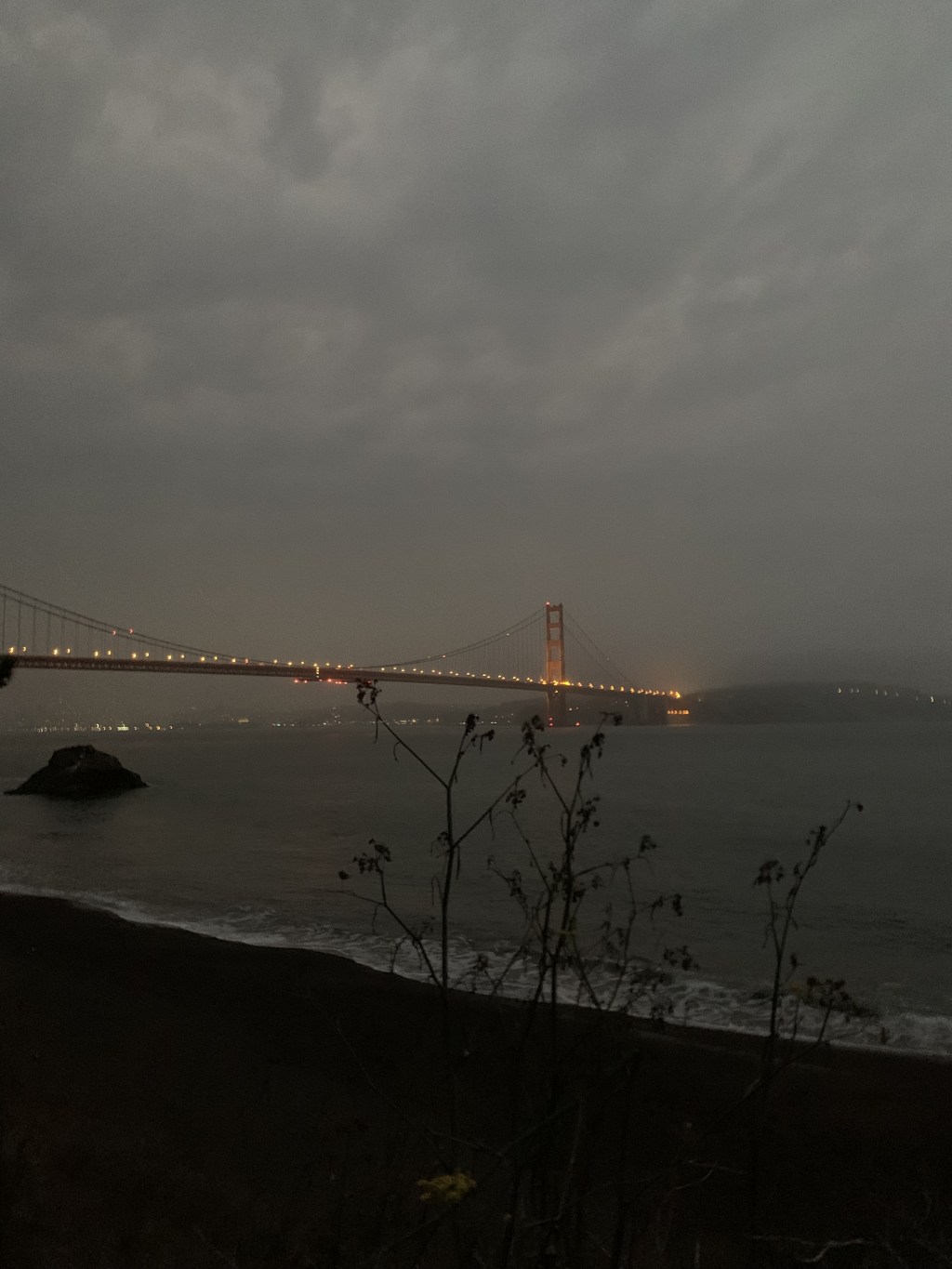
    I gaze out the car window at the trees shaped like witches hats, cloaked by a comforting fog. The path is narrow and bumpy, a windy dirt snake carrying my mom, Tiffany and I to the campsite where all of creative writing is to spend the night. The first “hellos” are never awkward the way they are with most groups of people. It’s the beginning of the year, and here we are inhaling the ripe air of creative writing tradition – the familiar smell of campfire, tree roots, and warm veggie burgers. I grab two bags of Sun chips and scarf them down as I absorb the specific kind of serenity you only feel with dusty pebbles between your toes and bundles of sleeping bags surrounding you. 

    All the creative writers rush to greet each other, anticipating the many hours we will spend getting to know the new fresh peeps and discovering things about each other we never expected to learn. It’s strange how openness comes in waves. It comes in the kind of ocean waves that we push the freshies into on the beach, laughing as their cheeks drip with freezing sea water. It’s a tradition, okay? Openness comes in the waves of safety versus discomfort, and my department floats on the very tip of the safest wave. As the sand falls asleep beneath my toenails and my goosebump covered arms are locked with people next to me, I am washed by a wave better than the ocean: the comfort of knowing I have people who will look out for me and who I can look out for too. This is Kirby Cove.

    Of course it isn’t perfect. There’s a tick in someone’s shoe that I scoop out with a leaf, a dead and stinky seal on the beach, and scrapes on my elbows from bumping into rocks and sticks in the dark. The thing is, I wouldn’t want to smell a dead seal with any other group of people. When it gets late and the black sky engulfs our faces into darkness, all of us from freshmen and sophomores to juniors and seniors gather together. We are so used to fiction, the way it feels to let ink spell out the billions of made up stories in our heads and read them to each other; we are familiar with that kind of bravery. But we leave our fiction in the classroom when we go to Kirby Cove. It’s refreshing to be vulnerable, to practice bravery in a whole new kind of way. Every one of us knows that we are a safe little bundle of young writers in the woods at night, and secrets prance from our tongues like fireflies. 

    After staying up close to all night, I nap right when I get home. But, when I finally wake up, all I want is to go back to Kirby Cove. Next year. 

  • Jude’s Guide to Writing the Bus by Jude Wong

    If a nearly naked man begins bathing himself in milk by the folding bus doors, try to stay dry. Or if a guy playing air guitar in a cascading cream ball gown offers you a lint-laden lollipop, gently say no. But if a dude enveloped in a Power Puff Girls bathrobe and bunny slippers starts describing his tumultuous love life, listen. My family never owned a car, so I grew up taking buses and have penned stories, poems, and even a play using scenes like these from San Francisco city buses. 

    In earlier years my poetry tended to be dark, abstract, and related to experiences I had never had. I wrote about ferocious fires, glorious battles, and dying soldiers. I began a dystopian novel set in 3868 about the daring breakout of a slave named Zed. Stories enabled me to build and inhabit other worlds, no matter how removed they were from my life. I used writing to escape into a fantasy bubble, isolated from the people around me.

    For my thesis I am writing about lives not often seen in poetry, especially those of the marginalized and disadvantaged people I ride with on the bus. People notice, think about, and help those around them in a healthy, caring society. I want to encourage this through my writing, suggesting that people “shout ‘Thank You!’ to the driver. This is non-negotiable.” Or that riders give up their seats as the “triple-sweatered old lady heaves herself onto the bus … freighted with torn pink plastic bags bearing broken bok choy and broccoli.’’ Or smile and make space for the “life-sapped mother … clinging to a stroller, a boiling tea kettle of sorts … inside a ceaseless screeching”. 

    Many riders don’t observe the range of lives around them, often just looking at their phones. I also used to be oblivious to those shaping the city around me. Still, the bus brings other people’s lives so close that we all become “like a can of stewed tomatoes with riders mushed together practically becoming red sauce.”; and these days, I pay close attention. I save fleeting glimpses from our rides that would otherwise be lost, suspending them in time through meter and metaphor. While these moments are random, they are essential because they embody our shared experience of moving through the city together, our community. 

    I recently published “How to Ride the Mission 14 Bus” in Parallax Literary Magazine and performed it to a large audience of 300 people in our school theater. I paced my words, leaving time for the listeners to respond, and used arm gestures to engage and draw laughter from them. One person even chased me down in the parking lot to share how much he liked my piece.

    I used to write only for myself, but now I use my work to connect to audiences and encourage their participation in our community. I write to inspire people to put down their phones, pay attention, be kind and connect with the people around them. To be present and to observe the little things in life.

  • WIP by Gabriel Flores Benard

    With the end of February came the beginning of March, and with March came the new Creative Writing unit: playwriting. I had only known snippets of the playwriting unit from what others had said. I knew we were fated to write and act out our own plays, which both excited and scared me. The first day was memorable, setting the tone for the unit to come. As we pulled out our notebooks, our instructor delivered our prompt: 

    For five minutes, write a list of all your obsessions! This is a free write, and you will not be sharing this part, so don’t be afraid to write out all of them. 

    I wrote out what could have been an encyclopedic testament to all the things I loved. After the five minutes had concluded, the following prompt ensued: 

    Alright everyone, now what I want you to do is imagine your childhood. What are the first things that come to mind when you think of childhood? What colors? 

    Standard prompts, nothing out of the ordinary. Then, the next prompt shook things up a bit: 

    Think about your childhood again. Who is the first person that comes to mind? Write thirty“I-” statements from their point of view.

    I did not expect this prompt, and I didn’t expect the first thing to come to mind was my best friend back in elementary school. I hadn’t thought about him in a while, and all of a sudden, a flash flood of fond memories rushed at me. I jotted down what I remembered of him, and recalled all the things we did together. It was a solid five minutes of nostalgia that enticed me. Then came the playwriting activity the prompts were building up to: 

    Alright, what I want you all to do is to look at the statements you wrote, and I want you to write a scene using three of the chosen lines. 

    In 20 minutes, I wrote a play about my childhood friend, and got two of my close friends to act it out. Now THAT was fun. I delved into the mind of my old friend and created a world from that mindset. That was a taste of what it was like to write plays, and it was tantalizing. That scene wasn’t perfect by any means, but I left the class that day feeling content. I wanted to learn how to be better at writing a play. I volunteered in class whenever I could to act out characters from plays we had read the previous day. To become another character is an exciting experience, and a valuable tool in writing. To embrace your characters, you have to understand them, and I believe acting them out is a great way to understand your characters. I’m excited to see how my playwriting skills develop throughout the unit, and I can’t wait to see what I write into existence, and what I bring to life.

  • Playwriting in Person by Isabella Hansen

    I started my first playwriting unit over zoom. Locked in my room, I would gaze at my computer screen as the Creative Writing department attempted improv games over the computer. Lockdown hit my freshman year, preventing me from gaining an in person playwriting unit. It was the same scenario with my Sophomore year and I vividly remember worrying over the fact that I might not ever get an in person playwriting class. And even if we did, would I be prepared? I have only ever had online playwriting units, would I even be qualified? I was both nervous and excited to start my first ever in-person playwriting unit and gain the experience of both acting and writing. 

    Fun is the least I can say about our playwriting unit. We have had Drag Shows with the theme of a Greek tragedy, almost busted our vocal cords trying to reach certain pitches and did scene work using fake words. I have been having a blast and all the expectations that I had about  in-person playwriting were drastically exceeded. One of my most favorite components of playwriting is watching my plays being performed in front of me. One assignment we had was to bring a play to class that we would like to see performed. I brought my most recent play about a smoothie shop and almost had to be resuscitated after my peer’s killed their performance as the characters I picked for them to play. Playwriting is our last writing unit of the school year and will always be my favorite unit. Acting and doing fun improv games and scene work with my classmates will be experiences I will always cherish. Although I can’t complain about zoom playwriting, I was lucky after all to even get a playwriting experience, I am very happy with the certain aspects of playwriting I can do now.

  • Playwriting by Sophie Fastaia

    A few weeks into our playwriting unit, our artist in residence, Ella Boureau, assigned a play called Medea, by Euripides. The play tells the story of Medea, the daughter of King Aeetes of Colchis. Medea is left by her husband Jason who marries the king’s daughter, Glauce. Medea pleads and begs to stay in Corinth with her sons, but is exiled from Corinth, Greece by Creon the king out of fear of Medea’s revenge. Out of jealousy, anger, and hatred towards Jason, she uses witchcraft, poison, and a sword to kill. She murders their two children, Creon, and Glauce, his new wife, to make Jason grieve. She wants Jason to be left with nothing, even if she has to live with the agony that she has murdered her dear children. 

    After we had read the play and analyzed it thoroughly, Ella told us that we were going to have a performance called “Drag Medea.” We were expected to dress up in any type of drag: feminine, masculine, or a mixture of both. Ella wanted us to portray the passionate, agonizing role of Medea and become unhinged, capturing the anger, heartbreak, an emotion that Medea had felt in the play. It took me a few days to choose a song, as I was anxious about lip syncing in front of everyone. Aria, my fellow creative writer and I, chose to perform “Dancing On My Own” by Robyn. We had very few days to practice; I had no idea what to expect, what to choreograph, or who was to play each role. The next night, I was rummaging through my closet, when I came across a gray baseball cap. An idea popped into my head as I tried the cap on; I should become Jason, the douchebag husband of Medea.  

    On the day of the performance, I came to school with a heavy bag full of makeup, a men’s flannel shirt, and a black vest. Everyone was dressed in costume: Oona in a cheerleader outfit and heels, Hazel in a blond wig and emerald cloak, Ella in a tophat and drawn on mustache, Parker in a lovely blue dress and lipstick, and me… in an extremely baggy men’s dress shirt and a cap that had “Jason” taped to the front. Ella rushed everyone outside as we sat in a circle of chairs; the show had begun. Hazel and Ester came through the door, lip syncing with confidence and pacing around each other like cats in a fight. Excitement and adrenaline rushed through me as I clapped and cheered. I was glad that the first act was done, giving me an idea of how the show was going to go. People lip synced to their songs that blasted out of the loudspeaker on the deck, one song ending, another beginning. 

    My breath refused to slow down as my name was called out. Aria and I went up front, amongst the row of eyes staring at us. When the music started to play, I became Jason, lip syncing with all the emotion that I had, falling on my knees in exaggeration. I collapsed on the floor when Aria stabbed me with a foam sword, pretending to be murdered. The song started to die down and was followed by applause and many smiles. I felt relieved that the song was over and proud that I was able to go up in front of my department and perform in drag. I realized that I was capable of going outside of my comfort zone and enjoying performing, even though I thought that I could never do such a thing.

  • On Dialogue and Playwriting by Zai Deriu

    Playwriting in general has never been my strong suit. I attribute this largely to the fact that for various uncontrolled circumstances, playwriting units have always been given the short end of the stick during my time in CW. Covid-19 broke out in the middle of our sophomore year playwriting unit, and the following years had to be done online entirely. Playwriting is such a performance and community based unit, so having it online was simply not as effective. Poetry and fiction, although they suffered from the online format, had more of a chance.

    Additionally, I notoriously hate writing dialogue in all forms of writing, which is unfortunate as I consider it to be a primary aspect of playwriting. Everything about putting any speech into my work feels gross. Not only does it feel clunky and unnecessary, but I hate the way it looks on the page. Quotation marks are my least favorite form of punctuation. They look weird. The lovely thing about writing, however, is that then I simply don’t use them. In fiction I typically opt to put my speech in italics (or not use dialogue at all.) With playwriting, however, I am a bit more trapped, as it is difficult to dodge dialogue in this format.

    Our playwriting unit culminates in each student turning in one completed ten minute play. Mine was inspired by fairytales, focusing on a character being cast away after their brother becomes convinced they are a monster. I’m happy with how it turned out, as I think I found a way to work with my strengths. 

    I think what I usually find so irritating about dialogue is that realistic speech tends to contain so much filler that I feel as though I have to decide between realism or conciseness. In this play, however, cutting away dialogue actually helped to bolster my whimsical tone. Leaving long pauses between most lines made the entire piece seem more like a dream. If it were to be put on stage, I imagine the actors would utilize this to act out their characters in the absence of sound.

    Despite all my feelings around writing dialogue and playwriting, I am quite pleased with my work this year. I am happy to say I am confident in the work I have done. It feels nice to leave my last CW playwriting unit on a good note.

  • Writing About Strangers by Jude Wong

    We are now in playwriting class. At the start of the class, we were given homework which consisted of eavesdropping on people around us, whether it be on the way home from school or to a job. Many junior writers struggle to make dialogue feel realistic, the exercise was to help us be able to embody our characters using lifelike dialogue. I take the bus to school every day and listen to people around me. Often I sit at the back, among the more rowdy folks, these are the people who fit the focus of most of my writing. This exercise is to help my dialogue become more real for readers.

    In my play a group of guys throw a ball around the back of the bus, and annoy and bully other riders. I incorporated a lot of teenage jargon into that space to create connections between characters and show their own internal conflicts.

    I also enjoyed writing the play because it was set in an enclosed, claustrophobic space, the bus. I found it exciting as I personally had not written or seen a play unfold on a bus. I feel it caused the character dynamics to be shown even more clearly as all the characters were trapped in close contact, forcing interaction. I will also say a lot of my play is based on true events which multiplies the realism in each action and word. 

    Draco: Nah, what’d he do?

    Diesel: Bro, he’s been selling off answers like crazy.

    Dunce: Yeah heard he got caught by the damn hall monitors, fuckin 

    try hard brats. It’s like bruh how?!

    Draco: Where the hell was he last year? I’d of 

    bought that shit up quick.

    Dunce: Ey man, we all know that expulsion

    was bullshit.

    This is a small excerpt from my most recent play. To further increase realism I added a character with a potential mental illness as gaps in public healthcare is a big issue in San Francisco right now. Instead of posing this character in a negative light, I raised him as the hero in the story, defeating the bullies and being cheered on by the surrounding crowd. 

    Big man steps towards him, a rumble grumbles within Big man. He clutches his stomach. Jonas looks at him, then suddenly skitters out. Diesel and Dunce peek their heads in. The bus remains stopped due to the commotion. Thick orange vomit launches out of the Big man’s mouth and splatters across the three dudes. Draco’s mouth is wide open as it falls upon him. The three dudes fall to their knees, defeated. Big man roars loudly in victory. Jonas, in safety, cheers him on along with the bus people who weren’t hit. Besides the vomit victims, they all cheer in the form of beating on their chests and growling in favor of the Big Man.”

    I believe writing is all about observation and interpretation. Look around and listen, there is a play on every corner.

  • Saying “Bye” to Performance Fears by Starlie Tugade

    How many people can say they’ve written a play, or been in an intensive class taught by a playwright from New York? I’m sure there are some people out there, but not the majority of the population. A couple of months ago, I couldn’t either. In Creative Writing, we have a playwriting unit every spring, taught by an artist in residence. As a freshman (or freshpeep as Heather likes to call us), I’m fully immersed in my first playwriting unit, and I can easily say that it is one of the most fun things about Creative Writing, but it is also one of the scariest.

    A few weeks ago, Ella, our playwright in residence, assigned us drag performance as a character in the play we were reading. We had a week to choose the song we were lip syncing to and choreograph, before performing in class on Friday. This assignment was somewhat of a wake-up call to me, because before, I had naively assumed that as writers, we would have to perform our own work, but not put on “Performances” with a capital P. However, being an introvert wasn’t enough to deter me from performing, and so I came up with a song and started thinking about different ways to choreograph my performance. I enjoyed coming up with different ways to act out my character alongside the song, and the night before, I put on a performance for my family, in hopes that my stage fright would disappear. That worked for the most part, but in the hours preceding the performance, my nerves were still present. 

    One of the things that I love most about Creative Writing is how supportive the environment is, because everyone is ready to support and lift up one another. The nerves I had faded the minute I watched the first performance and felt the energy all the Creative Writers radiated. We were all here to enjoy an afternoon of fun and bravery to make a fool of ourselves in front of each other. When I got up on stage, my nerves were gone, and I performed better than I even imagined I would. Afterwards I was riding on a high, and I’m never going to forget the love that the community gave me as I stepped past my comfort zone.

  • My Senior Thesis by Parker Burrows

    When I first learned about the senior thesis project all the way back in my freshman year, I was terrified. I couldn’t fathom the scale of the project, that every senior in the department would have to showcase their mastery of writing by producing a book’s worth of work. It was too much for me to even think about as a freshman. 

    Now, as a senior who is less than a month away from the final thesis deadline with almost a full final draft completed, the project still hardly feels real, but for different reasons. Throughout my life, I’ve had a habit of picking up long-term projects and dropping them soon after, whether it’s a lengthy book, a video game, or learning a complicated skill. I had formed an idea about myself that I wasn’t someone who was good at committing to projects, and this thesis has amazingly shattered that idea. Looking back at all the work I’ve completed, it’s hard to believe the hours I’ve consistently put into creating these poems that I’m so proud of. I found myself canceling plans to spend time writing and editing work. I’ve brought my notebook everywhere just to scribble down new ideas for improving my thesis whenever I can. This thesis is a document of what I’ve learned from my time in Creative Writing just as much as it’s a monument proving that I am capable of committing to something I am passionate about.