CREATIVE WRITING

at the Ruth Asawa School of the Arts in San Francisco

Welcome! CW develops the art and craft of creative writing through instruction, collaboration, and respect. This blog showcases STUDENT WRITING and how to APPLY to Creative Writing.

  • There’s a lot going on this week, and the blog staff are trying our best to accommodate SOTA Cdubs’ busy schedule, so here are the main things on the menu:

    1. Congratulations to Avi and Shanna on their upcoming publications! Avi is being published in amphibi.us, and Shanna is having her poem “Atrophy” published on Valentine’s Day in H.O.D., Issue #6. The editor originally praised Shanna’s poem, saying it was very close to what they were looking for, but did not publish it. She suggested some revisions and for Shanna to resubmit. Shanna revised, submitted, and the poem was accepted. It’s all about revision! –Heather

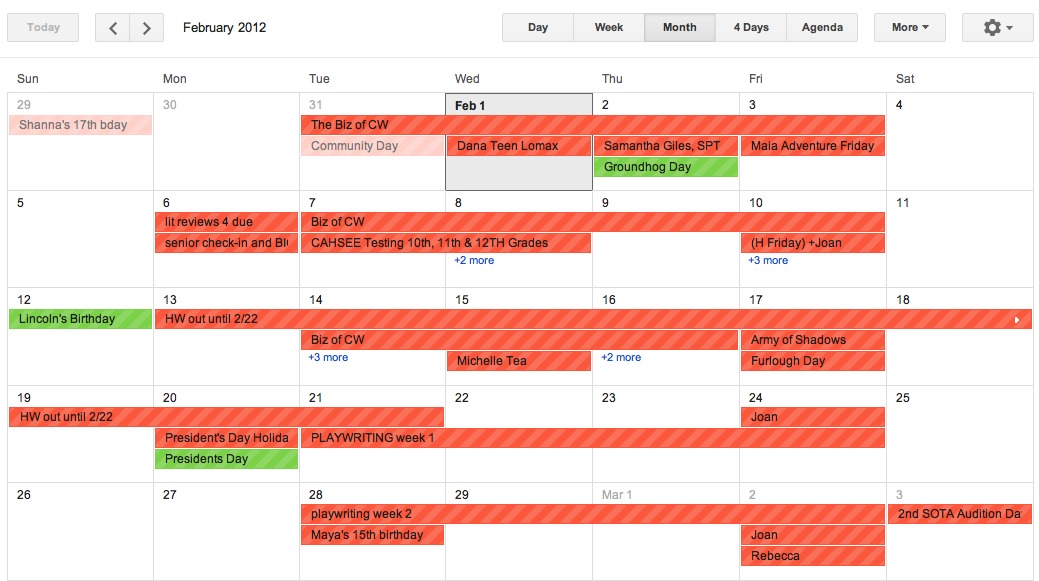
    2. As you may have noted, the CW Blog is currently undergoing a couple of formatting changes. Some are major, some minor, but one that deserves special mention is the new official CW event calendar! For all those who cannot access the GoogleCalendar, have no fear, for it is displayed publicly right on this page.

    3. As part of changes to our blog, it would be awesome if Cdubs can send Midori or Rebecca their poems or fiction pieces that they’ve published, or just particularly like and want to see on the website. We are trying to freshen up some content to make the site officially “student-run.”

    DATES TO NOTE

    Tomorrow, Feb. 7: You experimental poem assignment from Samantha Giles’ visit is due. Also, CAHSEE testing all morning for sophomores.

    Wednesday, Feb. 8: NO LATE START. Readings and Submissions are due

    Friday, Feb. 24: The Poetry OutLoud Final will be taking place in the CW room right after school. One of them will be going to Sacramento, so support your fellow Cdub!

    Tuesday, April 20: Be at the Herbst Theater at 7:30 to hear Ann Lamott.

  • As many of you may know, SOTA was recently renamed the Ruth Asawa San Francisco School of the Arts after the famous artist who helped found the school. At the renaming ceremony, Hosana, a sophomore in Creative Writing, read a statement about SOTA and the Creative Writing Department from author Dave Eggers.  Yes, THE Dave Eggers, author of A Heartbreaking Work of Staggering Genius, What Is the What: The Autobiography of Valentino Achak Deng, Zeitoun, and others, and co-founder of 826 Valencia, founder of McSweeney’s, etc.  You get the idea. He’s a big deal.  The department  is honored to have this endorsement from such a prestigious author and publisher. So, here it is, folks:

    “I’ve been teaching weekly high school classes at 826 Valencia for about ten years now, and the high school most often represented in these classes is the School of the Arts. When 826 Valencia opened its doors in 2002, SOTA kids started flooding in for evening workshops, weekend activities, and our summer writing and publishing intensive. And it became clear from the start that SOTA students were uniformly hard-working, self-possessed, knowledgeable and sophisticated about their place in the world, and very serious about pursuing careers in the arts. So serious, in fact, that even after the schoolday was done, they were hungry for more. That means that SOTA is doing something — maybe everything — right. The educators at SOTA are lighting a fire within these young people, making them passionate and insatiable makers and students of the arts. Without a doubt, if I had grown up in San Francisco, I would have fought like hell to attend the School of the Arts.

    The entire city owes a great debt to Ruth Asawa for her vision and persistence in making SOTA a reality, and it’s only fitting that the school’s new marquee gives her her due.

    I don’t know what 826 Valencia would do without partners like SOTA, and without gifted educators like Heather Woodward. 

    Every year, when I’m putting together the roster for my class, which produces the anthology The Best American Nonrequired Reading, the very first thing I do is email Heather Woodward, the extraordinary creative writing head at SOTA, and say, “Send me your best and brightest.” I’m looking for young people who want to spend every Tuesday night reading contemporary literature, from the Paris Review to Granta to Mother Jones, and then break down and debate what we read. I need serious young people who can and want to read at a college level, and have no fear of hard work and of articulating their ideas among a stellar group of high schoolers from all over the Bay Area.

    And invariably, Heather sends me three or four phenomenal young people who thrive and make SOTA proud. Just last week, we had our first class of the year, and there were four new SOTA students in attendance, all of them hugely impressive. It’s something I treasure every year, seeing the newest group of SOTA kids come through the door, hearing their stories, seeing them thrive. 

    I’ve been to a number of arts high schools around the country, and SOTA is among the very best. And this is borne out in how well SOTA students do in college. I write recommendations for the students in my classes, and SOTA students have gone onto a very impressive array of colleges all over the nation. I fully expect them to become major cultural contributors as adults — not just because they’re talented artists, but because SOTA instills in them a sense of art’s crucial role in social change….

  • FRIDAY FEBRUARY 3- CINE/CLUB DOLBY SCREENING ROOM 100 Potrero

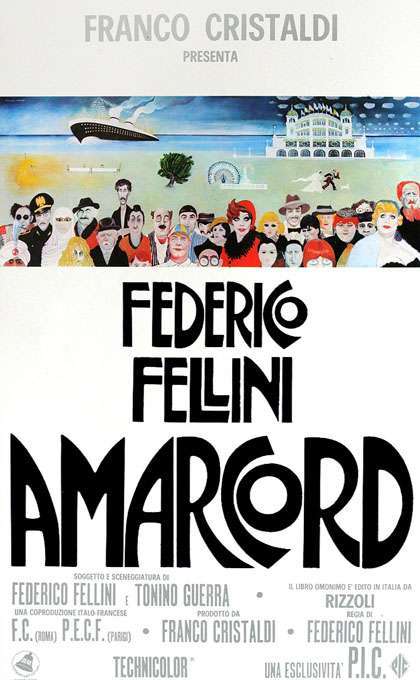
    Frederico Fellini’s AMARCORD (1973, Italy)
    This glorious film Fellini made about his childhood summons up atmospheres and images from the past. Amarcord recreates life in a small Italian town through the lives of a young boy. It’s magical.

    Runtime: 2 hr. 5 min.

    (Rotten Tomatoes)

    WHY WE CHOSE THIS FILM:
    As many of you know, we show a Fellini film nearly every year, and usually we run the gamut of his most famous masterpieces. This is our first time showing 
    Amacord and it’s high time. A very popular work, it captures much of the awe and wonder of life in a small Italian town with all the colorful characters in place a boy might remember. It’s one of the least aggressively bizarre films he’s made, but its rich imagery, honestly shaped scenes and big splashes of film magic make it a milestone in the later films.

    ABOUT THE DIRECTOR:
    Along with Bergman, Frederico Fellini’s career defines serious 20th century film, though in quite contrasting ways. Fellini began his career as an artist, and during the early 40’s wrote a number of radio and film scripts while being an all around help with an actor friends traveling theater company. At the end of the war, they opened The Funny Face Shop, an arcade for GI’s which specialized in quick portraits, photos, voice recordings for the folks back home. One day a visit from director Roberto Rosselini brought Fellini his collaboration on a script for 
    Open City, and he followed this with work onPaisan, both sterling film classics.

    After a couple of unsuccessful stabs at film, Fellini directed Il Vitelloni (the Loafers) which brought him great success.He followed this with one thoughtful success after another including La Strada, Nights of Cabiria, and La Dolce Vita, all in a familiar post neo-realist style. Out of this work emerged a new style which announced itself with 8 1/2, films driven by theme rather than plot, films filled with atmosphere, color,memorable characters and rich fantasy. From these films, the adjective “Felliniesque” entered our vocabulary. Amacord is one of the first of this later style.

    THERE IS NO ART SATURDAY THIS WEEK.

  • Many thanks to Dana for sharing incredible job and internship opportunities with us today. Here is a list of the places she named, linked to their individual websites:

    Teaching:

    Performing Arts Workshop: paid internship

    California Poets In The Schools: paid internship

    Reading Series:

    Small Press Traffic: an experimental writing series (Samantha Giles from SPT will be in to talk to us about it tomorrow)

    Grants:

    The San Francisco Foundation

    The Joseph Henry Jackson Award

    California Arts Council: check out their Opportunities page for grants and internships.

    William James Association

  • From the Creative Writing calendar:

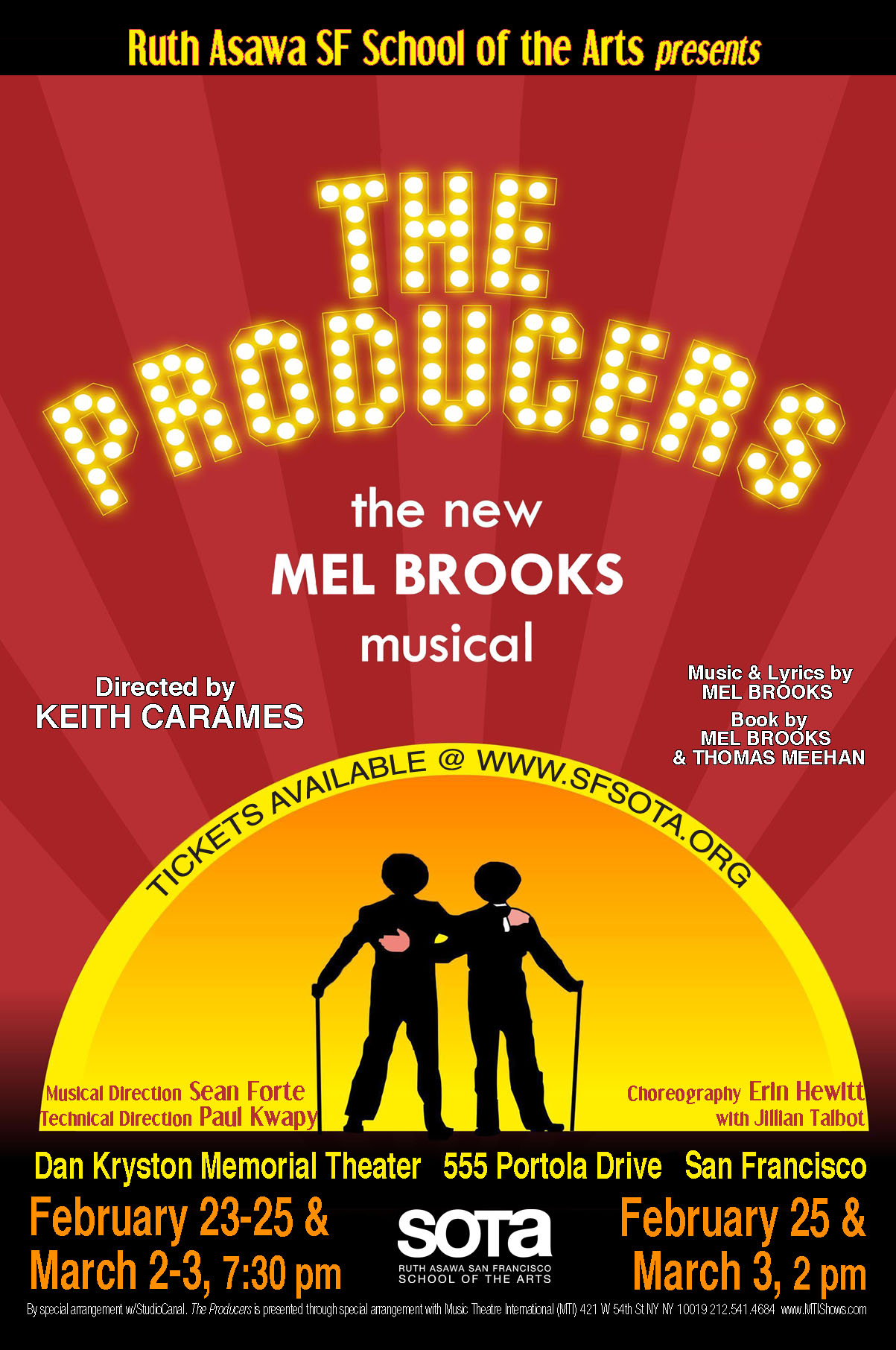
  • Bialystock and Bloom! Those names should strike terror and hysteria in anyone familiar with Mel Brooks’ classic cult comedy film. Now as a big Broadway musical, The Producers once again sets the standard for modern, outrageous, in-your-face humor. It is a truly “boffo” hit, winning a record twelve Tony Awards and wowing capacity crowds night after night. Now, you can see it at SOTA!

    Brought to you by the awesome team who gave you Ragtime, led by the Technical Theater Department who gave you Seussical, Fiddler on the Roof, Beauty and the Beast, Cabaret and more.
    Directed by Keith Carames   Choreography by Erin Hewitt with Jillian Talbot
      Musical Direction by Sean Forte   Technical Direction by Paul Kwapy

    Buy tickets online now!

    Facebook Event

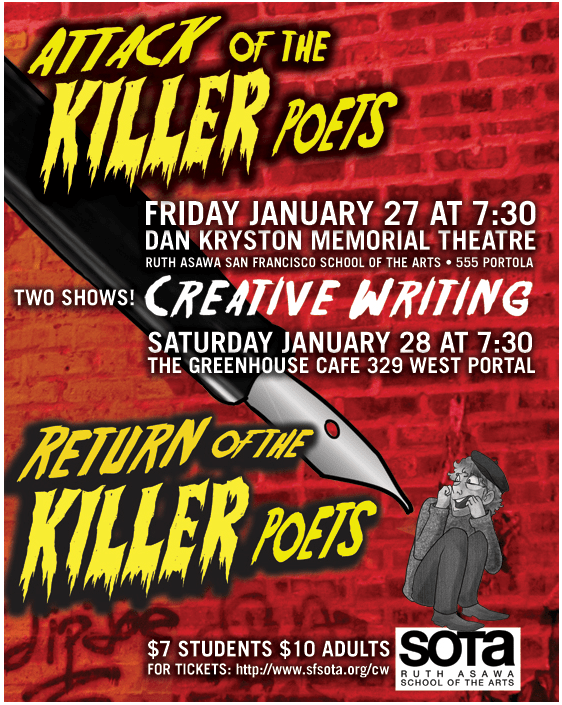
  • Our two shows were enormous successes– many thanks to parents that helped out and sold Creative Writing merchandise, Heather and Isaiah for working on our poems with us, and of course, the Seniors, for being absolutely amazing, open-minded to all of our suggestions but still getting things done. Alex, Rebecca, Aly, and Vanessa, thank you guys for making these awesome shows happen. We’ll miss you enormously when you guys graduate.

  • This year marks the ten year anniversary of Creative Writing. To celebrate, our beloved Cdub parent Julie Glantz toiled to create an amazing t-shirt that is now available for only $10. Price will go up to fifteen dollars after our Poetry Cafe on 1/27, so purchase now!


  • Friday, January 20th at Randall Museum (199 Museum Way) will be:

    Sayajit Ray’s PATHER PANCHALI (1955, India)

    The debut film from India’s most famous director was made with few funds and loads of talent and faith. It takes two children in rural India through their childhoods and into adolescence, capturing the atmosphere and rhythms of daily life with exquisite detail. Another genuine masterpiece you’ll be glad you didn’t miss.

    WHY WE CHOSE THIS FILM:
    This is the first film of the famous Apu Trilogy, but it also holds up on its own. The characters, mother, father, grandmother and neighbors, rich and poor, are brilliantly etched. You feel you are visiting India and are vividly a part of the images, the rituals, the texture of daily life and this bonds you to the the characters. It is an old fashioned “story film” as good as they come.

    ABOUT THE DIRECTOR:
    Ray studied painting and art history at the University of Calcutta. He started his career as an illustrator; one of the books he illustrated, 
    Pather Panchali, left a deep impression on him. He dreamed of filming it but in 1940’s India being a film maker was an unattainable dream. In 1950 he visited London and while there saw a film by Vittorio De Sica called The Bicycle Thief. This classic neo-realist film was filmed on location with non-actors, and on a tiny budget. Ray was so moved and excited, he returned to India and tried to raise money for his film. Unsuccessful, he nonetheless began filming with friends on weekends with the encouragement of a French film maker, Jean Renoir, who was in India making a film. To fund the film, he spent his salary and sold all his possessions. He was in despair, almost at the point of abandoning the project, when the Bengal government stepped in and gave him money to finish it.

    The story of the making of this film is an inspiration to all desperate young filmmakers. In 1955, Pather Panchali was shown at the Cannes Festival and caused a sensation. It introduced Indian cinema to the West and won the Jury prize. Encouraged, Ray went on to complete the trilogy with Aparajito and The World of Apu. He continued making masterful humanist films about India for the next thirty years, and was given an honorary Academy Award the year of his death in 1992.