CREATIVE WRITING

at the Ruth Asawa School of the Arts in San Francisco

Welcome! CW develops the art and craft of creative writing through instruction, collaboration, and respect. This blog showcases STUDENT WRITING and how to APPLY to Creative Writing.

  • by Molly (’15)

    There is a mess of pillows in the Creative Writing room. They are solid-colored squares and circles of red and black, and are indisputably chic. They are often used as headrests during Sustained Silent Reading and can also be used as devices to hide Colin with when Heather takes attendance or to throw at Justus while he is sleeping. By the end of any given day they are scattered across the carpet in a completely unorganized fashion, which Heather finds unacceptable.

    Students are asked to fix the pillows, and although this particular ritual is very common and necessary, there is not yet a set of rules on how these pillows should be arranged. Some decide to organize them by color, while others go by size. The way a person organizes the pillows is a direct window into their psyche; some throw them in an indiscriminate order, while others spend many minutes aligning them.

    Last Monday, our minds were opened by Tony, who runs an internship. While organizing the pillows, he suggested we spread them across the entirety of the carpet instead of piling them in a corner. The reds went on one side, the blacks on the other, and through this Tony created a work of art that was, as he said, “meant to be seen from a distance.”

  • CW Love

    by Mykel (’14)

    Love is “I don’t think the second person really serves the character development in this piece and also stop it with the italicized song lyrics.”

    Love is “HEATHER YOU DID NOT GIVE US ENOUGH WARNING ABOUT THIS HUGE ASSIGNMENT I HAVE COLLEGES TO APPLY TO.”

    Love is “buy our CDs, I promise we’re good!”

    Love is coffee and pillows and dance parties and paninis and three alternate realities coexisting in one conversation.

  • It’s Like Sex (But BETTER!)

    by Jules (’14)

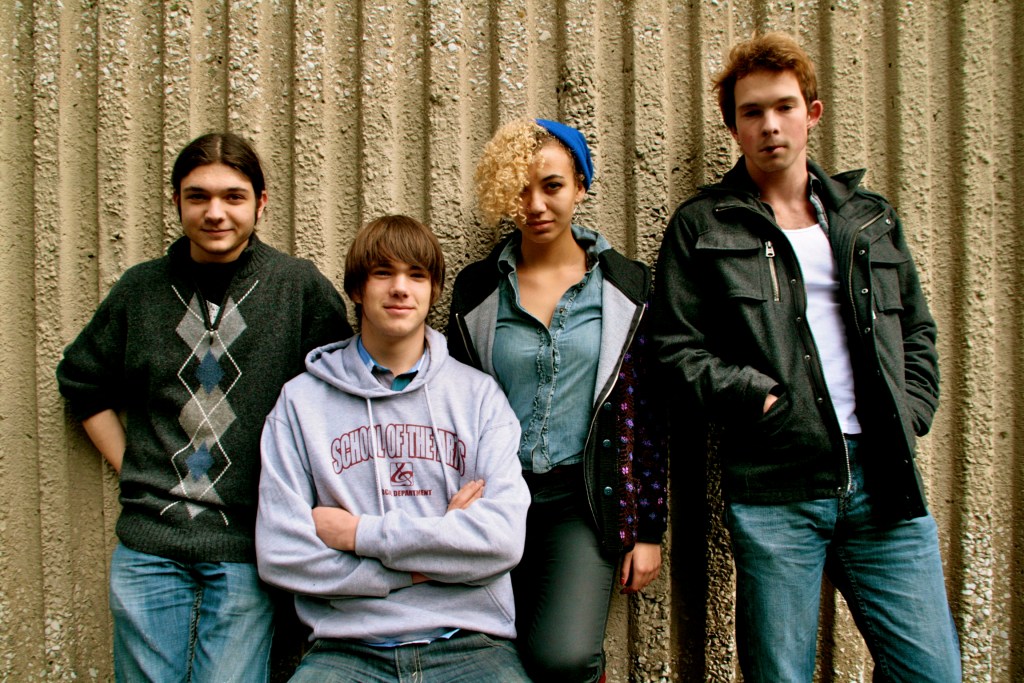
    Left to right: Alex F., Dorian C., Bailey L., and Jules C.

    The thing that I find really engaging about forming and leading a band is that it forces me into a leadership role that I wouldn’t otherwise be in, and I get to take the lead in a sort of communal ecstasy that not a lot of people get to experience. To hear someone playing a beat to your song, expanding on your vocal line, coming up with a bass part to your song, is a transcendental experience because even though I’m the one who brings the stuff to the table, we all get to tear into it and sometimes Dorian will tear off a really interesting drum solo, or Alex will just bake a badass bass line, or Bailey with take one of my vocal lines and cut it up into something completely different, and it becomes something we all get to share. To be able to play your own music, sing your own words, is something only writers get to do. The classical education in SOTA does teach theory, but only those people who want to apply it to creating something get to feel that collaborative ecstasy of having someone expand on something that’s yours. That’s really what The 28 Lifeline is all about. It may be my words and my chords, but I would never be able to sustain it by myself, and it certainly would not have the flavor and versatility it does without Dorian’s beats, Bailey’s voice, or Alex’s bass lines. For us, there’ll always be that moment when we look at each other after nailing a set list, and we just are all grinning because the thought is ‘That’s us. No one can do that but us.’ And that near post-orgasmic feeling is the reason we all do it.

  • by Hosanna (’14)

    Rejection. This nine letter word is common to everyone who has ever been on the planet. But what does it mean? Well, if I bring it up, most folks will assume I got rejected after I stuffed a bouquet of flowers in some dude’s face and asked him to take me out for ice cream. That’s not the case, though I wish I were that bold. Rejection doesn’t only revolve romantic relationships, it is a friendship, a social interaction, a life (is that too bold?). Taylor Swift sings about it all the time in When You’re “Fifteen”, maybe a little generic but tear jerking, “Dear John,” and “Invisible” (welcome to my life). Ever since my sixth grade year, I’ve been eyeing rejection, labeling it as my enemy. But now, my junior year, I’m beginning to find interest in it.

    It’s funny on TV, in music videos, and on anxiety blogs but once it’s in our own lives, where’s the tub of ice cream, or in my case, where can I break some glass (not really). I’m stuck with the image of Drew Barrymore in Never Been Kissed (1999) getting egged by her super hot “prom date” as she stands, red nosed and nerdy, on her front porch. Or the many blogs about thirty year old men who haven’t been kissed, the third wheel syndrome, and dare I say it, the socially inept pretty girl! Oh! It drives a stake through my heart just thinking of it. Even though these blogs can be dubbed a therapeutic circle, they are entertainment, a laughing stock to internet viewers and themselves. Rejection becomes a negative thing, humiliating, instead of a learning experience.

    But me? I say laugh at those humiliating times, shake it off, and learn from it. If you’re a third wheel, stop suckin’ your thumb and make yourself known! To those thirty year olds who haven’t felt another’s lips press against their’s, just go up to someone and kiss ‘em (just inspect for signs of mono). And the socially inept pretty people, flaunt it cus’ you got it because all you have to do is feel it. Rejection should only make someone more motivated, more ready to encounter unpredictable situations. This isn’t the time to skip the laxatives, who wants to be stuck on the toilet while everyone else is having fun?

    ***Sarcasm intended

  • by Hazel (’13)

    Recently, Heather set aside a day for the CDubs to help plan out next year’s curriculum. The beginning of this year, while certainly interesting and multi-disciplinary, was not the ultra-productive first two months that usually fuels our fall show, and so a little reorganizing was in order for fall, 2013. The seniors gathered in a corner of the room, and soon we had filled a page with names, notes, and ideas concerning what makes us productive. Throughout this process, I had to keep reminding myself that we were planning not for ourselves, but for the grades below us and the future freshmen we would never know.

    I’ve heard many people talk about what finally made senior year “real” for them. This was it for me. Before we sat down to discuss the specifics of the year to come, I didn’t realized what “the year to come” would entail. Every year I find myself with a few memories, fond and not, of my academic classes. Creative Writing is the only one that maintains a consistent narrative, that is populated almost entirely by people who intrigue me, whose life stories I would be more than willing to sit down and listen to in full. It is where I find the majority of the people my own age who are very important to me. It’s hard to imagine life without that.

    I know that once I am out of high school, everything will change. But, in the same way that Creative Writing is significant now, it will be the thing I miss most about high school (though if we are being honest, how many people miss much about high school?). The way I act in the real world will reflect the array of things I learned in Creative Writing, and I’m not even sure that list is topped by writing. It is no doubt too early in the year for a sentimental senior-year post like this, but essentially, thank you. Thank you all.

  • A Visit From Lorin Stein

    by Amelia (’13)

    As a Creative Writing senior, I’ve had my fair share of rejection emails from publications I submit my work to. Without fail, they open with a seemingly cheery “Thank you Amelia!” before the ominous “but,” and to polish it all off, “we could not accept your work at this time.” I remember feeling enraged at the fact that a stranger could not see the genius (or potential, mostly potential) my classmates saw in my work. I imagined magazine and literary journal editors as stodgy old men who read the first three words of my piece before laughing maniacally at it and sending it straight to junk mail.

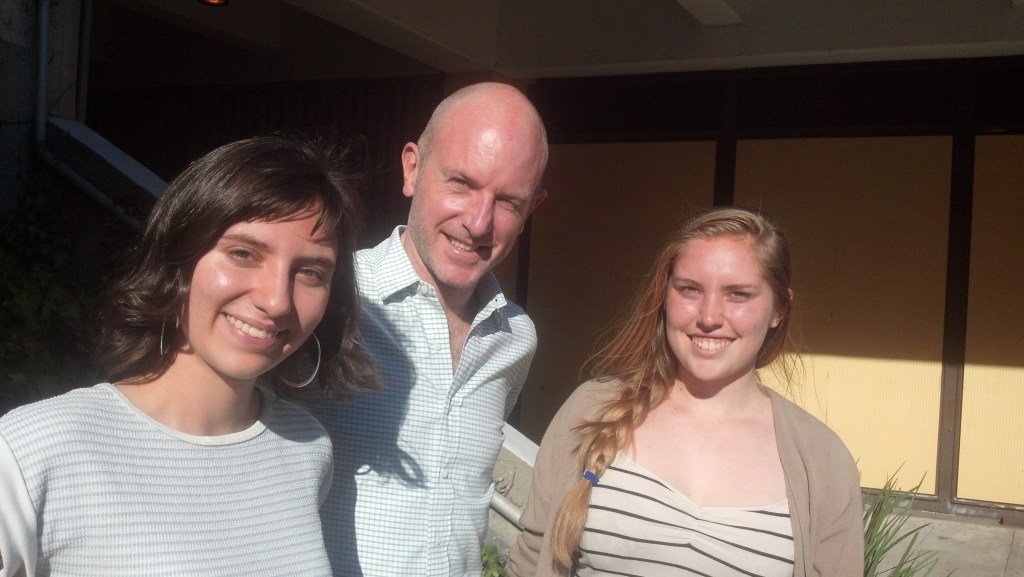
    Lorin Stein of The Paris Review is no such editor. First of all he’s not old, or stodgy, and I can’t imagine him laughing at the efforts of a fellow literary mind (with a few exceptions I’ll keep within the department). His humility and appreciation for the contributions of writers like myself are both a huge relief and reassuring for someone who is interested in entering the publishing and editing field. What the department anticipated as a lecture became a two hour discussion about personal history, ambition, the turmoil of self-interest and the interest of the magazine and the art of translation. How wonderful it is to have no preconceived notions of a literary figure and discover he is very much a man doing what he loves for the pleasure of other people. umläut is sending him a care package of our own editing expertise, for good measure of course. I find myself eager as a freshman to dole out the next round of pieces to the next round of journals and zines, in the hope and confidence that like Lorin Stein, they’ll feel bad about saying no.

  • About submissions! umläut accepts poetry, prose, short fiction, photography, painting, sheet music– anything that can fit in a book! The deadline is December 7th, and submissions can be dropped off in Room 202 or, preferably, emailed to umlautkingdom@gmail.com.

  • It is a well known fact that we CWs have a strong and insidious dislike of math. We are writers after all: wielders of the mighty pen. You’re using a pencil?! Haha, what is this?? We’re not in MATH!!!

    But lately there has been change brewing. Lately. . . well, the landscape has changed. The old ways are being reconsidered; the traditions are being examined. Is it time for us to change our ways? To accept the confusing notion of x’s and y’s? Is it time to give ourselves in. . . to graphs?

            Yes.
            No.
            No?
            No.
            Why not?
            I don’t wanna.

    Luckily this conversation has never happened, because let’s face it, graphs are awesome. They’re useful, they’re easy to draw, they’re visual and helpful.

    We have encountered two main types of graph: the emotional timeline and the vonnegram (adapted from a lecture from Kurt Vonnegut about the shape of stories). In drawing an emotional timeline, you are forced to iterate and plot what you’re trying to accomplish, what you want and are trying to make your reader feel or see. When drawing a vonnegram, you come to the depressing conclusion that you inevitably make your characters suffer with little reprieve: you have to draw the curve of your characters journey, showing where there is hope and where there is sorrow, all in relation to an “average day.”

    But why do we do this? What purpose does it serve? It’s probably because the shapes of stories matter: they help us see our writing and the writing of others outside of words. By looking at how we shape our stories, how we want others to see and experience the words that we write, we can see how we hope our words shape others.

  • There Was a Child Went Forth

    by Maya (’15)

    The poem “There Was a Child Went Forth” by Walt Whitman is about a boy who becomes everything he sees. All the things in nature that he glances upon become part of him, and they shape him as a person. He is becoming open and understanding the world more because he is able to take it all in. This poem addresses the social issue that people are becoming too attached to material things, and not appreciating nature to its full potential. The boy in the poem shows that this can and should be overcome, and that humans need to change society so that we become more in-sync with each other and gain more knowledge. The boy is also being aware of his surroundings, which humans today do not do often enough. The “moral” of this poem is that humans should pay more attention to nature, because they will learn things from it, and that materialism is becoming a problem in modern day society.

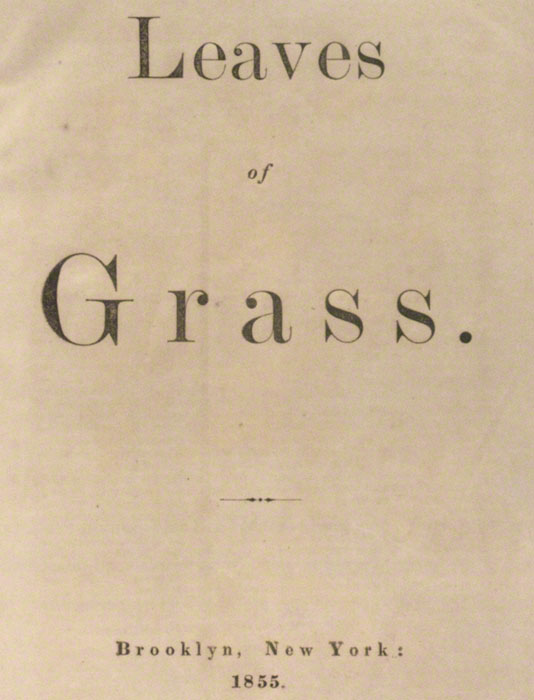
    Walt Whitman (1819–1892).  Leaves of Grass.  1900.

    There was a child went forth every day;
    And the first object he look’d upon, that object he became;
    And that object became part of him for the day, or a certain part of
    the day, or for many years, or stretching cycles of years.

    The early lilacs became part of this child,
    And grass, and white and red morning-glories, and white and red clover, and the song of the phoebe-bird,
    And the Third-month lambs, and the sow’s pink-faint litter, and the mare’s foal, and the cow’s calf,
    And the noisy brood of the barn-yard, or by the mire of the pond-side,
    And the fish suspending themselves so curiously below there–and the beautiful curious liquid,
    And the water-plants with their graceful flat heads–all became part of him.

    The field-sprouts of Fourth-month and Fifth-month became part of him;
    Winter-grain sprouts, and those of the light-yellow corn, and the esculent roots of the garden,
    And the apple-trees cover’d with blossoms, and the fruit afterward,
    and wood-berries, and the commonest weeds by the road;
    And the old drunkard staggering home from the out-house of the tavern, whence he had lately risen,
    And the school-mistress that pass’d on her way to the school,
    And the friendly boys that pass’d–and the quarrelsome boys,
    And the tidy and fresh-cheek’d girls–and the barefoot negro boy and girl,
    And all the changes of city and country, wherever he went.

    His own parents,
    He that had father’d him, and she that had conceiv’d him in her womb, and birth’d him,
    They gave this child more of themselves than that;
    They gave him afterward every day–they became part of him.

    The mother at home, quietly placing the dishes on the supper-table;
    The mother with mild words–clean her cap and gown, a wholesome odor
    falling off her person and clothes as she walks by;
    The father, strong, self-sufficient, manly, mean, anger’d, unjust;
    The blow, the quick loud word, the tight bargain, the crafty lure,
    The family usages, the language, the company, the furniture–the yearning and swelling heart,
    Affection that will not be gainsay’d–the sense of what is real–the thought if, after all, it should prove unreal,
    The doubts of day-time and the doubts of night-time–the curious whether and how,
    Whether that which appears so is so, or is it all flashes and specks?
    Men and women crowding fast in the streets–if they are not flashes and specks, what are they?
    The streets themselves, and the façades of houses, and goods in the windows,
    Vehicles, teams, the heavy-plank’d wharves–the huge crossing at the ferries,
    The village on the highland, seen from afar at sunset–the river between,
    Shadows, aureola and mist, the light falling on roofs and gables of white or brown, three miles off,
    The schooner near by, sleepily dropping down the tide–the little boat slack-tow’d astern,
    The hurrying tumbling waves, quick-broken crests, slapping,
    The strata of color’d clouds, the long bar of maroon-tint, away
    solitary by itself–the spread of purity it lies motionless in,
    The horizon’s edge, the flying sea-crow, the fragrance of salt marsh and shore mud;
    These became part of that child who went forth every day, and who now goes, and will always go forth every day.

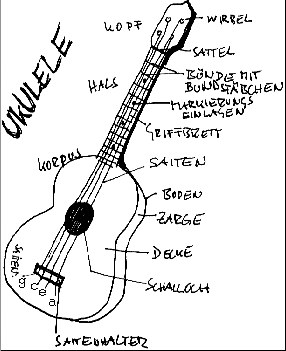
  • Learning Hawaiian Ukelele

    by Olivia A. (’14)

    I’ve played music since I took up the violin in fourth grade. Until this summer, I hadn’t deviated much from my training in classical music (“I Kissed a Girl,” “Eleanor Rigby,” and the My Little Pony theme song being notable exceptions). Over this past summer I realized that I was completely fed up with the attitude towards music of the classical musicians around me. I enjoy listening to a lot of classical music and I love a lot of the people I know who play it, so my reasoning was not so much rooted in the music itself or the people themselves. I quit viola because I personally couldn’t handle the competitive, judgmental musical culture that I was experiencing. It was difficult to quit—I have always been told to choose something and stick with it. That mentality, I’ve realized, often doesn’t suit my distracted, indecisive nature.

    I quit my private lessons, returned my viola, and decided to try something that is nearly the polar opposite of the musical culture I had become used to—traditional Hawaiian ukulele. This style of ukulele is primarily rooted in both the meaning of the words and in the purpose of the music as a component of hula dancing. My teacher treats the lyrics as poetry, explaining how the references and symbolism in each song relate to aspects of Hawaiian culture and history. For example, in a song called “Puamana,” the English translation of a Hawaiian line is simply “the bright moon glistening.” However, one word in the Hawaiian text, “kōnane,” is actually the name of an ancient Hawaiian board game similar to checkers. White and black stones are moved around indentations in a large slab of rock, creating an effect likened to the reflection of the moon on the waves.

    My experience learning Hawaiian music has been entirely different from my experience with classical western music. The process is much calmer, in general—I’m not constantly worrying about people judging my skill level. However, that isn’t to say that Hawaiian music is easy to play. It is difficult to strum, change chords, and sing in Hawaiian with correct pronunciation simultaneously.

    I always look forward to playing the ukulele. I’ll pick it up and accidentally play for hours without realizing that I’m practicing. Similarly, I often don’t realize that in learning the music, I’m exploring Hawaiian history, culture, and poetry. It’s all begun to blend together in my mind—the way a song can reference the leaves of a tree that grows nuts whose oil can be extracted to create candles likened to a lighthouse on an island with a history about the Spanish cowboys who lent the song its Hispanic influences that influenced the culture of the island, that informs the poetry of it—I’m learning to see these islands through the songs, and I wonder how I’ve managed to learn anything in any other way.