CREATIVE WRITING

at the Ruth Asawa School of the Arts in San Francisco

Welcome! CW develops the art and craft of creative writing through instruction, collaboration, and respect. This blog showcases STUDENT WRITING and how to APPLY to Creative Writing.

  • The Culture of Suits by Isaac Schott-Rosenfield
    I’ve always wondered why it stopped being proper practice to wear suits, not just in the
    workspace or at court, but as everyday wear. They’re comfortable, attractive, afford a fine range
    of movement, and, most importantly, they signify an interest in a more mature brand of social
    interaction: a proclivity for adult grace. They pushed The Beatles to fame, the Mafia to infamy.
    They look brilliant on “The West Wing,” “Madmen,” “Brideshead Revisited.” So why do we
    abjure the trappings of professionalism, of power and elegance, in favor of ripped jeans and
    sloganized T-shirts? For the “comfort” of stiff Levis? Alors vous êtes nonconformist? Alors vous
    êtes cool? It is this culture of studied indifference that I find insulting. It’s not so much that
    people don’t wear suits, but that were I to walk into a school in a suit, I would be mocked, the
    occasion questioned, my reasoning examined and discarded. A suit is ridiculed as formal and
    snobbish, cast aside as foreign and outdated, replaced with a ragged pretension of nonchalance.
    These same principles apply to writing and speech. I recently watched a TedTalk with a man who spoke of texting as “writing like you talk,” saying that it would be ridiculous to speak like good writers write. Why? What’s wrong with eloquence, with literacy, with speaking with more than a thousand words, more than ten basic sentence structures?  Would it be so bad if people thought a little before they opened their mouths? I’m not advocating that we speak in regimented sentences, or force a manufactured word into a situation where it doesn’t belong. I’m not saying that casual speech should be lost on us, simply suggesting that we drop the tired offspring of an incestuous diction, to speak with dignity, with care and with grace.
    Isaac Schott-Rosenfield, class of 2017
  • On Physical Beauty by Killa Heredia Bratt

    Today in Creative Writing we had a new teacher, Ms. Eisler. (Emma E.) All the CW II students have to bring in a short story or excerpt, and then ask us thought-provoking questions based on what we just read. After, they give us a prompt. Today, Emma handed out to us an excerpt from How To Breathe Underwater called “When She Is Old and I Am Famous.” It is a smooth and powerfully written tale about the relationship and conflict between two cousins. The narrator, Mira, is a twenty-year-old visual artist who is studying art in Italy. Her cousin, Aïda, is a fifteen-year-old model visiting Mira. There are many contrasts, such as Aïda being skinny and having physical beauty in her youth, and Mira being corpulent and, in the ways of making art, creating art that lasts far beyond surface beauty.


    When I’m reading any type of teenage-fiction novel or even a novel like East of Eden, there always seems to be that perfect girl. You know what I’m talking about, those girls who have ideal bodies, a gorgeous face, has everyone awestruck by her beauty and sheer perfectness. They also seem to have that manipulative personality that makes everyone like them. The cliché of all the guys wanting her and all the girls all wanting to be her. They come off seemingly getting whatever they want and having no problems what so ever. This is how I found Aïda to be portrayed, and whenever I find this character in books, I get this mixture of excitement and exasperation. Excited, because they do give the story somewhat of a zest. Exasperated, because they’re so unrealistic. (I have only ever met one person who had the physical perfectness down pat. But getting to know them more, I realized they too had similar problems to me that I would never think someone with such physical beauty would have to deal with. And they have to work just as hard as everyone else. As I’m writing this I realize how superficial I’m sounding, but in truth these past few weeks of high school has actually taught me that even if you have good looks it will only take you so far. Personality actually does matter.)


    To cut to my point, these seemingly perfect characters only are in books. But authors seemingly like to leave these perfect characters perfect. There is no humanization, it’s almost as if they’re a whole other species. (Similarly to how I gave said person-in-real-life a whole different expectation than everyone else, even though they’re just another human being.) However, in “When She Is Old and I Am Famous” there was this moment where the cousin-model Aïda was talking about how she’d have a few good years in her career, then settle somewhere and be forgotten. I feel like this (along with the title) really gave the message. The longevity of art and physical beauty are not the same. Art can last on forever, a beauty that is everlasting. All these seemingly perfect looking people, whether they are in your math class or on the cover of Vogue, their beauty will fade.


    And beauty is the eye of the beholder! It really isn’t that important. I’m sorry if I turned this into another rant about beauty being superficial. Super huge thanks to Emma E. for bringing in that excerpt! It was easily the best, most mind-boggling thing I’ve read in the past six months.

    Killa Heredia Bratt, class of  2019

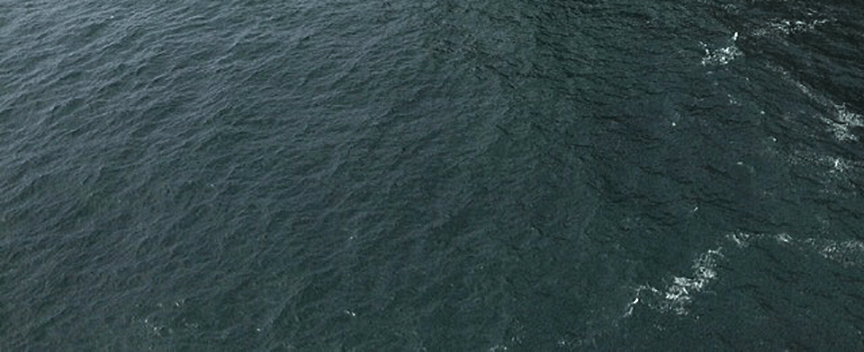
  • On September 28th, the SOTA creative writing department visited the Dolphin Club, which is a private establishment bordering the San Francisco bay where members can swim in the ocean or spend time on the beach. The first two weeks of every creative writing year are dedicated to building community, and this outing is my favorite of the many that we do. Plunging into the frigid waters of the bay as a class always proves to be a bonding experience, as well as great inspiration for creative work. I have always been fascinated by the ocean, particularly the sensory experiences, including the smell of saline air, the texture of sand, sounds of waves breaking. After the trip this year, I sat on the bus on the way home listening to music and thinking about how I would creatively respond, when the song I was listening to ended, and Clair de Lune began to play. For those who are not familiar with the piece, it is a classical movement composed by Claude Debussy. It is slow-moving and elegant, reminiscent of a lullaby, and rhythmically reminded me of hearing waves crashing on the shore of the Dolphin Club. The piece primarily features sequences of light, high notes followed by a low note, which in my mind mirrored the sound of waves rising and falling evenly against the sand. I wrote a poem for my response, in which I have used rhyme, meter, and musical vocabulary to portray this aspect of the theme. The poem is included below:


    Song of the Sea

    My legs are swimming in heavy blue sheets,
    head resting where a maternal hand meets;
    whose hum sways to a movement floors below,
    whose lithe fingers dance as chords ebb and flow.

    Woodwinds whir through the month of November,
    strings sing until the end of December;
    my apricity each day that only fades
    as sleep marks the close of cold winter days.

    On my head, mother plays the Clair de Lune,
    reclines in a bath of light of the moon.
    Behind my closed eyelids, in darkness seeps,
    and slowly I’m slipping, into the deeps.

    After three breaths of cadence, one of rest,
    I resurface to find that I’ve left the nest.
    To a haven where song comes to run free,
    I am cradled in the arms of the sea.

    Into flowering seagrass my toes sink,
    wading through schools of fish dotted with ink,
    Leaping over anemone blowing
    as the arm waves, flowing and reflowing.

    As the tide rises, my limbs rise up too,
    dancing as I bid the seastars adieu.
    It’s been a short visit, but I’ll return soon
    when my mother hums as I greet the moon.

    There is a song found only in the sea,
    that lives in the waves and is played for me.
    A crescendo as the sea’s arm takes hold,
    a cado as I succumb to its fold.

  • Having a Muse by Davis

    I’ve been wracking my brains, trying to find a way to incorporate kpop into this blog post that’s supposed to link everyday life to my writing, and I’ve finally found something:

    I am obsessed (if anyone reading this blog doesn’t know this they soon will) with a very articulate and coincidentally very attractive Korean rapper named Rap Monster, but I will refer to him by his given name: Namjoon. I was never attracted to rap music until three years ago, when I first heard Namjoon growling about societal pressures in South Korea, and the strain that students are under from age six onwards in order to get into a good school. All of the rap music I’d ever heard was demeaning towards women, and even though it took reading translations of his rap to understand what Namjoon was speaking about—since I unfortunately cannot speak Korean (yet)—I instantly connected with him and his message. It didn’t matter that most of his raps were in Korean, it didn’t matter that he was incredibly attractive, what mattered was that I felt drawn to him, and his art made me want to create art.

    I really wish that I could tell him in person how much he has influenced my art, how before I knew about him, I avoided talking about societal issues like they were the black plague. As a matter of fact, I’m meeting him tomorrow, in concert, but the signing of an autograph isn’t enough time to tell him everything I want to say, so I’ll just have to keep writing to him, and echoing back his art with mine.

    Davis Dubose-Marler, class of 2017

  • On Field Day and Traditions, by Thalia Rose

    For nearly all of us at SOTA, making artistic progress is just as important as making academic progress and thus, most students perform a balancing act on a regular basis. A friend of mine has several auditions for orchestra, recital practice outside of school and AP music theory homework, all on a weekly basis.  For me, academics alone, there are at least three hours of homework each night. I don’t find this impossible or particularly unpleasant. I have been told that being an artist is a foolish choice with no revenue, a completely impractical occupation. In theory, it does seem quite impractical – from a purely mathematical perspective, the workload seems dreadful – but that is why it is so important to snap out of personal preoccupations and focus on managing time with all the determination one can manage. I feel that a reason for the emphasis on competition at SOTA is that the different departments want to prove to the others that we, as artists, should be taken seriously, that we need to be taken seriously because we are all working so hard.

    This year, all art departments participated in an athletic competition. Representatives were chosen from each department while the remaining forces basked in the sun on the bleachers. Some activities are about synchronicity – like the hula-hoop chain, the three-legged race and the human pyramid; some are about trust, i.e. two people holding a donut from a string and one eating it; and some are about the sheer power of physical force like tug of war, which, incidentally, Creative Writing rarely participates in.

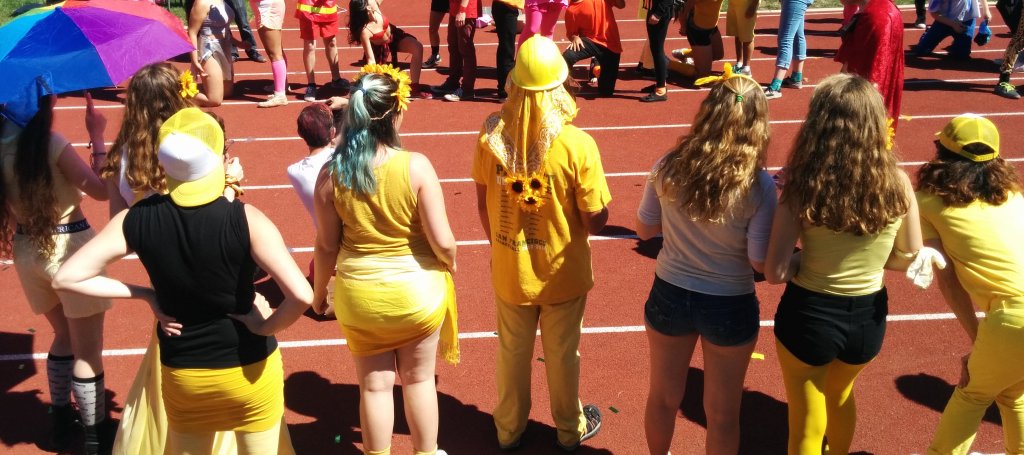
    Seeing twenty-six people all dressed in the most fluorescent yellow that they could find inevitably offers a sense of solidarity. Heather ritualistically chanting, “Banana dance, banana dance, banana dance!” and the rest of us joining in until Colin succumbed to an interpretive banana dance somehow eased the stress of competition. Traditions offer cohesion. It is comforting to know that, despite stress and routine obstacles, there is a department full of people that I care about and that care about me. I write now, and I will always write, because being in an environment where improvement of art is so strongly encouraged has helped me stay fastened to my goals and the progress of my peers motivates me to improve.

    Thalia Rose, Class of 2018

  • You may think that us SOTA kids are artistic recluses. We sit in a school all day with next to no windows and have been known to hiss at the sun like vampires, but you would be surprised how much we interact with the natural world.

                Sometimes nature comes to us, this week in the form of rainwater falling from the hallway ceiling. But tomorrow, School of the Arts is coming to nature, the field, more specifically, to take part in a legendary event aptly named Field Day.

                At Field Day, the departments battle it out in a variety of competitions including the human pyramid contest, donut-eating, a three-legged race, and a chain of people trying to fit themselves through a hula hoop. Historically Creative Writing has been a frontrunner in these events, winning the grand prize on two different occasions, and we always take preparations seriously.

                Thus emerges today’s montage of running and climbing, singing and yelling, all necessary steps to get ready for tomorrow’s games. Good luck, SOTA CW! May the best department win.

     Clare Sabry, class of 2017

  • This may be upsetting to some people, but Harry Potter and the Prisoner of Azkaban is my least favorite Harry Potter movie. While the time turner business is certainly a compelling plot device—and the hippogriff, Buckbeak, is pretty cool—I can’t seem to find my interest held by going back and forward in time and watching the scene of Buckbeak’s death over and over again from different angles. Long before our class today with our current artist in residence, Margot Perin, I had this feeling that time, in any story, is certainly not something to be messed with.

       This is what we talked about in class today—how time is sped up in some stories and how it is slowed down in others. For example, in a horror story, time is usually slowed, to create tension—the writer might describe the moment footsteps are heard behind the main character, elongate the seconds they take to slowly open the door. In Harry Potter, J.K. Rowling elongates the moment Harry picks up his wand, the look on his face, the spells he casts when he battles Voldemort, and describes it in much more detail than when he’s simply walking to, say, the Leaky Cauldron.
       Ok, now that I’m done geeking out— we finished the day breaking up into groups and writing stories with our prompt being only the two words “gender neutral person” and “train.” I’m not going to say that my group’s story was the best, but we did include a beautiful Russian named Fattoush selling hot buns and an exorbitant amount of train puns.
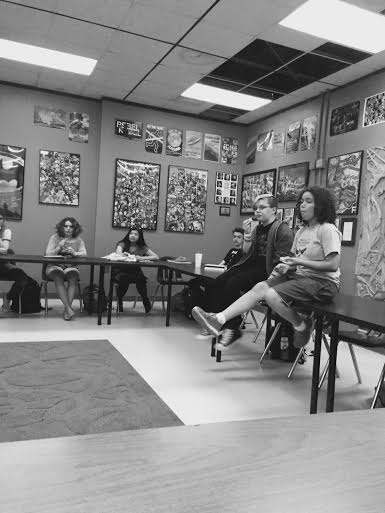
       Also, this is a picture (courtesy of the coolest freshie cat, Solange) of CW enjoying cookies and is super relevant to this blog post.
    unnamed-1
  • On My Visit to 82 Donegore Drive, Parkhall, Antrim, N. Ireland by Liam Miyar­-Mullan

    In CW last week we learned about memoirs from our great artist in residence Margot Perin. We talked about the fictionalization of memoirs and how it is OK to play with them a little, but to go too far because you’ll wind up like James Frey, who wrote a memoir that was accepted into the Oprah Winfrey Book Club only to be rebuked because of the fact that he had lied about everything. We also discussed our own life stories and how to properly write about them.

    This is a piece I wrote for one of her prompts, “Write about something that has happened to you.”

    On our last day of our trip to Northern Ireland, we went to Belfast, an ugly, outdated, bland, shit of a city. There’s nothing much to do there other than go to the Queen Victoria Mall, a large, glass complex shaped somewhat like a dome. It sits in the city’s center, which is a cobblestoned square with an abstract metal fountain in the middle. The surrounding streets are packed in with hokey Irish-themed gift shops that sell plastic beer mugs, scally caps, and vapid retro posters that read, “Irish Handcuffs: holding a drink in each hand” or, “Whiskey: keeping the Irish from ruling the world since 1793” or, “I’m not Irish but I can sure drink like one” or countless other simple-humored memes for simple-minded people.

    That is perhaps why we left early. Only after spending about in hour in the city we drove back towards the water, back into the thick Irish countryside. And on our way back, my father had an interesting idea.

    “How about we visit the house I used to live in when I was your age,” he said.

    “Sure,” my sister and I responded, not too eager, not too uneager. And that was that. We continued on Motorway 16 and swerved around and around the familiar Irish roundabouts before puling into Parkhall—a small housing community. And as we puttered   up to the stone entrance, listening to the low, grumbling voice of Luke Kelly, I knew

    something was wrong. And by the way my father was staring at the gate, I knew he thought so too. The three rows of tiny houses were completely covered in Ulster Volunteer Force flags. (Ulster Volunteer Force (U.V.F.) is a protestant, loyalist, and anti-Catholic paramilitary organization.)

    The community was shaped like a long letter “S” and looked like what you might imagine a rural, patriotic, Northern Irish working-class housing community would look like. For a Catholic to even be in there would be like suicide, like a black guy walking into a KKK trailer camp in rural Missouri. And although we weren’t Catholic ourselves, we came from a very republican (the belief in an Irish Republic) and nationalist family. My father slugged the rental car around for a couple minutes, following the red, white, and blue painted curbs. The people there were the seeds of this earth. Bleak sons-of-bitches walking around slowly, carrying watering cans to and fro. And as we sat in front of 82 Donegore Drive, we stared hard at the little door, the brown front yard, the stucco-walls, and the Union Jacks that hung wildly out the windows.

    I asked my father if he’d like to get out and show us around, but he replied with a sturdy “no” and a harsh pull of the handbrake, wheeling us back into traffic. On our way

    out our eyes were glued to the murals that were painted on the sides of the community Protestant church, which depicted the U.V.F. in full paramilitary garb: black ski masks, camouflage jump suits, and large, black guns. I don’t know what it is like to see your old house so violently colored with anti-Catholic propaganda. I can’t imagine returning to such a personal landmark only to see it’s been totally made over in an effort to scare away people like yourself.

    * * * * * * *

    A couple months later I asked him if he thought that he and his family could have settled down there in the state that it was in today. I didn’t really think much of this            question, and wasn’t really expecting an important or even truthful answer. My dad is reserved and very quiet about his life. In fact the only reason I know his sister was adopted is because of my mom. The only reason I know that he used to go in to Protestant bars and sing republican tunes with his buddies and get the living shit beaten out of him until his boots were red with blood is because my mom told me. So I didn’t think he was going to tell me anything I would remember. I expected him to say, “Yeah it would have been fine,” or “I don’t know.” But in fact he said, “No, probably not.”

    * * * * * * *

    And that sums up how I felt about Parkhall. No, it probably is not livable for a Catholic or a republican. And yes, it is crazy. But no, it isn’t uniquely more violent then the next loyalist housing community. And no, it isn’t a relatively big deal.

    Ulster

  • For the past two weeks, the Creative Writing department has been working on personal narratives with Margo Perrin. I came into this unit knowing one thing, and that was that I was bad at personal narratives. In fact I hated personal narratives. When asked why, my answer has always been that I am just bad at telling the truth. This is partially accurate. I do find it difficult to write about true events without filling in blanks, altering facts for convenience, and upping the tension by exaggerating the story. In the past two weeks, however, I’ve learned that these are generally accepted methods of writing memoire and personal narratives since no one can remember every detail of their life perfectly and the goal of a writer is to make our work enjoyable and entertaining to read. 

    Despite this discovery, I am still uncomfortable with the process of writing personal narratives. When trying to think of why writing about myself and people I know makes me uncomfortable, I think of something Margo has said many times over the course of this unit: “Your stories deserve to be told.” 

    I think it’s just hard for me, and probably others, to think of their own life as a series of fascinating stories that people might want to read. It’s even harder to think of people that we know as characters when we understand that they have so many more dimensions than we could ever put on a page. From this sense of inadequacy comes guilt, a feeling that we are giving our own stories too much time and effort and that we are not properly representing the situation no matter how many times we try. The trick to writing personal narrative, one I’m still trying to master, is to tell yourself again and again, “your stories deserve to be told.” Maybe someday you’ll even believe it. 

    Emma Bernstein, class of 2017

  • Building Voice in Gnarly Ways by Josie Weidner

    Let me preface this blog post by saying that I wish I were one of those people who could effortlessly slip words like “gnarly” or “that’s so dope” into my every day vocabulary. I have always observed that the people who looked happiest in life were those who thought of everything in terms of being “gnarly” and “dope”; Sean Penn in “Fast Times at Ridgemont High”, laid-back rock climbers, chill surfers who hang out in the tropical waters of Fiji. Yet, those types of words sound so ungenuine coming from my mouth. As much as I wish I were a surfer in Fiji, I’m just a high school senior who uses the word “awesome” too much.

    I didn’t start thinking about how important vocabulary is until this week, when I happened to flip through skating and surfing magazine Juice in a bookstore. They kept using words like “Outside” and “Barrel ride” and “Double axle curve, pineapple doing is best to remove all that sauce.” I had no idea what these words meant in the context of surfing, and they didn’t make sense in the context of my vocabulary. For some reason, I found these words to be so intriguing. This was true surfer speak.

    Building vocabulary is a fundamental part of writing. Before, I always thought it was enough to replace words like ‘rural’ with ‘pastoral’ or ‘big’ with ‘enormous’. Now, I think about building vocabulary in terms of voice too. What I had read in Juice was a prime example of what a surfer might say. I realized that being able to use authentic vocabulary and voice like that expands the range of characters I can write about. There are so many different types of voice that conjure up specific characters like business jargon or teen lingo or mom voice. How these characters speak already says so much about who they are, just like the types of people who say “Gnarly”.

    My ending point to all of this is that as writers, paying attention to how someone uses vocabulary in their voice creates more interesting, intense characters. Expanding what you read, listen to, and whom you talk with can build the voices from which you draw upon. Who knows, it may prove handy in life as well, when you’re surfing in the turquoise waters of Fiji and need to know that when someone shouts “Outside”, a new set of waves is approaching, and you better get paddling.

    Josie Weidner, class of 2016

    IMG_0961-1