CREATIVE WRITING

at the Ruth Asawa School of the Arts in San Francisco

Welcome! CW develops the art and craft of creative writing through instruction, collaboration, and respect. This blog showcases STUDENT WRITING and how to APPLY to Creative Writing.

  • Going Places by Charlotte Pocock

    I started a list the other day of all the places I want to go in the world. It is currently five pages long. Each page is for a different continent, their titles being “Europe”, “Asia”, “South America”, “Africa”, and “Other” (because I am not going to dedicate an entire page to Antarctica and I am not too comfortable placing Iceland under “Europe”). There are, as of today, twenty-six countries and twenty-one specific cities on the list. These include Prague, Tokyo, Victoria Falls, Palau, and the Northern Lights.

    I may never have enough money or time to visit the twenty-six (and counting) countries. I could, maybe, make it as a gypsy. I could learn Romani and join the ones I saw on the sides of highways in Greece and travel from place to place with them. I could learn self-defense and hitchhike across Europe. I could walk across borders, doing small jobs so I can afford food and to renew my passport. I could do a lot of things, but I probably wont. At a certain age I’ll settle with the handful of wonders I have seen in my life and spend my time finding new things to love about wherever I end up.

    We have recently started working on our fiction unit. The hardest part about writing, to me, is deciding where I want to go with the piece I am working on. Many difficult choices come with beginning a work of fiction. There are so many ways to interpret things, so many ways to develop a prompt. Most of the time, I have no idea what I’m doing when I start writing. Of course, after a few lines, I start to get an idea of what I want to do and things start formulating themselves, but it is still a frustrating process. Some days I feel like I’ll never be able to start a piece smoothly.

    However, writing is free, and I have so much time to grow, to develop skills and plotlines. Who knows, maybe I’ll still be making things up as I go by the time I’m a senior. Maybe I’ll never see the Northern Lights. Maybe I’ll wake up one day and regret all the things I never did. But I doubt it.

    Charlotte Pocock, class of 2019

  • Discussing Hemingway by Abbegail Louie

    During this years fiction unit, CW I is focusing on Hemingway. We are focusing precisely on his stripped language throughout his short stories and his use of structured absence. Today we held a discussion on Hemingway’s subtext within “The Killers.”

    Our discussions are held after reading the text, and while everyone is participating I use discussions to clarify. Even when I read as carefully as possible, phrases and sentences jump up from the pages just to fly over my head. I feel like I’m always missing something while I read, but I assume that is why we hold discussions. Hearing my peer’s thoughts and interpretations of the text make me want to reread every book I ever “read” in my life.

    I am usually not one to shy away from talking, but during discussions I have to really think before I try to make a point. That should go for everything, but I usually don’t mind making a fool out of myself. How else will I learn? Every time a point or realization pops into my head, I jot it down into my notebook and read it to myself. This orients my ideas in a more organized matter where I won’t trip over my words as I talk.

    There are a lot of takeaways I am gaining from studying Hemingway’s short stories, like:

    • The importance of diction
    • Clarification is key
    • Less is more.
    • Detach yourself, it will be fine.
    • Discussions are like SparkNotes.

    Along with the takeaways, I have one burning question that bothered me throughout our whole discussion: Is everyone’s life structured around the absence of not knowing what really happens to you after death?


    Abbegail Louie, class of 2019

  • Teenage Girl Meets Disco Ball by Julieta Roll

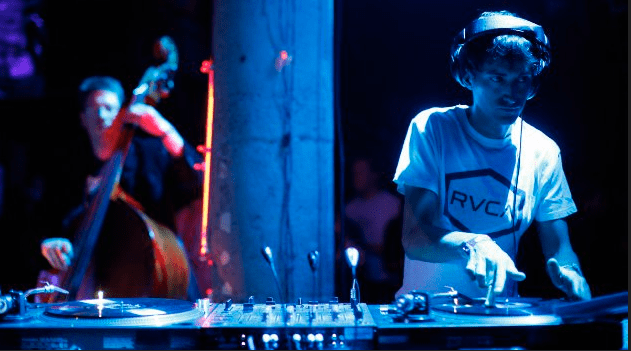
    In the fourteen years I have been alive I have never stepped in, nor even been near a nightclub. Wow, crazy right? Yeah, the whole idea of going to a ‘club’ when I’m twenty-one and doing whatever it is twenty-one year olds do I had never really thought about until a few days ago. It was Tuesday (Sep 29) when Maia Ipp came into our Creative Writing Class and announced that we and the entirety of SOTA had been invited to an event called Mercury Soul. Mercury Soul for those of you who are uninformed is a concert of live electronica music and classical orchestra mixed together. The idea of the event is that you’re taking two types of music (electronica and classic) that are very much on opposite ends of the spectrum and mixing them together into one soup of sound. I was intrigued by the idea and thought it sounded exciting. So, as expected, the whole freshman class and Harmony (‘18) decided we would go all together on one big Friday night outing. We also settled on the idea that after our time at the club we would walk to The San Francisco Art Institute where we would participate in Cine Club, but that’s besides the point.

    Mercury Soul was located at Ruby Skye, a club space near North Beach. The place is usually meant for only twenty-one and older but this night was the exception. The whole experience was fun and crazy. The night was filled with blue disco lights, bass strings being sprung at the notes of electronic music, and the smell of teenage sweat. I have never been the kind of girl who just starts dancing at events like these with confidence and grace. I’ve always felt awkward and the self-consciousness can really get to you at times. As a writer, I’ve always felt more comfortable inside my own head and notebook. Social skills are not my forte and I’m perfectly happy when I’m alone with my book. This isn’t to say I don’t love having friends and being with the artistic minds of people at SOTA because I do. Since being the Creative Writing Department I’ve noticed there is this stereotype that other people have of what a writer is. That where all introverts who stay inside all day, hunch over our notebooks and read. I find this funny, because in some ways this stereotype this very true, and it’s true in a good way. Everyone I’ve meet in Creative Writing is so unique and intelligent and I feel we’re all just a bunch of weirdos who like making our own paths. That’s a good thing, being unique is important, and it’s something very valuable when you’re a writer. At Mercury Soul I felt I was too able to loosen up and be myself. I was able to just dance to the music, only being with the people I love and who I know love me.

    Julieta Roll, Class of 2019

  • I am Jewish. My family is not orthodox, but we are part of a Reconstructionist synagogue; Or Shalom. We celebrate major holidays like Chanukah, Passover, and the High Holy Days. I’ve had my Bat Mitzvah. I’ve had the experience of fasting on Yom Kippur the past two years. Fasting is different when you’re sleeping in the same room with girls who think they know you, but truly do not.

    Last year, one of my close friends invited me to come to a program for teens at her church called Youth Night. Middle and high schoolers meet every other week and play games. There’s also a bit of prayer, but I’ve gotten used to that in the year I’ve been going to Youth Night.

    Once a year, Youth Night participates in the Thirty Hour Famine, a community activity designed to raise money for those who have no food and to teach kids more about Jesus Christ and empathy with the hungry. I was invited to join them, and accepted. The Jesus bit was kind of lost on me, but I was excited to spend time with the people I had come to see as friends in the months I’d gotten to know them.

    The Thirty Hour Famine at my friend’s church starts in the morning. The last meal before the famine is breakfast. In the evening, the teens meet at church and have a conversation and do a few activities related to world hunger. The activity we did included paper bags of beans and various penalties each group had. Afterwards, some of us stayed up, sorting the dried beans into the various types. At first there were five or so of us, but people dropped off to sleep. By the end it was just me and one boy. When we had finished, I joined in on the YouTube karaoke session that some of the other girls were having. After trying and failing to sing Chandelier (none of us actually knew the melody, and we could just barely hit the high notes in the chorus), we finally retired. By then it was around eleven. We clambered into our makeshift beds and fell asleep.

    But I couldn’t. I was in a room with three other girls, only one of which knew that I’m lesbian. She was tolerant of my sexuality, but not entirely comfortable. I couldn’t think with the hunger in my stomach and melancholy in my mind. I slithered out of my sleeping bag and grabbed my journal and a pencil. I frantically scribbled down the beginning of a poem that I was terrified I would forget. A month or so ago, I had come up with a set of lines for a poem.

    A fear of my peers,
    It has always been here.

    Suddenly the rest of it came pouring out of me. I tried to convey the strange emptiness I felt at the moment, while at the same time capturing the pain of certain rejection.

    Once I had finished my poem, other ideas seemed to come from nowhere. I don’t know if it was my exhaustion or my empty stomach that left my mind free to think of new things to write, but whatever it was, I woke up the next morning with several pages of messy words written in a sloppy, blind hand. I wrote a bit more, no longer as frantic, but still just as thoughtful.

    I wouldn’t go so far as to say that fasting was “enlightening,” but the lack of food combined with the late hour and the fact that I was surrounded by religious, slightly homophobic girls inspired me in a way I hope to someday experience again. Although the feeling was

    uncomfortable at the time, I want to go back to that moment. See what I was thinking. I want to be able to have ideas like that out of the blue without the sadness, but I know that emotion is a big factor in my writing.

    The girls in the room that night were oblivious to their contribution to my writing, but because of them I felt the tightness in my chest that comes when I have ideas I need to get down on paper. I felt the emotions because of them and the fasting, the anger at both them and myself for my discomfort, the sadness at the knowledge that they didn’t really know me, and the detachedness that came with my slight delirium.

    A fear of my peers…
    …It has always been here.

    Lena Hartsough, class of 2019

  • To be completely honest, I was not in the mood for Kirby Cove this year. My days of being charmed by dusty hiking boots and campfire scented hair are long over. Besides, what high school junior in their right mind wants to finish a stressful week of school only to pack up and head straight to a campsite where the latrines are bottomless hell pits and it gets cold enough at night to seriously endanger any toes left poking out of a sleeping bag?

    Despite this, I couldn’t manage any genuine irritation as I was shuttled across the bridge toward the Marin Headlands. Everyone who has been on this annual CW trip before knows that Kirby Cove has its own particular brand of magic; no matter how surly you are coming in, it always wins you over in the end. On the winding walk down to the campground, listening to the excited chatter of my friends, I could already feel my mood changing for the better. The spell was starting to take effect.

    At first glance Kirby Cove looks like it might really be enchanted. Nature seems to be slowly encroaching on the man-made, with canopies of thin trees bending overhead and brush and stoic flowers creeping in on dirt paths. Down by the shore, a precariously constructed rope swing hangs over open water. You can grab your notebook and tuck yourself away in a corner of the forest or the damp tunnel of the old gun battery by the beach, where the sound of waves breaking against the shore is amplified a hundredfold. The scenery practically begs to be written about, to be filled with war heroes or musketeers or wild animals of your own invention.

    The real magic of Kirby Cove, though, is what the Creative Writing department brings to it. Within a few hours of our arrival, the unspoken barriers between the age groups had lifted, and I found myself standing on a picnic table belting out “Space Oddity” with a group of equally tone-deaf freshmen and sophomores. It all felt perfectly right, even if our neighboring campers didn’t think so.

    Later, after Heather’s husband Sam had read us two fantastically creepy tales by firelight, we all adjourned to the gun battery for our traditional game of Hot Seat, the details of which cannot be discussed due to Vegas Rules. I will say that I was touched by the outpouring of support and empathy that everyone showed not only toward their friends but toward everyone in the department. Creative Writing is a community where no one has to change any aspect of themselves to feel safe or accepted, and in the middle of high school’s high-stress social environment that’s both rare and invaluable.

    When the last vestiges of daylight had ebbed away and the stars winked to life along with the multicolored lights on the Golden Gate Bridge, I watched cars crawling like slow, metallic bugs to and from San Francisco. My friends were sprawled out all around me, half zipped into their sleeping bags. A few yards away in every direction other small groups whispered or slept, the sound of their breathing mingling with the swish of the waves against the shore to form a comforting background noise. There was a sense of peace about the whole scene. We were all safe in the knowledge of being surrounded by people who we loved, and who loved us back. It’s moments like these which make Kirby Cove an indispensable part of the CW experience.

    Sophie Mazoschek, class of 2017

  • Every year, the Creative Writers go camping in the Marin Headlands, at a small campground known as Kirby Cove. It is, of course, scenic. There is bright blue water, and trees, and fresh air. There is a rope swing above the water that is incredibly fun. There is a bunker upon which we hung out. However, it’s more than that. It’s a bonding experience.

    As a freshman, it was my first time. I was apprehensive for a million reasons. I was worried I wouldn’t get enough sleep, worried people wouldn’t like me, worried I wouldn’t have fun. None of this proved true. It was incredibly fun, and I grew better friends with everyone there.

    We talked, and sung. We made s’mores, and we ate s’mores. My fear vanished almost immediately. Everybody was kind to me and my fellow freshman. I felt like we were part of a giant family.

    Of course, this has some bearing on my writing. Nature always inspires me. I want to write every time I am in the woods, or at the beach. Also, the friendships that I have made encourage me to continue to write and share and make art.

    Huck Shelf, class of 2019

  • The HyperWebster by Kayne Belul

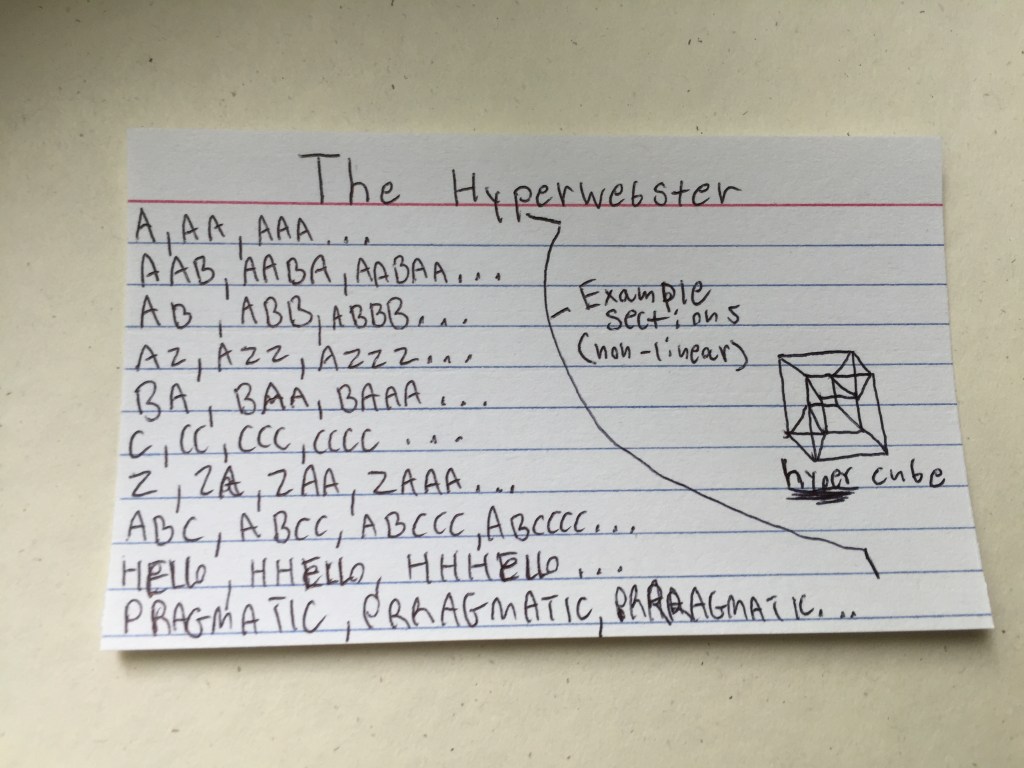
    The HyperWebster is a hypothetical infinite dictionary, also capable of generating every piece of writing and snippet of thought ever conceived. It’s a more accurate and less cliché billion of monkeys typing out the full works of Shakespeare. The way this hypothetical text works is formulaic: starting with the letter A, it will cycle through all 26 letters. After it gets to Z, it will reset and add an A. Starting with AA, it will cycle through all possible combinations. When it gets to ZZ it resets and adds another A. This goes on infinitely.

    If this were ever published, perhaps by four dimensional extraterrestrials, every piece of writing would become plagiarized in an instant. Since that’s not probable, I’m going to look at it from the perspective of a very 3D writer. 

    Every draft of every one of my pieces would be contained in the Webster, including better edited versions of what I write. I’ve been thinking about that as I edit recently. Each piece has the potential to be perfectly edited; I just have to figure out what which words I am supposed to place where.

    The Webster also relates intimately with playwriting; it illustrates the fact that a simple starting point or plot can develop into literally anything. Plays are meant to have a plot while most of my writing consists of abstract or absurdist concepts. It’s gratifying to know that, given the amount of drafts in The Webster, a simple plot can theoretically be developed into the greatest story ever written. 

    The possibilities have always been there, but I’ve never seen it proved before. Sure, there are a lot of words in the English language, but not an infinite amount. Adding in the slang, kennings, and special characters that could be added to The Webster, it’s a lot more illustrative of the possibilities.

    Math and writing are one of the typical left brain right brain examples, which is interesting because although creativity is a right brain trait, thinking in language is attributed to the left. In this way, it’s less strange to think of math and writing as kin, rather than opposites. Even science is more attributed to writing (given that it has its own genre). The Webster is a good example of math and language combined. Some more (as I trail off into recommendation) are the collection Cosmicomics by Italo Calvino and a good number of Borges stories. 

    Kayne Belul, class of 2018

    IMG_6957

  • Today in class Maia Ipp came in to teach us about Lit Critiques. For those who don’t know, Lit Critiques are papers written to extrapolate literary devices/analyze a piece of writing. Accompanying the essay is a creative response that demonstrates some of the literary devices in the poem, fiction, etc. that was analyzed. For the first lit critique of the year we work on the essay with our writing buddies, which I feel really helps the freshman become less confused. We need to complete one per marking period (six per year) so these papers are an anticipated and vital part of CW, and as a freshman I felt somewhat anxious about making my first one.

    Maia first explained what a lit critique was supposed to do and have, and then told us the different between form and content (shown in the photo). She gave us examples of literary devices, which really made it easier for me to understand what to write for a critique. Then we split up into our writing buddies and showed each other the pieces that we could choose. My writing buddy, Clare (’17), and I came to a consensus on the piece we would work together on, and got to work analyzing the poem (“The Poplar” by Vladimir Nabokov).

    Overall, today was a great day. I’m excited about writing my first (of many) lit critiques, thanks to Maia.

    Ren Weber, Class of 2019

    IMG_4116 (1)

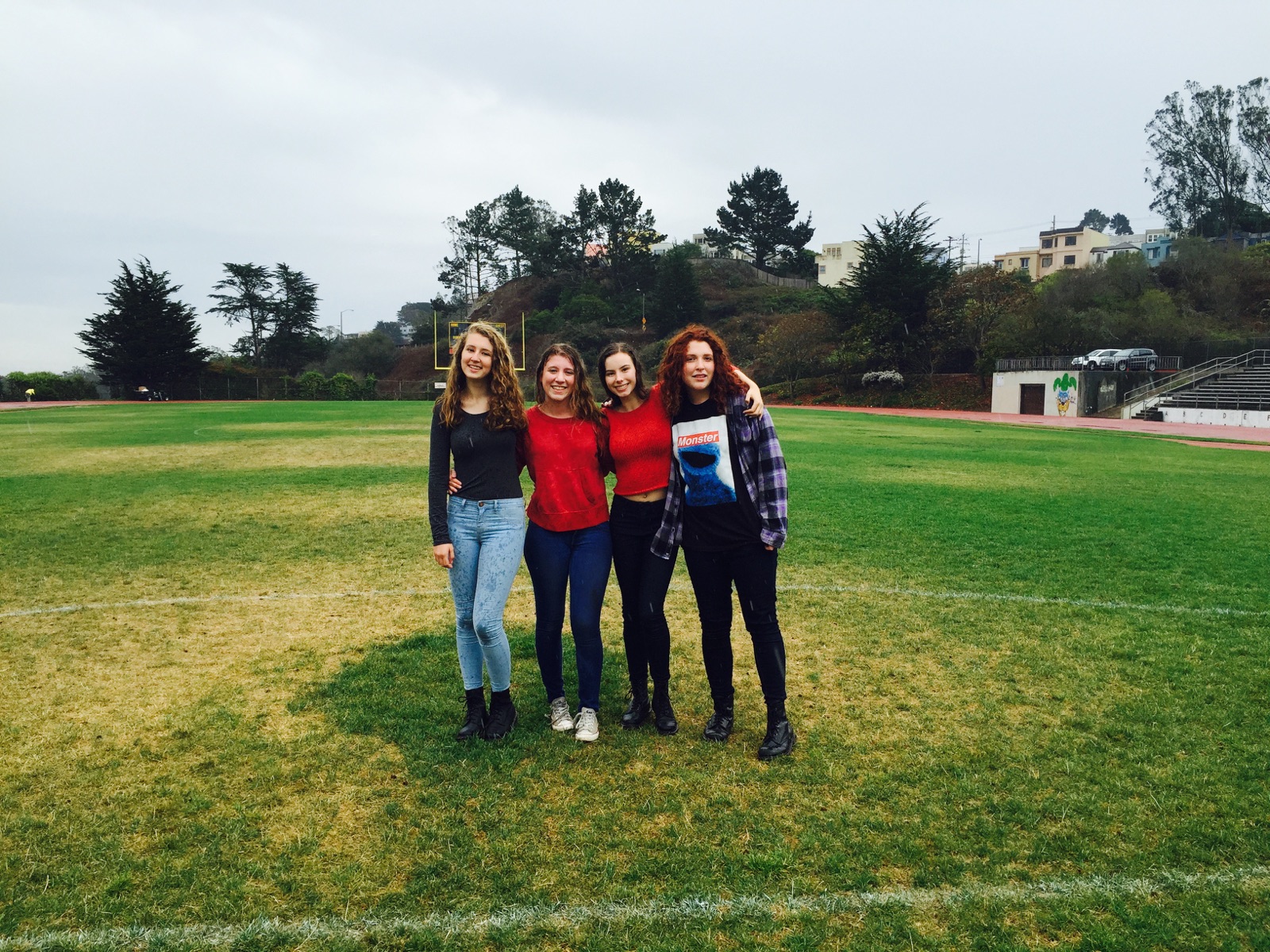
  • Today it rained more heavily in San Francisco than it has in a long while. Naturally, this prompted me to suggest we take a quick roll in the glass. I raced down to the field with Davis and Clare, laughing loud and strange from somewhere deep in my stomach. I collapsed in the grass immediately and felt the rainwater seeping into my sweatshirt and jeans.

    Emma B eventually came down to the field and joined us, and then we ran back and forth across the field in a hysterical, wobbling line. I kept yelling, “It is raining and I am so happy,” over and over in a voice that was loud and uncontrolled like I must’ve sounded as a kid.

    Later, in thinking about this moment, I realized what an accomplishment this kind of happiness is at sixteen. It is so easy to become caught up in the drudgery of work and routine and to lose sight of the incredible color and texture of the world. As a little kid, it is easy to be moved to moments of intense wonder or joy but every year the threshold for what is beautiful and what is important becomes a little higher and losing oneself in the feeling of rain in hair and grass on skin becomes just a little harder to obtain.

    After coming to this realization, I began to wonder, as I always do after this kind of revelation, how this new understanding relates to my writing. The answer I came up with is pretty simple. When I am writing, I am attempting to portray a more heightened, more vivid version of the world. I am attempting to create something that somehow succeeds in being more real than the literal world around me. In order to succeed in this kind of writing, however, I need that basic love and respect for the world I see day to day. I need to be sensitive to changes in the weather and all the tiny and glorious phenomena that happen every day. Although people usually think of writers as being mature and self-contained, I find that my best writing actually emerges from the intense, unrestrained emotions of childhood and the days before maturity became a relevant idea.

    Emma Eisler, class of 2017

    IMG_4724

  • On The Ocean by Angelica Joy LaMarca

    Considering I am not a very good swimmer and I rarely visit the beach (despite having lived next to it all my life), I guess it’s quite surprising that the ocean is present in almost everything I write. I began to notice this last year, and it’s something I still exhibit subconsciously, whether it’s the central theme of a poem, or just a little simile. The ocean seems to invite itself onto my page. I don’t even like the ocean that much! I dislike how the cold slides around you when you step in, and that one time I had a pet hermit crab, he escaped his cage and a week later we found him kneading his way across the tub, probably suspecting of my contempt for sand. So, if the ocean isn’t necessarily a place of comfort for me, I thought, why are eels, sea­foam, and anemones so often laced in my writing?

    When walking through a lively street, clotted with powerlines and cement, it is easy to forget that at any point on the San Francisco peninsula, you cannot be any more than roughly four miles away from water. In Pacifica, where I live, literally everything is named after the ocean (“Oceana High School” “High Tide Cafe” etc). I only noticed it when one of my SOTA friends pointed it out, and I realized that the ocean is such a consistent element in my life that sometimes, I may even take it for granted (as cliche as that sounds). But on another note, how can I forget something so vast, and when I see it’s name advertised on every street sign? Maybe this is where my original question comes in. It is compelling to think about how our environments influence our subconscious, and this can be both in a physical sense and in a place of mind. I noticed that I found it slightly difficult to write this past summer, cooped up in my bedroom with just my dog and a blank Word doc for company. It only took a few days into the school year to sync back, and I suspect it is because of the creative stimulants that SOTA offers. As writers I think it is vital we acknowledge our surroundings because in more ways than one, we are products of our environments, hence what we craft will reflect it.

    Angelica Joy LaMarca, class of 2018

    IMG_1617