CREATIVE WRITING

at the Ruth Asawa School of the Arts in San Francisco

Welcome! CW develops the art and craft of creative writing through instruction, collaboration, and respect. This blog showcases STUDENT WRITING and how to APPLY to Creative Writing.

  • Last Wednesday marked CW’s last day with artist in residence, Taylor Duckett. For the last two weeks, Taylor taught us the foundations for performance poetry. In the unit, we differentiated a storyteller from a music artist and analyzed what being a storyteller meant; we wrote and performed pieces written to a sixteen beat, and compared a line of poetry to a measure of music. As these lesson changed each day, one aspect would stay the same: the free-writes.

    At the beginning of the unit, Taylor asked each student for one song in order to compile a class playlist that we would listen to for each free-write. Every day to start class, end break, and end class, Taylor would play one of our songs for us to respond to. Her challenge for us was to keep our pen moving for the entire song. Which is difficult when I am trying to jam to a song that I have not heard before, or trying to make out lyrics on the first listen.

    Taylor’s hope was that we incorporate what we hear into our writing. For each song, maybe we would use the song’s beat in our piece, maybe sample a few lyrics, or respond to how the song made us feel. Typically, when I listen to music, I am reminded of the events surrounding the first time I heard the song, but what happens when I hear the song for the first time? With a pen in hand and paper in front of me, I found that, for me, I am transported back to a time that resembles the mood of the song.

    Oftentimes, listening to a certain song on the list brought up a memory that I had not stopped to think of since. For example, the song “Handle With Care” by The Traveling Wilburys reminded me of when my brother and I would go on bike rides to a school near our house during the summer. I found that music can evoke emotion by relating to its audience with parts like the beat or lyrics. The ability for music to bring up instances from the past is something I found fascinating.

    While I was able to enjoy the music and relive, mostly happy, memories that the songs brought back to life, it was difficult for me to write a creative response to the song. I felt that I was too focused on listening to the song, or trying to uncover more details of a memory that the song evoked rather than allowing the song to aid my creative writing.

    Everything that Taylor taught during her performance poetry unit were things that I had not attempted or observed before. Her lesson also prepared us for our upcoming showcase.

    CW Performance Poetry Playlist

    1. I’m Not in Love – 10cc
    2. And the Waltz Goes On – Andre Rieu
    3. Millionaire – Kelis
    4. In the Kingdom – Mazzy Star
    5. Wigwam – Bob Dylan
    6. Cassiopeia – Joanna Newsom
    7. What You Won’t Do For Love – Bobby Caldwell
    8. Moody’s Mood for Love – Tito Puente
    9. Heavenly Father – Isaiah Rashad
    10. Every Planet We Reach is Dead – Gorillaz
    11. Will of the Wisp – Miles Davis
    12. Thinning – Snail Mail
    13. Feel It All Around – Washed Out
    14. Pienso En Mira – Rosalia
    15. Fireworks – Animal Collective
    16. Transit – Fennesz
    17. Suzanne – Leonard Cohen
    18. Handle with Care – The Traveling Wilburys
    19. Lonely Girl – Oceanlab
    20. Mythological Beauty – Big Thief
    21. Pool – Tricot
    22. He Loves Me (Lyzel in E Flat) – Jill Scott
    23. Wham Bam Shang-a-lang – Silver
    24. Fancy Shoes – The Walters
    25. Come Together – Beatles
    26. Powerlines – Riz La Vie
    27. No Other Plans – Sunny Levine
    28. Graceland – Paul Simon
    29. Hear You Me – Jimmy Eat World

    Xuan Ly, Class of 2021

  • Over the summer I was in a funk. Whenever I tried to write, I got the overwhelming sensation that I was wasting my own time, in addition to whichever poor friend who had to read my own piece. For months this creeping sensation followed me, making itself intertwined with the heat of the summer like a cat in a curtain! I roamed about my day to day of summer nothings with this funk gnawing away at my creativity and only at night when it got cooler could I assess the damages. After the summer, I named this time in my life the “Funky Hours,” and out of the Funky Hours came nothing but that grey spitting funky mush.

    The one and only salvageable thing I wrote over the summer came to me thusly, on the hottest day of the year. I was sitting at a kitchen table, sweltering. The window yawning, and through its mouth I could see the greater countryside of Britain. A man stood in front of me, and had been talking and talking for maybe days, who was I to say? I tip my chair back, and while balancing on the tip of two legs is when I deem it appropriate to evaluate how each part of my body is feeling, specifically (as I do in moments of great…inaction). I start with my toes, work up, and come to this conclusion, expressed best in the poetic form:

    I feel like an old oak door

    by Max Chu

                  I
    feel      like
    an        old
    oak
                  door
    .

    This may be the best poem that came out of the Funky Hours. In the moment of conception, there was no doubt in my mind that this was the truest poem I could have written. As the author, I can tell you with full assurance that the speaker and the author are one, that the old oak door that the speaker describes is the same to the one that the author envisions in his mind’s eye! Therefore, whichever old oak door that the reader envisions the speaker to be envisioning is the same to the one that the author, me, is envisioning.

    My godmother use to own this enormous house in the wilderness of Inverness. Whether it was actually in the wilderness and whether it was actually enormous is unknown to me, as I have not been back to the house since my childhood. However, in the mornings, my godmother would take a dog food dish and fill it with birdseed before leaving her front door and placing the food on the front porch. Then she would turn around and go back inside, closing the red old oak door behind her. I bet you didn’t expect it to be red!

    Max Chu, class of 2020

  • CW at the Magritte by Hannah Duane

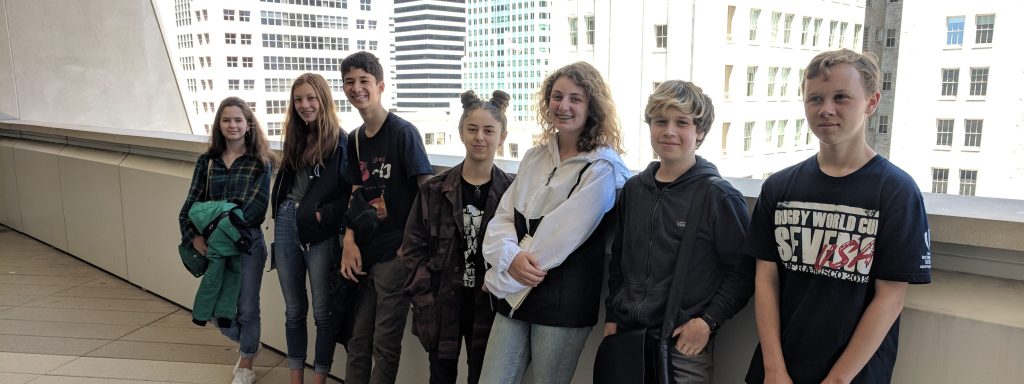
    On the last Monday of September, Creative Writing made its way to SFMOMA to see the exhibit of Magritte’s late work. We met, excited in the lobby. Many students among us had already seen the show, were quick to tell us it was fantastic.

    In the first two weeks of school, Creative Writing builds community by going on many field trips. Some of these excursions are purely enjoyment, such as our ritual swim in aquatic park, however many connect CW with the culture and art happening in our city. This year, we went to SFMOMA to see Selves and Others, a collection focusing on modern self portraits, as well as the De Young to see a Judy Dater photography show, and attended a reading at Booksmith to hear Thomas McBee, and finally, back to SFMOMA for the Magritte. After two weeks of talking about art and learning to further develop our vocabulary, this final show was our chance to take the art in on our own. Most of the Creative Writers went through slowly, and by themselves or with a few friends, talking about their opinions with each other, and occasionally stopping to write.

    The show was set up across many rooms, each focusing on a different period in Magritte’s life. I very much enjoyed seeing his progression, and beginning to understand the themes and motifs Magritte found most interesting. As a writer, it was intriguing to see how these same techniques are applicable across art forms.

    Magritte’s exploration scale, light, and weight most affected me. In the final room displayed a painting of a rock suspended over the sea. In this image, entitled “Clear Ideas,” the rock is the same size and shape a cloud above it, asking the eye to equate the images. However, while a cloud is light, and in its whiteness does not connote danger, the rock is menacing. It nearly represents rain, and yet the light coming from the position of the viewer illuminates the rock as quite solid.

    I also enjoyed the way he captured light in the painting “Evening Falls.” This piece features a sunset behind a window frame with the fractured glass strewn around the floor. Though the glass, in reality, would show what is newly behind it, the shards depict the sunset as well. This surrealistic image invites the reader to question representation, and merge past and present visions.

    I left the exhibit inspired to write surrealism and explore what themes I am drawn to in my own writing. It is easy, at a school full of artist to attempt to find clear lines between the different disciplines, however in reality, art is far more fluid than that, with a variety of forms in conversation.

    Hannah Duane
    Class of 2021

  • There’s no way to say it nicely. Assigned summer homework is not something all CW students enjoy. Summer is the only extended period time over two weeks in length where we aren’t sitting through classes lasting an hour and twenty minutes. It’s when we do not have to wake up at ungodly times of day to get to the climate-indecisive Glen Canyon where SOTA is located.

    I am so fortunate to be a part of the uniquely Bay Area SFSOTA Creative Writing department. Throughout my year and three months here, I have become a much more responsible and aware person. Heather has not only guided and strengthened my writing passion, but has introduced me to perspectives I had no experience with prior to high school. But summer work was not my motivation to apply to this department, nor is it my favorite thing to do now. During the three months we have off of school, I’d prefer to escape to sleepaway camp without any looming deadlines.

    However, one of Heather’s many insights is about how to improve one’s writing skills. It is centered around the cliche phrase, “practice makes perfect” (but of course as a writer, Heather introduced this concept without using any cliches). Her reason for assigning summer work is something like this: if one would like to strengthen their writing abilities, one must constantly write. I have taken this mindset to heart during the two times I have been assigned summer work, and I appreciate her firm belief for I have been able to explore my specific strengths in writing outside of the class environment.

    Upon arriving back in school during August, CW revises their summer work based off of Heather’s comments. This has been an unpleasant process for me, as revisiting work done months in the past has been like looking at my application portfolio for this department after a year of being immersed in sophisticated writing — cringe-inducing. Regrets come forth about the piece, for example word choices or chosen formatting. Heather counsels us individually after reviewing our summer work, and has jokingly dubbed me the “thousand-poems-in-three-poems” girl after commenting that I wrote a poem with many concrete images but didn’t particularly blend cohesively.

    These are some selected stanzas from a poem I had written this past summer and recently revised. I’ve centralized the theme, unified the imagery, and excluded extra words.

    Excerpt from Coyote Bones

    The bones flow and grow and sway,
    suspended from cloud toes,
    blown away with a fist of air
    carried into Yosemite valley
    by millions
    of thousand year-old trees,
    roots plunged to Earth’s core.
    The trees remain there,
    forever anchored in an ocean of
    lush soil.

    Robins greet blue jays
    atop speckled boulders,
    iridescent wings intertwine.
    Slugs the hue of sunflower petals
    mingle on slabs of granite.
    Raccoons sulk in the heat,
    claws clicking on rock,
    paw pads lurching forward
    to the dining birds.

    And the bones keep moving,
    around Glacier Point
    where young couples marry,
    out to fields enveloped in
    sunset and lupine blooms.

    Thank you so much for your comments and care, Heather! I truly appreciate the confidence you’ve instilled in me.

    Sequoia Hack
    Class of 2021

  • Freshie By Benjamin Leuty

    As of today, the Creative Writing department has concluded its sixth week of the 2018 school year, and its brave band of freshmen has survived to participate in the fall performance poetry unit. It’s been a wild ride for us freshies, and I already feel like I’ve done more over the course six weeks than in my entire eighth-grade year.

    These first couple of weeks have led my mind to wander back to my early childhood, specifically how young children seem to find such joy and find such novelty in experiences that for their elders, would be considered mundane. That same overpowering feeling of wonder has been present throughout my experience in the Creative Writing department as I explore the alien customs of my new habitat. The feeling was present during the roaring of the yellow-clad crowd on field day, the surreal Kirby cove camping trip, the thought-provoking Magritte exhibit, and has been part of every other enchanting afternoon spent in Creative Writing.                                                                                                                       

    My time at SOTA starkly contrasts with my middle school years, as 7th grade Benny so eloquently put it “middle school sucks!”. Middle school was nothing more than an endless cycle of repeating lessons, filled with interminable boredom, and unmotivated, uninspired students (myself included). SOTA has been the complete opposite, every day is different, indistinguishable from the last, which is part of the reason why I can never seem to answer the “what do you even do in creative writing?” question which is frequently asked. Everyone here loves what they do, everyone here is happy, and for the first time ever I am happy to go to school every day.

    As with most high schools, adjusting to SOTA is difficult, it’s a very different environment and Creative Writing, in particular, has its fair share of whacky community building traditions and field trips, many of which take place in the first couple of weeks. Every day of these past few weeks has been a blur, as all of us freshmen try to find our place at SOTA and in our respective departments. It has taken a while, but I think most of my fellow freshmen have started settling in, and as the dust settles I’m starting to truly comprehend and appreciate this one of a kind school. I can already tell that the singers and the dancers, the actors and the architects, the musicians and the writers of SOTA are, and will continue to be, some of the most committed and talented artists I will ever meet.

    Benny Leuty
    Class of 2022

  • As a senior I’ve begun the ultimate task, I’m writing my thesis. All Creative Writing seniors are required to write a larger body of work as a final project, a last hurrah in the department. The thesis I’d like to think represents everything you’ve worked for as an art student. You completed four years in Creative Writing, so what? A thesis answers that question, encompassing the talent you’ve gained in the form of stories you want to tell.

       I won’t say the journey to a thesis is easy though. I am only starting my writing process, and there have already been some bumps in the road. I think the difficulty originates in pinpointing what exactly you want to focus on. Topics and themes can be broad of course, but the thesis has to be cohesive; the writing has to connect and talk to each other. I, for example, plan to write a series of short stories all within the genre of magical realism. I chose this idea not only because I love magical realism but because I felt my best work could come out of a surreal world. I knew to explore what could be off about a universe would fuel my motivation more than writing realistic fiction.

       I cannot express my gratitude more to the Creative Writing Department. My high school experience has been indescribably special, and my thesis can only begin to articulate that uniqueness. Senior year is a year of finalizing everything which is both terrifying and exciting. I can’t wait to see what these next eight months bring.

    Julieta Roll
    Class of 2019

  • Kirby Cove Year Three by Emily Kozhina

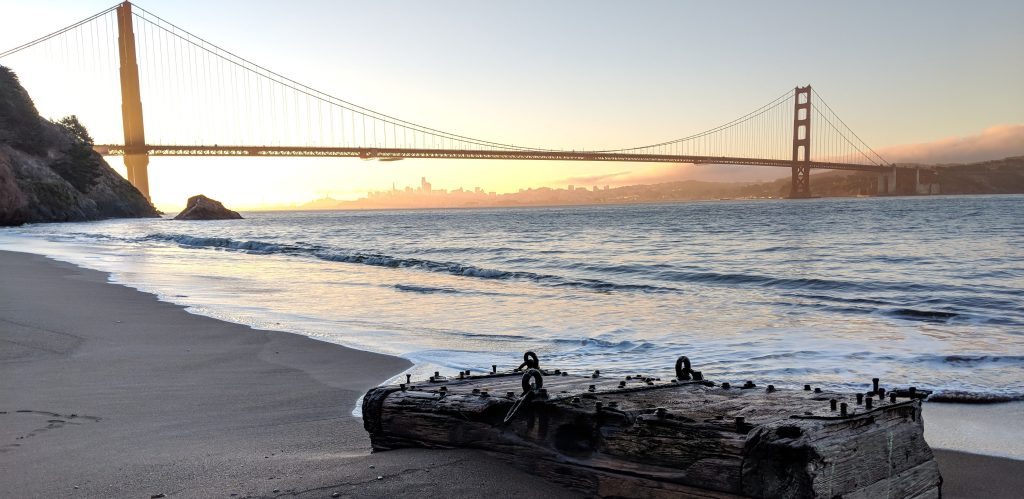
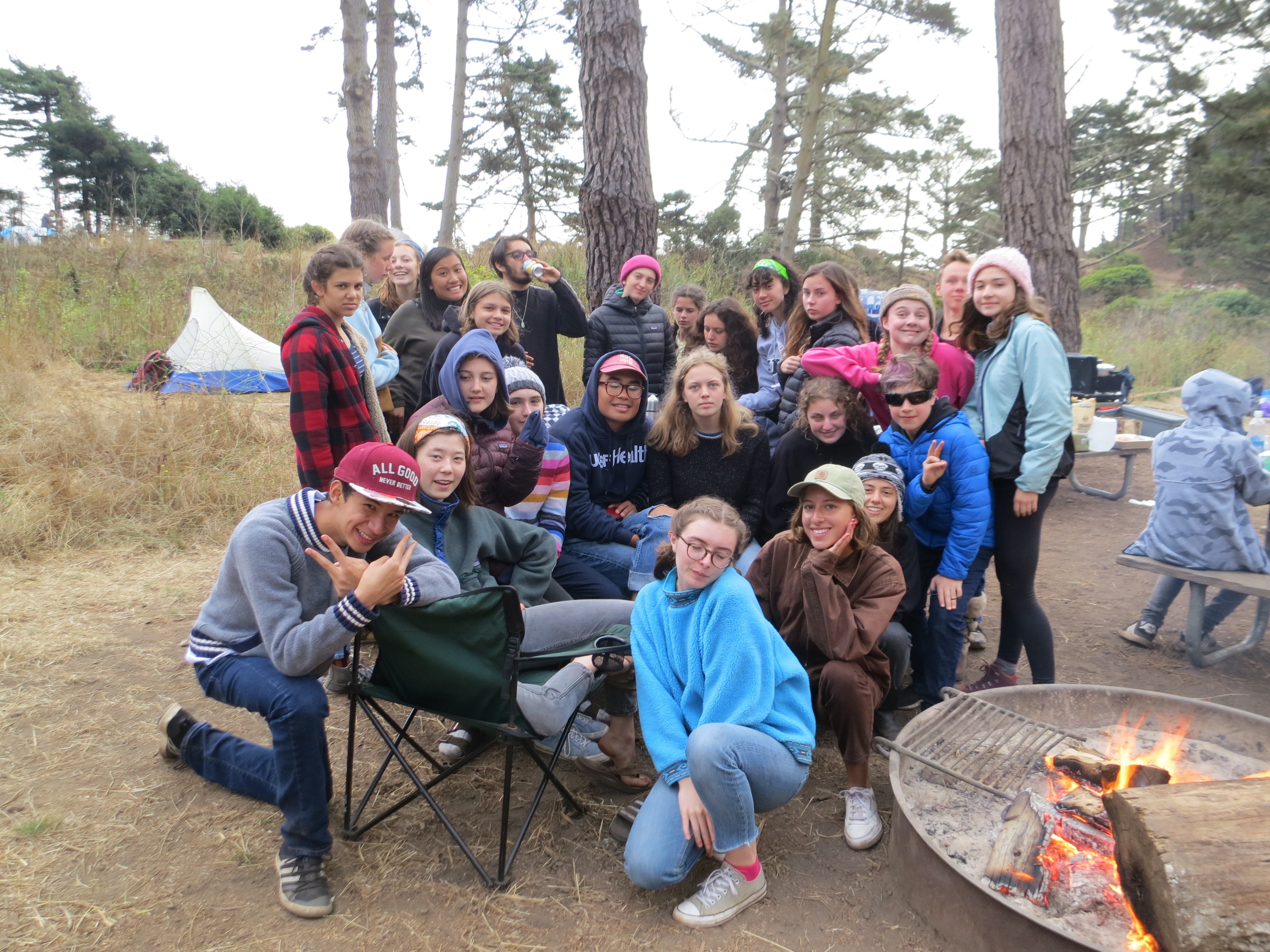
    Being a creative writer at SotA comes with accepting all the traditions that come with being in the department. One of the most favored traditions is the overnight trip to Kirby Cove, a camping spot in Marin County. During our stay, all the students participate in activities like swimming in the bay, soccer, and sitting around the campfire, face glowing with content and sweat and bay water.

    When I was a freshman, “Kirby Cove” was a magic word, one mention and all of the other grades began to chatter excitedly, which both intrigued and terrified me. What was so incredible about some overnight camping trip? Now, as a junior, I’ve gone three times, and I completely understand. Of course, I won’t go into detail of the events that occur, because the students who have gone already know, the parents of those students have already heard about it, and the future CW students will soon find out.

    Rather than the events of the trip, I wanted to write about something far more touching, which is the pleasant bonding that occurs during the trip. One of my favorite times in Kirby Cove is sitting around the fire late at night. People are roasting marshmallows, telling stories and chatting, and most importantly, making sure Heather wouldn’t wake up (It happened once, but she was too charmed to get angry with us, and went back to sleep). I watched as some nodded off to sleep while they stared into the fire, while others protected the group from thieving raccoons. Occasionally, a handful of people who leave to walk around and stay awake, and always came back cold and lonely, cured by the peaceful bonfire. Staring into the fire and hearing distant laughs further down by the ocean, I am reminded of how grateful I am to be in this department, and have experiences I’ll cherish until I’m old.

    Emily Kozhina
    Class of 2020

  • Poetry Inspired by Music  By Nadja Goldberg

    Carmina Burana is a cantata written by Carl Orff in the 1930s, using the Latin text from a collection of medieval poems. A cantata is a narrative piece of music with singing and musical instruments. On April 26, at the Scottish Rite Masonic Center, several art departments from SOTA are participating in a show inspired by the works of Carl Orff. The show will involve vocal and instrumental music, a dance performance, and visual artwork; and I and five other creative writers will read pieces we have written in response to the cantata.

    To prepare for the show, we met up twice and played sections of the music while writing. As the music resonated throughout the classroom, I was enthralled by the elaborate texture and emotion the music conveyed, with deep, sorrowful solos, delightful, high-pitched melodies, and shrill chords on the violin. We also read the English translation of the 24 Carmina Burana poems, and identified a few common topics from our writing and the poems, such as rivers, mountains, birds, beetles, spring, and cycles. We each then wrote a piece incorporating those topics. I wrote a poem about a lakeside scene at dawn:


    Five Silhouettes

    The lilies sit, glossy and ruffled
    Atop the navy water; silver wisps of fog
    Drift slowly; from the murky shore, a frog
    Croaks a persistent, heavy heartbeat.

    The moon hovering, bright and full
    Coats the water’s surface with
    A white, gleaming sheet.
    Frozen, windless air—
    Unmoving like a buried breath,
    Fearful under the moon
    And its unceasing glare.

    A single loon drifts along.
    Beneath it, water ripples, trembles.

    Five silhouettes ascend
    The distant hillside; footsteps brisk,
    Rhythmic, as pale sunbeams peek
    Eagerly over mountain tops, extend
    Long fingers that lightly tap a creek
    Trickling through grass; night becomes day.

    A tiny swift darts overhead;
    Sharp wings and tail poke
    Up at sky as it lands
    On a twisting branch;
    Chirps a sugary melody.

    Two of the five silhouettes
    Tilt softly outlined faces
    Toward the swaying tree top.

  • Creative Writing has just performed its final show of the year, and wrapped up its playwriting unit simultaneously. There were many things I learned from playwriting, and I am grateful for all of them because when playwriting season starts up again next year I won’t have the same what-the-hell-am-I-doing freshman sort of feeling again!

    It was an entirely new world. The quiet, thoughtful Creative Writing classroom I had learned to expect was gone every Friday (quite literally, as we had to relocate all the furniture into the hallway), and replaced with a flurry of movement and voice exercises we needed to learn to become familiar with how stage directions physically appear on stage. But the change was refreshing. Just like every other unit we’ve had this year, playwriting changed most of what I knew about writing. Before, with fiction and poetry, writing was something very private and created almost entirely by the author. And that was true of playwriting until we had to act our scenes out, then I realized that the final project was very much a collaboration between the actor, the set, and the playwright. It was all very different from what was imagined on paper.

    There were other barriers I had to overcome for playwriting, such as the idea of having to manifest physically what a character was thinking instead of just saying it. Yes, these new changes were hard, but with them came many unexpected creative opportunities. The playwright could dictate the set, the costumes, the sound cues and lighting. The world created on stage is limited to the first glance, but boundless at the second. The playwriting unit is over, but that only means next year’s unit and show are going to be better.  

    Lauren Ainslie, class of 2021

  • Every year Creative Writing has a playwriting show. We select around ten plays from our playwriting unit to produce, all of which are performed by us. By no means is Creative Writing a master of theatre, but in my three years in the department I have become infinitely more comfortable with the stage.

    I have never been an outgoing person. As a child I would often cower, begging not to be seen. Now as a teenager I have taught myself to be in the spotlight, to be accepting of attention. Creative Writing has taken my humility, in a good way. I have learned that I can’t spend so much time worrying about what others think of me. I should act as I wish, be completely myself. As much as that sounds cheesy the Creative Writing shows have truly aided me in reaching that confidence. For rehearsal week we have to spend hours on stage, fully becoming our characters and yelling at the top of our lungs. The process can be overwhelming yet it has pushed me to explore my abilities in performance. I have no choice but to play the role I have been given and give it all I have.

    In this year’s playwriting show I played the role of a maleficent bird. As I looked through the dialogue I would have to memorize and the cues I would have to learn I felt that familiar surge of panic. The feeling of ​stagefright ​and worry. ‘I can’t do this’ I thought, thinking of myself up there on the stage, everyone staring. Yet, rehearsal week arrived and I knew there was no backing out. I would play a bird, a pretentious demanding bird, a bird that was quite the opposite of myself. Like all the years past I memorized I went through grueling rehearsal and when the moment finally came to walk on stage I felt that pumping adrenaline fuel my body. One thing I always remember about being on stage is how quiet it feels. You become consciousness of how many people can watch you at once, waiting for your words. As always, the play continued and as if on autopilot I said my lines and walked off stage. “I just did that” I thought as I often think when I finish a performance. I had enough confidence to go up there. I demanded attention.

    Julieta Roll, class of 2019