CREATIVE WRITING

at the Ruth Asawa School of the Arts in San Francisco

Welcome! CW develops the art and craft of creative writing through instruction, collaboration, and respect. This blog showcases STUDENT WRITING and how to APPLY to Creative Writing.

  • A Magical Field Trip by Claudia Porter

    There are a variety of wonderful and educational field trips that you will get the privilege to take part in if you are in Creative Writing. One of these field trips, my personal favorite, so far is the writing buddy date. 

    I remember being extremely nervous and confused on my first day of Creative Writing. I had no idea what I was doing, and one person that helped me feel more confident was my writing buddy. She’s been an incredible mentor to me and an overall great person to look up to in Creative Writing. Writing buddies are an amazing part of Creative Writing, helping you to work collaboratively, gain knowledge and new ideas, and, overall, get a better sense of what Creative Writing is like. Because of this, I was looking forward to the writing buddy date. 

    On this writing buddy date, the older buddy is required to take the younger buddy to a destination of their choice. The older buddy will show the younger buddy around, tell them about why they chose this spot, and maybe even buy the younger buddy a treat. (My buddy bought me a milkshake!) This is a time for the buddies to get to know each other, ask questions, and make memories that will last forever.

    On the day of the field trip, my writing buddy told me that we were going to Golden Gate Park. We got on the bus together, and it was so easy to talk to my buddy about anything I wanted to; we clicked immediately. After the bus ride, my buddy decided to take me to a boba shop for drinks! It was a very warm day, so I couldn’t wait to sip on a refreshing drink as we lounged in the shade. My buddy treated me to a delicious milkshake, and we explored the shops and the park. We browsed around a quirky magic shop and giggled as we talked about anything that came to the top of our minds. After some window shopping, we found a shaded spot under a beautiful tree right near the Botanical Gardens. It was such a magical moment as I was bonding with someone whom I looked up to so much, and I knew was an incredibly talented writer. We talked about everything. Our lives, our goals, and Creative Writing. It felt so inspiring to have a mentor that I could look up to, and I was relieved and excited to know that I had someone I could go to if I ever had any questions about Creative Writing – or if I ever needed any advice. It was refreshing to get to talk to someone that I knew really wanted to help me succeed in Creative Writing. 

    After the field trip, I felt so connected to my buddy, and I felt a stronger connection than I ever had before to Creative Writing. Now, I am able to go to my buddy whenever I have questions or concerns regarding Creative Writing or, really, when I need any advice in general. I know that there is so much more to come, and I can’t wait to form an even tighter bond with everyone in Creative Writing. Going on field trips in Creative Writing has been an enriching and wonderful experience, and the buddy date is now a core memory engraved into me forever. 

  • A Voyage Through The Gardens by Celeste Alisse

    Each school year, towards the beginning of community weeks, the entire Creative Writing department journeys to the Botanical Gardens. There, we prance around the rambunctious geese, who leave presents of poop in the grass. Clinging to each other, we narrowly avoid the poop, cackling to ourselves about how silly we must look. But looking silly isn’t and has never been our main concern, especially not when we’re all immersed in each other’s company.

    By the time we’ve gotten situated—either under the tree or next to the water fountain—Heather, our lovely department head, distributes our missions. Together, in duos or trios, Heather gives us a map of the botanical gardens with six different destinations and prompts. At each destination, we are to hand-write a collaborative poem with our buddy, building off each other’s writing to create a work in accordance with the theme we were given. Once finished, we delicately place the poem in a spot visible to random passer byers. 

    The idea is that our writing will light someone’s day up, that they will find the small poem on the slip of paper and smile. However, what we fail to notice is the smile that spreads across each Creative Writer’s face as they contribute to their section in the poem. The joy we aspire to share with others is already imprinted in our own selves, which is—in my opinion—what makes Creative Writing such an enlightening department. 

    So without airplanes and trains, we travel through the world, delicately stepping across continents as if we were giants. We journey through the gardens: through Temperate Asia, New Zealand, and the Meso-American Cloud Forest all in under fifty minutes. Our feet touch the soil and our eyes recognize traditional plants native to the location we stand in. From temperate art to dirty fountains, we inspect them all, especially when it comes to determining landmarks so we don’t get lost. And though our missions are timed, many of us end up taking much longer than the given amount of time, as we take one too many wrong turns or merely wind up in a tree (I’ve seen it happen before). However, the timing does not matter as much as one may think. Instead, the main priority is to spread the Creative Writing cheer—even if it means spreading the cheer all the way to the tops of trees. 

    At the end of the day, everyone regroups and collapses into the grass, our exhaustion finally taking full control of our bodies. As we lay, we whisper small secrets about our day into each other’s ears and show each other pictures of the funny moments that occurred during our voyages. Sometimes, if we’re especially lucky, a loving alumni will even stop by to meet the fresh faces of the department and hand out donuts!  The voyage through the botanical gardens does not only consist of beautiful plants but also of smiling faces and full bellies! To join our expedition through the Botanical Gardens is to experience a trip of immersive writing and beautiful sights; the perfect Creative Writing field trip.

  • Magical Realism in Playwriting by Raquel Silberman

    Ever since beginning our playwriting unit, I have wondered the ways in which I can incorporate magical realism into my plays. I could not help but notice that most of my plays I’ve written, weeks into the unit, have had something missing. Every prompt I wrote seemed bland and unexciting. After finishing our fiction and poetry unit, I was used to expanding on small moments; a ten minute play seemed far too daunting. So I began a mission to thaw out my prose mindset and unveil my passion for playwriting again. It was a rocky road of many short scenes full of yelling, perhaps a projection of my frustration. In our third week, the class was prompted to incorporate a magical character into a scene using subtext. I was intimidated at the idea, how could I communicate anything meaningful through something that isn’t real? Or, how could I do that and also convey multiple meanings? But then I thought of all of the ridiculous magical characters that have imprinted on me and the ridiculous real figures that I will never forget. Both of which could have fishy intentions. This prompt made me think: why not use both? I always thought I was a drama kind of gal, but drama is ten times better when it’s coming from a talking octopus. Here is a monologue prompted from magic and subtext, a dangerous mix.

    BUBBLES

    I am not a horrible octopus. I am very friendly, all of the fish in the sea would agree. But I must address a video of me that’s been floating around all over Fishbook and Instaclam. And I’d like to point out that I am the victim here. All of this has been taken out of context. I never meant to offin anyone with my actions, but you try reacting reasonably when a smelly fisherman picks you out with his load and starts filming you. Things may have gotten messy…but I only inked in self defense! I never intended to make anyone upset, but I also never planned on getting fished out of my house. And I certainly did not expect to be trending on Turtle for the next week! I just wanted to say to all of my sweet generous fins, thank you for all of your support in this huge sandal. I love and appreciate all of your fan mail and will be releasing my revenge music video for “Inked” next Friday so leave a like and comment and I’ll catch you Bubble Babies later. Toodles!

  • Poetry Negative to Poetry Positive by Emilie Mayer

    Similar to the saying, “You are what you eat,” the creative writer often reflects the literature that they consume. Over the past year, I have not read an impressive or even adequate amount of poetry. As a senior in Ruth Asawa School of the Arts’ Creative Writing Department, I am tasked with creating a thesis. I decided last year, in my final months as a junior, that I wanted my thesis to be a novel. Since then, I have for the most part only read novels as a form of research. I was not actively avoiding poetry, but I was neglecting that side of my writing. 

    More than six months passed without me seriously sitting down and crafting a poem. On the rare occasion where I tried to don my poet’s hat, I was too much in my head and could not translate my thoughts onto the page. I had fallen out of love with poetry, when poetry was the genre that first introduced me to the craft of creative writing. 

    Going into the Creative Writing Department’s poetry unit, I was apprehensive. I feared that my poems would be too plot-based: all exposition and no imagery. My fears were confirmed. For the first week or two, my poems—in simplest terms—sucked. I wasn’t connected to anything I wrote. It was all word soup. 

    As I read more poetry, I hungered after writing poetry again. And, little-by-little, the prose started flowing. Finding motivation caused the shift. For every poem, I require some sort of exigence. Recently, emotion has been my kindling. As a senior, departure is at the forefront of my mind. I use the complex feelings related to leaving as the core of my poems. When I have a focused intent, I think less about the crafting of the poem and am instead swept into greater purpose.

    Poetry still scares me, but now I have rediscovered the joy of finishing a piece. There is nothing quite like the thrill of crafting a perfect reflection of my emotions and thoughts.

  • Playwriting with Haiku Forms by Pascal Lockwood-Villa

    Starting this month, we students at Ruth Asawa School Of The Arts Creative Writing department are working on a six-week unit in playwriting, thanks to our current artist-in-residence Hasti Jafari. In this unit, we are being taught a plethora of new playwriting strategies; I found it appropriate to talk about some of my favorite learning opportunities which I have gleaned from these lessons. 

    For starters, thanks to this unit, I got the opportunity to write a variety of new scenes in new formats that felt refreshing and new all at once. One example of this was the “haiku plays” our artist-in-residence had us create. These unconventional little scenes were, like their name suggests, made up of only three line of dialogue in the entire play: the first, a five-syllable line from one character, the second, a seven-syllable line from the other character, and finally another five-syllable line from the first character. This lack of dialogue may seem limiting at a first glance, and many of us thought so when Hasti introduced this exercise to us. But as we would soon learn, the true storytelling elements of this exercise came in the form of expanded stage directions, of which Hasti encouraged us to make far more descriptive and elaborate than what normal stage directions would encompass. With this new format, we were allowed to go all out in these stage directions to compensate for the lack of dialogue. In writing mine, I spent most of my time developing the scene with the free reign I was given in the stage directions. I was taking my time as I worked; I obviously didn’t want to turn in and of my work half-baked. It didn’t take me very long to have a scene in mind, and I was allowed to be as expressive with my work as I saw fit. However, it was only as I was struggling to find what I wanted to write for my dialogue did I realize the true purpose of this assignment: to find a balance between showing and telling in playwriting. While I had placed a lot of detail into the stage directions, it consequently left me unable to find what I was looking for in the dialogue. After I realized this, I went back and edited all of the stage directions to be more realistically achievable and this gave me the space I needed to write my dialogue. I’m grateful for being able to learn this valuable skill so soon into playwriting!

  • My Personal Muse by Leela Sriram

    As I am nearing the end of senior year and finalizing my senior thesis, I have started thinking about how I find inspiration in creating a large body of creative work. While this is an awkward time to think about the muse of my thesis, I have discovered that my little interests such as birds, and knitting have allowed me to step into the minds of my characters. I think of everything I write as a reflection of me. In many ways, through my writing, I take on many different personas. I am an old woman by the seaside, and a runaway cowgirl in other moments. 

    The idea of a muse is taboo, and I believe that as a writer I should not wait around for the inspiration to come to me. Rather, I think about the little moments in my life, such as rain on a sunny day or seeing the pelicans on the pier. This is what I see as the muse. Inspiration is what I think of as impressionable in my life. The little moments, while fleeting, are pivotal to creating worlds. They are what make my thesis feel like more than a collection of pages, to me. While writing a deeply personal collection of work has been difficult, I am grateful for the opportunity to share my innermost thoughts and feelings with my fellow seniors and eventually, the entire Creative Writing Department. I am eager to see my thesis come alive in the form of a physical book instead of a google doc. 

    Working on my senior thesis, while also completing college applications, and now waiting anxiously for college decisions has been a difficult task. However, I have learned so much about how I can generate more fiction using my perspective on life, and how I can create a cohesive collection of fiction and poetry by myself. I am eternally grateful for this experience, and I know that I am going to cherish my thesis after I graduate from Creative Writing.

  • Touching Emotions by Sophie Fastaia

    On the last two days of January, Speak (Easy), our poetry show began. A week before the show, we had chosen and workshopped the poems that we were to read to an audience of about three hundred. I remember on a Friday when we spent the whole two hours allotted memorizing our poems in pairs. Kenny, a Creative Writing freshman, sat with me, as I tried to recall each line. While I read the poem in my head, it felt like it was not being absorbed, like my mind was a strainer that couldn’t retain the words. I had written about a great loss in my life that happened when I was eleven and even though I was not talking about the event directly, I realized that it was hard to memorize because of how it made me feel; I was almost reliving the experience and felt so much sadness building up behind my words. 

    The first night of the show began at six. I recorded myself reciting the poem and listened to it multiple times to get the lines to stick. When it was my turn to stand under the yellow spotlight, I felt confident, holding the poem in my head, but then the poem fell from my mind and I blanked. I staggered through, taking long pauses and skipping multiple lines. I was disappointed and surprised because I had never had so much trouble memorizing a poem. I felt vulnerable on stage and had chosen to share a piece of writing that was based on a heartbreaking event in my life. Even though sharing vulnerable pieces can be painful, opening up helped me to slow down and feel emotions that dwell deep. Creative Writing has given me the ability to explore internal emotions and share vulnerability with the support of the people I love around me. I was able to drop down into my wound and touch my grief when I shared it with others. Touching emotions is at the root of what Creative Writing brings forth.

  • A Cure for Writer’s Block by Gabriel Flores Benard

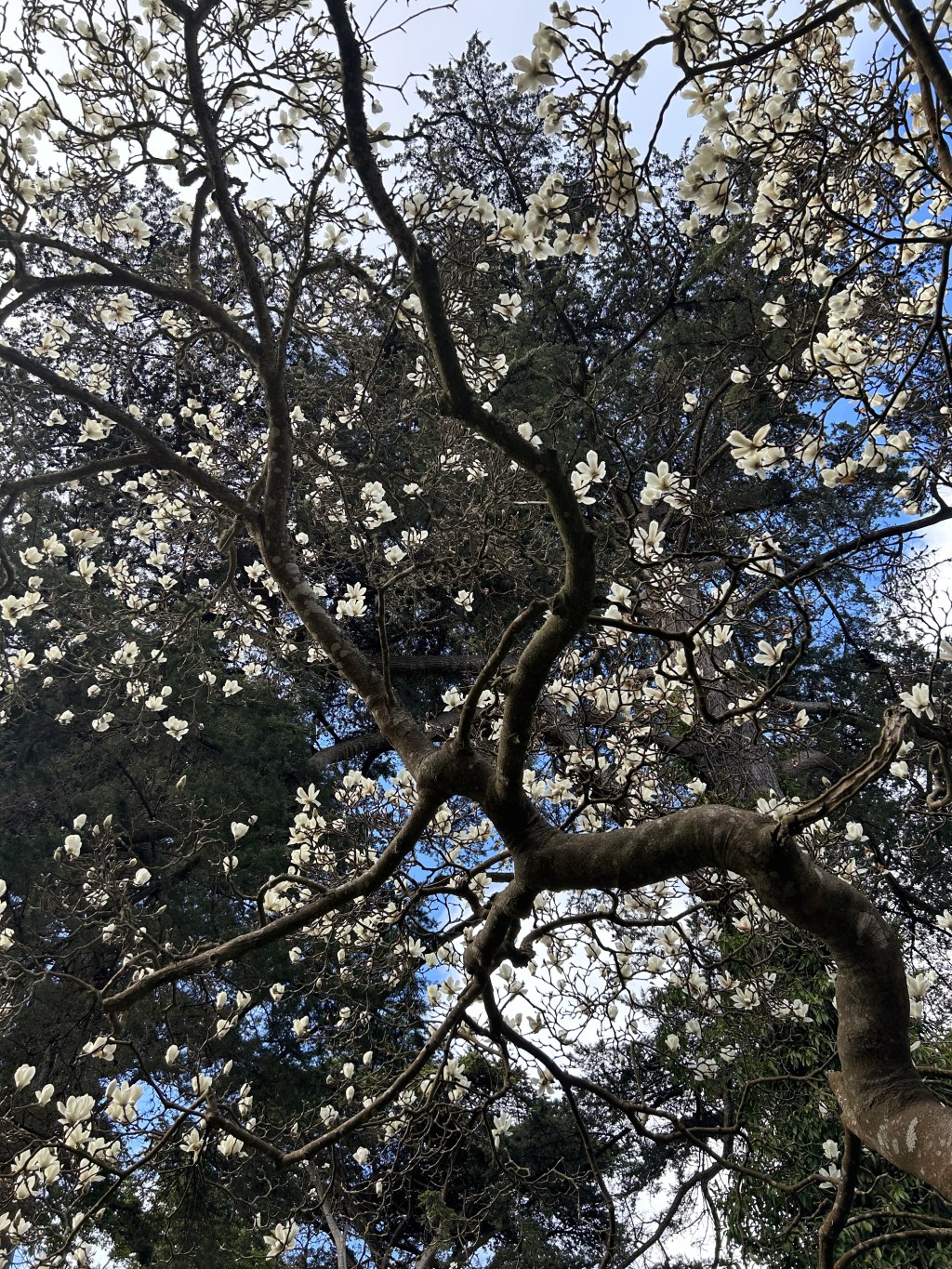
    Creative Writing recently went on a trip to the Botanical Gardens. Although the frigid winds and potential threats of torrents loomed over our shoulders, the Creative Writing class went to see the magnolias bloom. I dislike the rain, and I constantly noticed the clouds above. Puffy clouds peppered the skies as we left, clumps of cotton balls strewn together as they failed to cover the sun. As we arrived at Golden Gate Park, the clouds congealed and darkened, filled with water like an antsy child. I felt droplets kiss my face. 

    By the time we entered the Botanical Gardens, the raindrops had faltered and stopped. The congealed clouds roamed close but allowed the sun to peek through. Heather took the Creative Writers along endless trails of flowers and other flora. Large, magenta petals littered the floor and poured over us. The trees grew in twisted ways, yet their branches wove intricate webs that diluted the sunlight. Heather stopped us along the trail to point out the coloration of the flowers, the sunlight peeking through the leaves, and the trees felled by strong winds. A few of my friends and I took pictures while others strung words together in their notebooks. My friend gave me her earbud, and we danced as the sun peered into our eyes; the clouds left us alone, and the wind left the trees to revel in the cold. 

    The trip to the Botanical Gardens allowed the Creative Writers time to unwind. Fresh, virescent sights also inspire us writers before entering the next CW unit. Do not let anything stop you from relaxing, observing, and taking time to reignite your literary fire. The cold, sun, rain, wind, and flowers all have stories to tell. Take advantage of every sight and memory; you may find inspiration without trying.

  • Sluggish, But Fast by Filip Zubatov

    I am stalking the clock persistently, like a killer to its prey. The hand’s fingers are frozen, but I wait. My eyes never shift from the clock, for the fingers would sprint away. I would stand helpless, like a deer on the road, trapped in the headlights of a car. Why aren’t you making more friends? Why are you eating that? Exercise. I’ll do it tomorrow. A plethora of hopes, goals, and accomplishments waiting at the end of these minutes; both academic and personal. So I rushed through my days, like something was chasing me. Expecting something, without working to make that expectation a reality. I sit, glued to a desk, watching time pass me by, hoping when the day, week, month ends, my work and self will be improved in some way or another. At the moment, life seems to be going by like a turtle walking a marathon. After the turtle has crossed the finish line, I realize that I let each mile go by uncounted, when I should have utilized each one to create something better of myself and what I can achieve.Start tomorrow. I should have started today. The lit crit isn’t going to write itself. Everyday, putting off the goals you have, expecting results. The quality of my work, no chance of improvement, a stalemate, or so I thought. Waiting weeks without pushing myself, the same results. How could my work for Creative Writing or work towards personal goals have a chance to improve without time spent? Spending time you have for worthwhile activities will ultimately help you achieve any goals you have in mind. There are a plethora of ideals I wish to achieve in the near future, and I haven’t done anything to help myself reach them and rather watched time slip through my fingers. A message to everyone reading this piece; don’t watch time pass in hopes of your ambitions coming to fruition, and rather make your expectations a reality with diligence.

  • Literary Ditches by Natasha Leung

    At the beginning of my first year in creative writing, the seniors gave the fresh peeps a lesson on what might be the most important assignment in the class: literary critiques. We got a lesson about what literary devices were, and how we would have to write an essay about them, but I focused more on the exciting new aspects of writing—poems, skits, and other fun games. While the topic had been mentioned over the course of community weeks (and quite heavily complained about), I didn’t imagine an essay to be the most difficult part of the class. In middle school, I loved writing essays, especially about works of literature. I had thrived in analyzing tiny aspects of topics, and sharing my perspective on the meaning of situations. I had, naively, hoped that I would be one of the few people who at least semi-enjoyed writing literary critiques. However, my hopes were dashed as soon as I got back the comments on my first draft. A slew of comments, mostly repeating the same message: I was completely all over the place, didn’t stay on topic, and overall had a horrible ability to be concise while still making sense.

    Wrapping up our fifth literary critique for this year, I’m beginning to find myself closer to the knowledge of what in the world I am even supposed to be writing about. I chose my own poem to critique for the first time, which I found a liberating while also quite stressful experience. The ability to handpick a poem that specifically stood out to me after paging through websites for a good hour seemed to help me get into a groove of digging through layers of literary dirt. After finishing the first draft, I counted four printed-out copies of the poem, each page so covered in annotations I wished for a pair of binoculars. As the due date loomed closer, I traded drafts with a fellow classmate and felt my inner professor kick in, as I peppered their analysis with responses of my own. I spent what felt like years condensing every note, every question, every single thought that crossed my brain in regards to the poem into four pages of connections and realizations.

    None of the process I went through is to say that I’ve gotten particularly good at writing a literary critique, one that doesn’t leave my reader scratching their head and wondering how I managed to write something so completely nonsensical. On my most recent one, for example, while doing peer revisions I received at least three comments simply asking “Natasha, what the heck does this even mean?!” I admit I asked myself that many times while writing: “Natasha, what does anything you’re thinking even mean?” Despite this hagarring inability to do what appears to an outside view a simple assignment, I haven’t given up on ever writing a perfect literary critique, something that makes my reader think to themselves, “Yes, you took the words right out of my mouth!” I still believe that I’ll be able to sound intellectual instead of spewing randomness. Despite the randomness, I would have to admit I love the feeling of getting into a poem. I love spending the day as an archeologist, sifting through mounds of gold in the form of words, and finding pieces that connect like bones creating the skeleton of a newfound perspective.