CREATIVE WRITING

at the Ruth Asawa School of the Arts in San Francisco

Welcome! CW develops the art and craft of creative writing through instruction, collaboration, and respect. This blog showcases STUDENT WRITING and how to APPLY to Creative Writing.

  • There always has been lots of talk about how Creative Writing and our operations are vaguely cultish. This is completely untrue, if we understand the purpose of a cult to be veneration for a perceived idol. This is completely true if we base the label on actions alone— small, inclusive, apparently secluded. So for the sake of transparency, here’s a glimpse at one of my favorite aspects of CW:

    Creative Writing, when the emphasis is on Creative.

    Not in a bipartisan way where it means anti-writing (we try our hardest not to be “us and them,” here). Needless to say, I love writing— love it so much it seems completely inadequate to state it outright like that. I can write a full showing-not-telling discourse on my love for writing on a later date (maybe I’ll use it as a college essay, ooh), but for now, take my claim in good faith. Writing is so entrenched in me that I don’t even need to specifically mention it— it’s become part and parcel of me as a person.

    (Consider cooking as an analogy. You get a new wooden spoon, a spatula, a panini press, whatever untensiland it’s the coolest thing ever. You explore all avenues of its use— the slight indents, the sleek metal that provide numerous functions, whatever you can think up. You do everything— stir fry, whisk, spread butter— with it. But once you get used to holding it in your hand, it becomes a tool, something to help you get to an end. What’s fresh and new become the ingredients, the recipes. It doesn’t mean you lose your love for the utensil, and it becomes so essential to your process that it’s completely unperceivable, the thought that you’d have to fry eggs without your spatula.)

    So here in CW, Creative is as much of our content as the writing. My favorite example is that one time in freshman year when we went ice skating. For creativity. And it sounds like a nudge-nudge-wink joke (it most definitely 50% is), but we’re serious about it. To write takes knowledge in both its form and content, obviously, and we can’t write about or with knowledge we don’t have, obviously. So part of CW is supplying us with a large bank of knowledge we can draw from.

    And here’s another thing that I absolutely love— the fact that we’re so judicial about what sticks and what doesn’t. We know that ice skating isn’t for everybody as much as we know that sonnets and rhyme schemes are not for everybody. We get that some people can do parkour or capoeira, and respect them as much as we respect us folks that lie on a sunny patch of carpet every chance we get (that is most definitely not just me). If our unit is on Beat poetry, no one will take it personally if that style doesn’t particularly resonate with you (appreciating the topic in context and seeing its value in its time is another story— one that I personally think should most definitely be a requirement). We get and respect that other people have opinions. Whoa.

    This leaves us with a lot of freedom to pursue anything we wish. In case it hasn’t been hammer-over-the-head obvious yet, I’ve discovered a heavy fascination with the psychosocial effects of war. For other people, I know there are authors, styles they are enamoured with, or other topics of discussion (social welfare, the prison system) they explore and explore and always come up with something fresh for. It seems a bit counterintuitive, but honestly, in my experience, I think the more you write about a topic and the more you explore/research it, the more you have to write about. It’s all the different perspectives, see— the 7 billion in the entire world, and I’m not even counting the artsy interpretations of the POV of a molecule or something (but seriously, science poems are the best). And should you ever find yourself done with a topic… teach it, I guess. Impart that knowledge onto someone else who wants to know everything about the world (the entire CW department comes to mind).

    I don’t know; I don’t really have a thesis. I just love to be around people who love to learn, I guess. That candle-lighting analogy might work here— that lighting another candle is not a detriment to your own, that the more candles there are, the more light there is.

  • by Giorgia (’14)

    On Monday we returned to the classroom from our annual camping camping trip at Kirby Cove sleepy and smoke-smelling with fresh faces and new stories. Among which Heather learned to play snaps, Giorgia (’14) tried to teach samba, Justus (’15) was a sexy bookcase, the freshmen underwent forceful (and ultimately unsuccessful) segregation, the Schott-Rosenfield (’14, ’17) sibling rivalry went crashing into the sea, and Colin (’16) finally took down Jules (’14), our own departmental kraken, during our traditional beach romp. Mostly, it was just, as the young ones say “cold as balls.”

    Obviously, we had a lot to discuss on Monday. We did this eating delicious peanut butter chocolate cookies Noa (’16) made for her writing buddy, Lizzie (’14) (happy 17th birthday lizz!), and leftover croissants, potato chips, and izzes from the trip. We talked about our favorite moments, what went well and what didn’t.

    After our Kirby Cove debrief, the freshmen went off to the dark cavern they call “Freshmen Seminar” with Maia, and the rest of CW settled down with Sarah Fontaine (<3) for umläut. It’s early on in the year, so we are currently lying out preliminary framework, along with rebooting umläut‘s online presence and overall mission statement.

    That evening, five seniors– Midori , Mykel , Giorgia , Frances, and Abigail  —read at the Book Club of California (of which Abigail is a member). We were asked to the Book Club by Abigail’s grandmother, Kathy, earlier this year. Each of us read through a section of the Club’s collection (the club specializes in fine print press), mostly Tangram books, and each selected one or two works from which to write from. Our response poems focused on California history, and the relation of landscape and the individual. It was quite exciting to read our work outside of the school community, especially in such a rich and resonant environment full of so many monumental works.

    We also sold a full set of umläut to the Book Club!

  • Yes, that exclamation point in the title is totally warranted, even if the permalink doesn’t think so.

    Voyager is off to a great start— we’ve got our whole cast and crew here: Heather, Tony, Rachel, Carol, Isaiah, Maia… Plus the brilliant tech crew we can’t do without (as Beyoncé once said, “Who run the world? [Tech]!”). For the first time since my four-year-memory (the average lifespan of a high schooler), we’ve got all our Skits-I-Mean-Interludes finalized and roughly staged in the first day of theater rehearsals. We’re also aiming high this year, in that every CDub will have their pieces memorized for the show. I expect to just cruise (badum–CHING!) along this week, until Friday, our big show.

    In the mean time, here are some pictures to keep y’all entertained:

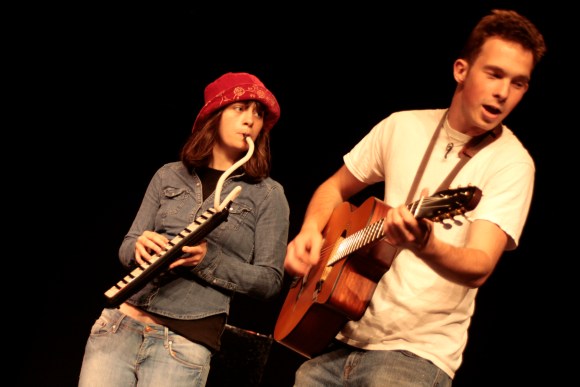
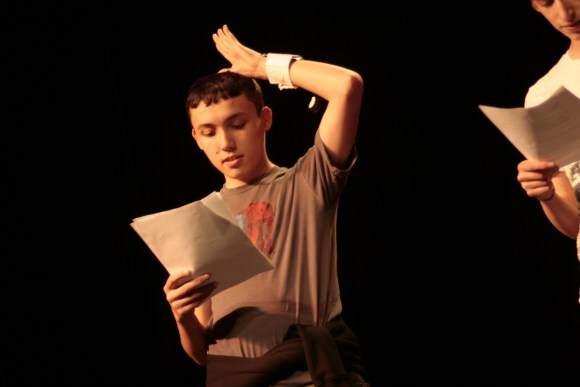
    Melodica-Alien and Jules Justus-Alien Hula/Macarena (?) girls Audience

  • For a week in September, Maia Ipp came into Creative Writing and taught a “Craft and Critique” class in order to prepare us (well, us being CDubs sans seniors, ’cause our three years of sweaty toil has earned us privileges, dammit) for a new department requirement— the literary critique (see Smolly’s Daily Report for reference).

    We began by defining the word “critique” and its connotations— for someone to be critical is usually negative, though to look at something with a critical eye is pragmatic and sort of good. Using these definitions as a springboard, we then worked to redefine “critique” and came up with a new operational definition: analysis of the text and its effects with the intention to either better it or to simply point out its success.

    (Yes, those are my words, and yes, they are carefully diplomatic, but that’s the jist of it, I think. Y’know, people always say to not shoot the messenger, but what if the messenger screws up?)

    (No I change my mind. Please don’t shoot this messenger.)

    We also discussed ekphrasis, which is sort of the evolved version of part two of the lit critiques, which are the creative responses. An ekphrastic piece of art is inspired by another piece of art in another medium— the example we looked at was a poem inspired by a painting. The poem stood on its own well enough, but with the painting there was a basis to work from, and there was suddenly a synesthetic duality to its evoked meaning.

    On Friday, September 20th, Maia’s  class ended on a high note. We visited the de Young museum and the Diebenkorn exhibit (which I will admit I did not see, sadly— it was just so… populated there) to create our own ekphrastic pieces of writing. And it’s kind of hilariously awesome, because Maia was so inspired by all the poems we turned in, that she took lines from all of them and created a group found poem, so it’s something like meta-ekphrasis.

    (Though if we really did the math, it’s 1.5 ekphrasis, because while not everything we wrote was poetry— mine certainly wasn’t— words to words still doesn’t count as an entire ekphrasis, I don’t think. Hence the point-five.)

    On top of that, Frances (’14) and Lizzie’s (’14) poems were chosen for special mention. Here they are below:

    After the de Young: a group found poem

    The poem that follows is composed of lines taken from the Fold-Up responses. Every Creative Writer is represented, and lines have been only minimally changed where necessary.

    Tell me about the life you’ve built
    the way it seems to fall apart
    in the drifting winds that run through empty houses.
    I, too, remained nameless that year.

    A stretched film over the skywater above us.
    It fractures though, by gravity or worse.
    How hard it is to keep it together:
    the water that was made in darkness.

    The sun is smooth and patient, a pulse of light wavering between leaves and branches.
    The ocean offers a flat relief.

    I would die in this place,
    my body slouched on a blue plastic chair, the door
    open for the world to see.

    Skin the taut surface of water—
    A round, flat eye.
    It is dangerous without being alive.

    Examine for bloodlessness the bold predawn birth.
    I had golden feathers,
    but now everything is moonlight
    undersea.
    Stung, bitter, by our blackened palms.

    I found you beached,
    your burnt snow gills gleaming.
    To do something with these arms—
    I nod quietly, stare into wind and snow, letting its sting replace the one I feel in my chest.
    I am not to be approached.

    The most refined woman is nothing but texture.
    You may be full to the core with honey and old water.
    So soon, we’ll both be useless things.

    Frances S, after Richard Diebenkorn, Untitled, 1955

    I, too, remained nameless that year—learned in the clench of summer the constituencies of self, somehow—
    One night she’d gone and I took three, four tries at a match, but too selfless to start supper I let them die out—
    What was moving that year, what was anything?
    I needed medicine and thought a spoon of vinegar, a slice of lemon looked all right.
    And I thought I’d go on a walk but of course I didn’t. She came home, I stayed seated, she let the water run in the kitchen sink, I thought about the lengths of water, for lengths, the anonymous water.

    Lizzie Kroner, response to The Wild Swan by Alexander Pope

    It is wild—it is like painted taxidermy. The swan hangs so majestic but still so pathetic in its demise, tied to a door. With its full, faded head it can only exist as a symbol now. It evokes meaning without having a meaning of its own. In its death, as in all deaths, it has lost life, but its corpse, bright and beautiful and sprawled, wings spread, emanates such vivacity you have to question whether it is really dead or not. Of course it is dead, its webbed feet are tied by a string to the hinge of a green door and its gold is only visible when it is directly under the light. But the stillness of its heartbeat means nothing. The painting doesn’t have a heartbeat either, neither do these words, but they mean something.

  • by Sophie (’17)

    IsaacCreative Writing is the last class of the day which means that by the time we get here many of us are exhausted and want nothing more than to sleep for a few hours. Sadly, that’s not possible because we still have an incredible amount of work to do for our upcoming show. Today we started things off with a pep talk slash lecture which seamlessly meshed reassurances about our capabilities as C-Dubs with the fact that we need to go deeper with our theme. It can’t just be the funny story of aliens on a cruise ship— it must be the meaningful funny story of aliens on a cruise ship. As Heather and Rachel said, the best humor is the kind that reflects the truth.

    After this Heather took it upon herself to energize and inspire us by jumping around and impersonating various animals on the carpet (see the sotacw Instagram) while challenging us not to laugh, which to her credit seemed to bring stress levels way down. We also fretted about what decorations are absolutely necessary for the show (not to give away too much, but, portholes).

    For the second half of CW we worked on tightening up our skits, which are admittedly all over the place in a fabulous sort of way. We developed characters, reviewed dialogue, and tried to bring a deeper meaning into the show. I don’t know about everyone else, but I think my group has definitely got the scriptwriting thing down to a science. Write something down, laugh about it for a while, then realize it’s the best we can come up with and move on.

    We wrapped up the day by celebrating Giorgia’s birthday (apparently I was too early with the cupcake/cronut thing yesterday) in a suitably CW-ish manner, involving the rapid consumption of chocolate cake and lemonade.

    In conclusion, if you aren’t already planning to attend this year’s Creative Writing show, I have one word for you. C’mon! CW ’13: Insane Alien Cruise Ship Skits With Deeper Universal Meaning is really not something you want to miss.

  • by Maya (’15)

    We spent Creative Writing today presenting rough drafts of scripts we had written in small groups for the show. This took, surprisingly, the entire period, but we gave each other helpful feedback and will continue to develop our scripts and ideas. We presented in the order that the “interludes” will appear in the show. This was helpful because it gave us a better idea (or, an idea in the first place) of the cohesiveness of our scripts, and showed us how we can create more of a through-line. Also, we got necessary feedback on the content of our scripts from Tony and the rest of the class.

    Another thing we did was start to cast the main characters in the “interludes,” which, without giving anything away, turned out to be exciting and efficient!

  • by Lizzie (’14)

    As this blog post is delayed and I have had the weekend (which seems like ages) to think (or rather not think) about class, much of my memory of Friday CW has been muddled by the utter blur of Saturday and Sunday. However, here are the details of class that have prevailed—It was a beautiful day, disproving Jenna Maroney’s (of 30 Rock) snarky remark on the Bay Area, “Have fun always carrying a light sweater,” for no outerwear was required. Now this point may seem irrelevant to CW but the presence of the sun completely alters the CW environment—everyone seems to have a sunnier disposition (pun intended). With that in mind, our class discussion on our soon-to-come show was light-hearted and (although correlation is not causation) thus more productive. Yet this was only the first half of class. For the second half, we went, as a class, to the Ruth Asawa memorial held in the Dan Kryston Memorial theater.

    It was a well-staged production that reflected and respected Ruth Asawa’s artistic vision. The memorial began with a Taiko performance and ended with a ballad sung by the entire vocal department. Not only did it honor the life of Ruth Asawa but it also boosted the morale of us SOTA students, combining our art forms in a moving and well-executed way.

  • by Justus (’15)

    After excessive quantities of democracy it seems a sort of constitutional monarchy has been established in Creative Writing: we have our no-longer-negotiable show idea, the still-currently-unnamed show involving aliens and cruise ships (possibly Starboard or Alienation Generation, among other suggestions). We are also not allowed to argue about what the skit– er… interludes’ themes will be anymore, by royal decree of our Monarchs Tony, Rachel, and Carol. Finally.

    So today it was time to create our skits interludes, and we split into groups to begin the plot outlining process. I myself was in the group dealing with the opening of the show, in which we attempted to introduce the characters of our alien protagonists, while still making them seem like aliens (“what they communicated via interpretive dance?” and “is crash-landing a UFO a totally normal thing in alien culture?” were just two of the important decisions our group needed to make). The other groups held meetings on how best to discuss the themes of [Redacted][No spoilers] through our unconventional plot thread.

    The democracy in Creative Writing has been overthrown. Let the group writing begin.

  • by Avi (’15)

    Democracy.  It isn’t what you participate in on the first Tuesday in November. Nor is it a system of government through elected officials (thank you Google).  It means to raise your hand and vote!

    Today in Creative Writing we closed our eyes, covered our heads, and raised our hands high to vote for the theme of the show we liked the best.

    And after the results were in, and ALL tallies were counted, we found our answer, our result, our president: The Yet to be Titled Show Involving Aliens and Cruise Ships!

    It took some discussion, it took some frustration, it took some back-tracking, but like a green alien, it finally came to us… in a UFO containing Jules’ brain (what a wonderful genius he is, what a shame he isn’t taking Calculus.)

    After voting on whether or not we should choose our script-writing groups, we divided ourselves and began the arduous process of writing our scripts— excuse me, interludes (as skits are FAR too elementary, get with the program.)

    For those of you non-Creative Writers reading the blog, you should be— need to be— worried, confused and most importantly, excited. Preferably feel all of these emotions at the same time.  Just know that the aliens of planted CDub are coming to a stage near you… if you live in San Francisco.  Sorry Grandma and Grandpa, you will need to fly out, no C-Dub wants to perform in fifteen feet of snow in suburban Minnesota.

  • by Emma E. (’17)

    One of the most exciting parts of planning anything is watching it begin to come to life. During Creative Writing today, we began discussing details of what we want our fall show to look like. Although we are still in preliminary (and top secret) planning stages, the show already feels real and immediate. To help us begin working on the show itself, we had two artists, Tony and Rachel, come in. One of the nice things about enlisting outside help is you get the benefit of their ideas and opinions. Having Tony and Rachel in helped us make our plans more detailed and organized. It’s crazy how much can happen in a class period; at the beginning of the day, we hadn’t even decided on a theme and now our show is already taking shape! One of my favorite parts of the day was when we each said one thing we could bring to the show that was specific to us; the list included knife throwing and onstage cooking, so it’ll definitely be exciting. Today was both productive and enjoyable and I can’t wait to keep planning our show and seeing the new directions it takes!