CREATIVE WRITING

at the Ruth Asawa School of the Arts in San Francisco

Welcome! CW develops the art and craft of creative writing through instruction, collaboration, and respect. This blog showcases STUDENT WRITING and how to APPLY to Creative Writing.

  • Lately, to start off class, the head of Creative Writing, Heather, has been having us write little notes to each other. Just something nice to a random person in the department, or a book recommendation, or a secret, or something like that. It’s a quiet sort of ritual. We tell each other brief little stories at the beginning of class every day. It’s become one of my favorite things to do, simply because I get a sweet little note from someone, and get to give a sweet little note to someone else. Before Thanksgiving, our prompt was to tell our person what we were thankful for. I got a note saying that my person was thankful for me.

    I’m only sharing this because I’ve had a terrible few days, and it’s a nugget of gold in this field of coal. I’m sharing this because I want everyone who reads this to know that if they want to be part of this community, we will welcome you, and we will find you a safe place. Even if it feels like everything is falling down around your ears, we will find you a safe place, a place where at least there is one thing that is positive. Yes, this is cheesy, yes, it might even be cliché, but it’s also important. If you feel down, someone will care. If you feel lonely, someone will help. If you need to talk, someone will listen. I can’t even begin to express how grateful I am for these small moments that I get every day that make things seem not quite so bad.

    Isi Vasquez, class of 2019

  • On the last day of Thanksgiving Break, I was lying on my couch, feeling miserable. I had a cup of steaming hot tea in my lap, three blankets piled on top of me, and my fever was still raging hard. It was about six in the evening, and I had just woken from a brief, disorienting nap when I had wandered into the living room, where my mom and grandma were sitting. They were watching TV and, despite my confusion about who I was or what day it was, I decided to join them.

    I could barely focus, but I managed to gather from the blur of shapes on the screen that we were watching a performance by Andrea Bocelli, the famous, blind singer. His eyelids were closed as he leaned into the microphone and sang “Maria” from West Side Story. His voice vibrated and filled the vast theater. And though I’ve never been a fan of musicals, and though I was shaking and near hallucination, I started to cry.

    What I realized then was something Heather had told me a long time ago, but I had failed to truly understand what she meant at the time. She said that the human voice was the most beautiful sound ever heard. And I agree. I can’t think of a single animal or force of nature that compares to a person’s voice. We hear it so often that we tend to forget. Just go into a public space, a park, a bus, and just listen to what’s around you. Voices are fascinating. They rise and fall and roll and strike. We have the power to take emotions and assign words and sounds to them. What’s amazing to me is that everyone has different tones and inflections but yet they all serve the same purpose: to articulate what is inside of us.

    Obviously, I’m aware that SOTA already has a Vocal Department, but the Spoken Arts branch of Creative Writing will be the first time students will be creating art with special attention to how it is going to sound when performed. And that’s so cool! I hope its freshman year next fall will go alright, because it really is an excellent idea.

    Amina Aineb, class of 2017

  • In Six Months Time by Abbegail Louie

    You attempt to delete every single post on your Facebook wall. You’ve not only shared embarrassing Wetpaint articles, but you also have written some horrible, blackmail-worthy statuses during your pre-fetus years. Resent your parents for not stopping your 5th and 7th grade self from posting unflattering selfies because those are the only pictures that you can’t delete. You’ve put them on private.

    After the evidence of your not so appealing childhood has been destroyed, create a new persona. Become said new persona. Write. Give up after two days because you hate not being yourself. Be you, but quieter. Give up because you get way too excited when someone mentions an anime you watch. Make yourself intimidating again. Write. Wear sweatpants. Go on a huge rant on why you don’t want a boyfriend. Ask a guy to make out with you. He says no, don’t believe him. Ignore him for three days. Make intense eye contact with him, count to 5, look away. Go up to him. Say “I hate you.” Expect him to say nothing, while also expecting him to pull you in for a kiss and say “where have you been all my life.” The latter is your hormones. He says nothing. He is nothing. Realize your life isn’t a Korean drama. Get angry. Write. Move on. Go on another rant about how you don’t need a boyfriend.

    You have schoolwork up to your neck. Watch an episode of Mad Men. Jon Hamm is the man of your dreams. Write. Realize that he is 44. Write. You’ve sworn off boys for awhile. Write.

    You’ve changed since the end of 8th grade. You want to write daily statuses and post pictures of your freshmen year. You activate your Facebook once again. You wish you saved a few weird statuses. All you have left are pictures of your 5th and 7th grade self.

    Abbegail Louie, class of 2019

  • Every Tuesday and Thursday for the most couple months has been shadow day at SOTA. This means that around 1 o’clock pm every department receives a handful of ‘shadows’. Shadows are 8th graders who are interested in the department and come to visit the school for a day. They sit in with us during the art block and ‘shadow’ a student, usually a 9th grader.

    Every Tuesday and Thursday that I am reminded that not to long ago I was a shadow, and a scared 8th grader who wanted to apply to the Creative Writing Department. Seeing the new group of people interested in CW it makes me reflect, and as the due date for the portfolios approach I can not help but remember my experience applying to this department. I often look back and try to remember my audition process, but all I can really recall feeling is nervous, and wondering if my writing was any good, and if it was even a good idea to apply in the first place. It is these doubts that we all feel that get us down and prevent us from doing things we want to do.

    For all those applying to the department the advice I give you is to not be doubtful of yourself and your writing. If things don’t work out the way you want them to it shouldn’t stop you from continuing your interests, especially if that interest is writing.

    Julieta Roll, class of 2019

  • As kids, we’re often advised to find ways to let out anger and sadness. Find a hobby, the adults say. Join a club, or a sport. Learn martial arts, or even just hit a pillow. Scream into that same pillow. Anything but hurt other people. Then later, we’re finally told what will happen if we don’t follow the rules the adults have set for us. If we hurt other people, they might hurt themselves—and we’ll get in trouble. And if we can’t find a different way to let out our anger, we might hurt ourselves.

    A lot of us learn this the hard way. I went through time outs and punishments because I got angry and hurt people, and sometimes I still hurt myself a bit. But recently, when I’ve gotten sad, angry, overwhelmed, or anything like that, my first thought is to take out some paper and write. Sometimes I’m not able to put my thoughts into words, but the act of writing and searching for the right way to say things soothes me. I go into the writing pressing hard enough on the paper to break my pencil, or barely brushing the surface, but finish skimming the lines like a normal person…or as much like a normal person as my chicken-scratch-writing self is.

    I put my whole self into writing, refusing to let my mind wander into whatever was making me upset. Writing about my feelings make them dull somewhat, and I can see how small my troubles are compared to those of people without food or education; it’s like I’m an outsider observing the silly problems of a teenager. I read through my work, editing it, and I can see what’s actually happening, and how I can fix it. My writing is a chance to step back and try to figure out what I need to know.

    So although I do, occasionally, need to scream into a pillow, writing protects me from breaking the rules that I find are still just as relevant now as they were when I was in preschool.

    Lena Hartsough, class of 2019

  • Last week in Creative Writing we started the process of making zines (replacements for our beloved but occasionally overambitious literary journal, Umlaut). We were broken up into groups of four and tasked with coming up with an original idea for a zine. I tried to look contemplative and scribbled a few notes on my paper, but my mind was elsewhere; On the huge stack of English work I had waiting for me at home, the fact that I was scheduled to babysit for the entire weekend, and a hundred other minor problems that somehow felt like the most reprehensible injustices the world had ever seen.

    Recently I have been complaining to anyone who’ll listen. I realize that this isn’t exactly an endearing characteristic, but I can’t shut it off. My relatively normal life has suddenly and inexplicably become a source of constant frustration. I’m out of it all the time and feel stuck on autopilot, as if my daily life is just a boring short film on a never-ending loop. Obviously this is a normal thing for a 16-year-old to be going through, and people tolerate it to a point, but after, say, a week, you’re expected to suck it up and feel better.

    What usually gets me out a funk like this is doing something productive or focused on self-improvement, like exercise. But this time around I haven’t been able to redirect my feelings into the sort of productive energy that might help solve my problems. Attempts to sweat them out always end in sore muscles and frustration, and trying to write about them yields at most a half-page of repetitive whining. And without an outlet, the negativity festers until I feel compelled to unload it on my friends again. It’s a vicious cycle.

    After brainstorming aimlessly for a while, one of our group members (I want to say it was me but I honestly can’t remember) came up with an ingenious idea: Complaints. Our zine will be a compilation of multimedia grievances from students all over the school. We’ll be accepting anything from angry anarcho-punk playlists to letters to the editor to straight up bellyaching. After all, doesn’t everyone need to vent about something?

    As a junior, I’m the head of my zine group, and I’ll be the first to admit that I have absolutely no idea what I’m doing- submission guidelines, deadlines and design ideas are all up in the air. God knows if our zine will come together or not. But I’m excited to get started; Whether it ends up being a hit or a miss, at least I’ll finally be channeling that negativity into something productive.

    Sophia Mazoschek, class of 2017

  • Chess and Such by Kayne Belul

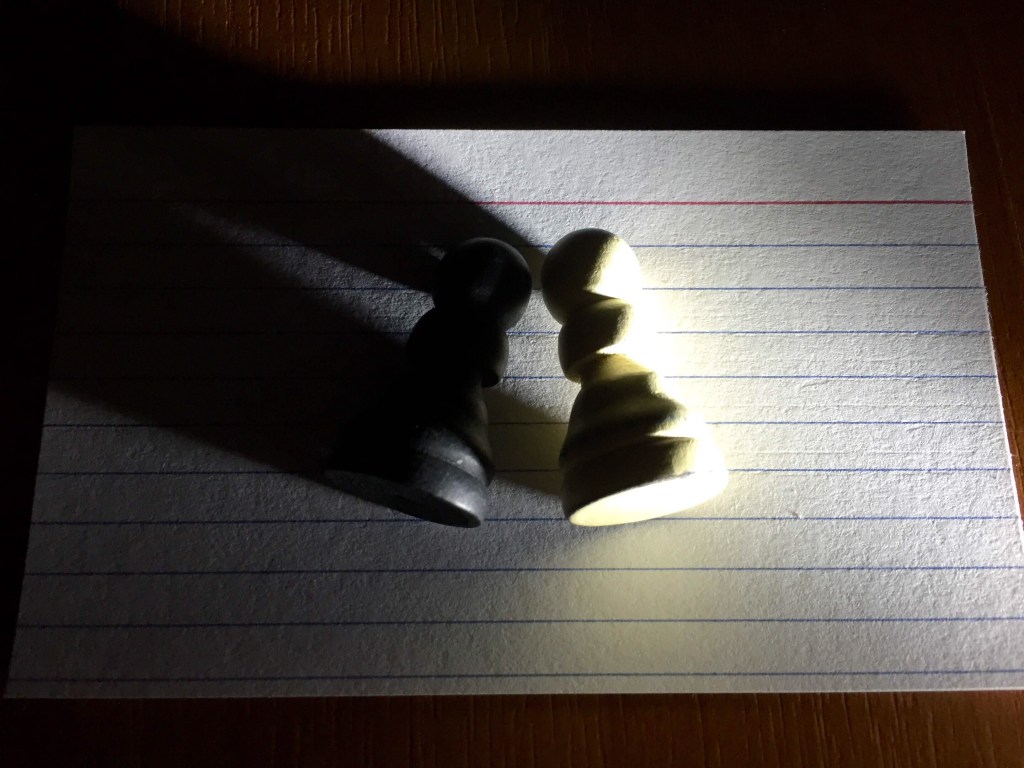
    Pawn to e4. There are other options for sure, but it’s always a safe bet. One move into the chess game and there are already eleven common enough ways for black to respond. If both players are skilled and want a safe game, the first half of their match becomes choreographed. Certain moves just work.

    A few weeks ago I attempted to have the protagonist of one of my stories play a game of chess with the omniscient narrator. I’ve since given up the idea. There are too many ways the story could play out. I can’t narrow the choices down.

    I: The protagonist is sitting alone, in a park, at a stone chess table. A piece moves.

    II: The protagonist only exists in the moments when his eyes are open. When his eyes are closed, he flickers out of existence and is replaced by the narrator, who wants to play chess in the intervals.

    III: The narrator is standing in a white cube, watching a projection of the protagonist on one wall. To make a move, the narrator simply alters every slide from the moment when a piece moves to infinity. If he only altered one slide, the piece would revert instantly.

    IV: The narrator thinks in the mind of a passerby, allowing him to play the protagonist in human form.

    V: The narrator believes the pieces move, and so they do. The protagonist is driven insane.

    VI: A homeless man acts as the king. The narrator half-heartedly attempts to kill him off while the protagonist tries to save him. Sort of like a word game.

    And so on. None of the options quite worked.

    Many people have made the case that pawn to d4 is the superior opening move. I don’t get it. I will eventually.

    Kayne Belul, class of 2018

  • As our final fiction project in creative writing two, we have been putting together small story collections. These collections are compromised of one nucleus story, the story that is at the core of all the other stories, and three orbital stories, shorter stories that engage in different kinds of dialogue with the nucleus story.

    ​As I started working on this collection, I realized I was actually writing two parallel collections, one about the stifling quiet of suburbia, and one about the isolated displacement of travel and being away. Because I could not stomach the idea of abandoning either of these trains of thought and exploration, I decided to combine the two collections into a larger series of two nucleus stories and six orbitals. Although this has added fairly significantly to my work load, I could not be more excited about continuing to work on this project.

    Not only am I working on my writing on the usual level of creating, I am also beginning to look at my writing through a larger lens that extends beyond the borders of any one story. Throughout my high school life, I have always had the sense that every piece of my writing has been steadily adding towards something bigger and greater than any of the individual pieces.

    Despite still being far from digging my fingernails into this something and holding onto it long enough to write it down, I can already feel how much closer this collection is bringing me. I have an individual voice and I am a writer, and this power extends beyond the last page of any single story.

    Emma Eisler, class of 2017

  • Sci-Fi Week by Killa Heredia Bratt

    In our seventh week of fiction, the amazing Terry Bisson has come to teach Creative Writing I a thing or two about science fiction.

    Science Fiction is fiction based on imagined future scientific or technological advances and major social or environmental changes, frequently portraying space or time travel and life on other planets. I was a little timid–it seemed like such a complex genre to step into. And who was I, someone who hardly ever reads or watches sci-fi, to write about it?

    Before this unit, I was not really introduced to this particular genre, save for the occasional post-­apocalyptic novel. And with the first assignment that Terry gave us, watching The Day the Earth Stood Still, (the original) it seemed I would be diving head first into it.

    The thing about that movie, is that amongst the spaceships and the robots and the aliens, the real meaning behind it is to be at peace. That war is a childish, immature thing. It is a thing of stupidity. And so even though with all the complex science, everything about it seemed to be straightforward and easy to understand.

    The real fun started when we all shared out our ideas to each other. There was a huge range between GMO freak accidents, (GMOcalypse!) and animal hybrids which drove some people to incest, and even selected memories being deleted from one’s mind to improve education. Everyone’s imagination just really came together to create these new worlds.

    And that’s when I realized there was absolutely no reason to be scared or apprehensive about writing sci-fi. It’s just a way to express your imagination, to deliver the message you want to get across just like you would any other story but with a twist. At least that’s what it is to me. I happen to love using my imagination. And with science fiction, you can do so much with it. So if you want to write stories about aliens or meteorites or even vampires whose to say you can’t?

    Killa Heredia Bratt, class of 2019

  • I started reading poetry again. Not that I really had stopped, but I hadn’t read any in maybe months. I’d been in a fiction unit in school, which meant reading it and writing strictly prose for class, and prose was all I was getting in my English class with The Great Gatsby and One Flew Over the Cuckoo’s Nest. Plus I’d been reading novels back to back; Hemmingway’s A Moveable Feast and A Farewell to Arms, and Faulkner’s The Wild Palms. The tangibility of the prosaic object assailed me on all sides. The poem was being subverted to the abstract slur which many of my peers maintain it is. It was too fanciful and too intellectual in turns.

    I was beginning to have doubts.

    Then my mother asked me to help her find a poem. I went to grab a book of poetry, and looking at the bookshelf, got distracted with the titles and authors that jumped out at me. I made a stack of books I’d read, and grabbed a few I hadn’t, looking for the poem. I brought a few books—Unattainable Earth by Czeslaw Milosz, The Simple Truth by Philip Levine, a book of Merwin, a book of Ferlinghetti, and a copy of The Bhagavad Gita—to bed, and then to school the next morning.. In a couple days I wrote a poem, unbidden.

    It hadn’t left.

    I am always scared poetry has left me. That I won’t like it anymore, that I won’t be able to write it, that no one but a poet would ever read it. It turns into a blank word document and retreats up in to the air.

    But only for a while.

    Isaac Schott-Rosenfield, class of 2017