

CREATIVE WRITING
at the Ruth Asawa School of the Arts in San Francisco
Welcome! CW develops the art and craft of creative writing through instruction, collaboration, and respect. This blog showcases STUDENT WRITING and how to APPLY to Creative Writing.
-
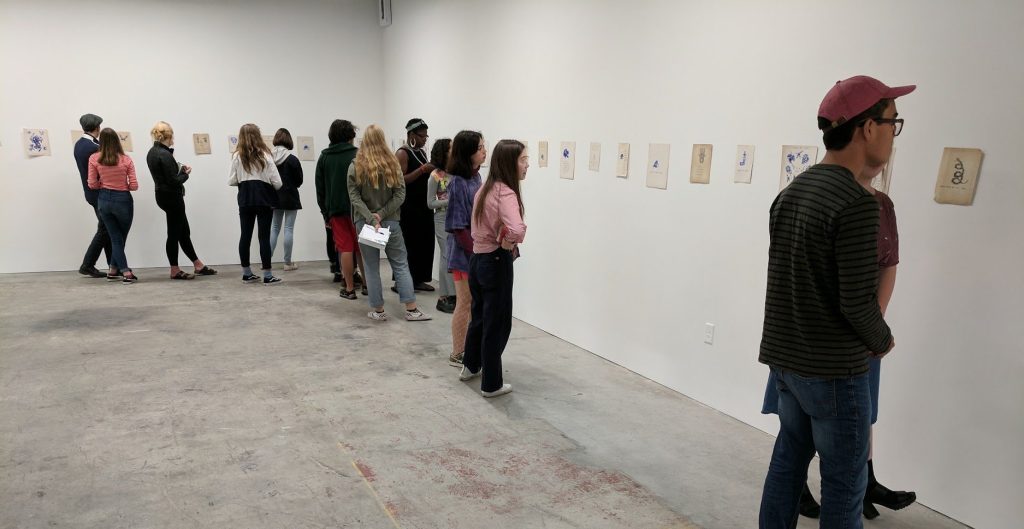
On August 29, all thirty members of the Creative Writing department took a long, hot bus ride out to the Minnesota Street Project art museum. Here, we saw the collaborations of Griffin McPartland and Paul Urich. Over a number of years, Urich sent McPartland his drawings, asking McPartland to write on them. At first he declined, not wanting to disrupt his friend’s art. However eventually McPartland decided to comply with the request, and together they created a number of pieces. These pencil or ballpoint pen sketches each had what McPartland calls a short story over them. These stores were very short, a fragment or sentence in length, and not visibly connected to the images. Most were funny, and many complex or puns with multiple meanings. This exhibit inspired our three-week independent buddy collaboration.
My writing buddy and I decided we would text each other photographs we took each day, and write a short response. I wrote mine in prose poetry, responding to the image but not necessarily addressing its content, while my writing buddy opted to pose questions in response to the photograph or write “stream of consciousness opinion pieces.” We traded nine images, ranging from humorous (I received a photograph of someone putting a trombone over another person’s head) to tranquil (a sunset over Twin Peaks). We kept our responses informal and did not share them with each other. Occasionally, we asked questions about the photos received, but most of the time just wrote pieces loosely based on the content shared and did not worry about what exactly the photo represented. For the conclusion of the project, we printed out all of the photographs and then inscribed our written responses over or next to them. We ended up with eighteen pieces, each from a different day and with different mood and presented them to the class by laying them out on tables and asking our classmates to walk around and look at them.
I very much enjoyed taking part in this collaboration. It was a pleasant exercise to every day be looking for something beautiful or interesting visually in my surroundings, however towards the end I did struggle to find something I deemed interesting enough to photograph (we’re creative writers, not photographers…). Some of the photos I received were easier to write from than others, but it was exciting to each day get a window into what another person found interesting.
Hannah W Duane, class of 2021
-
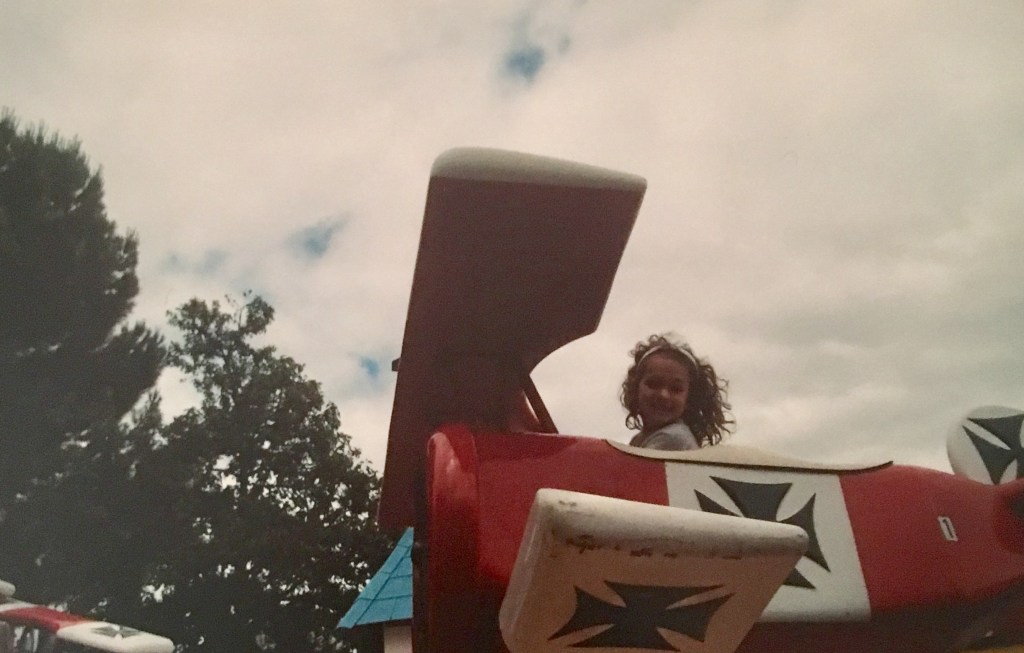
I can easily remember when I was the ages six, seven, eight, and nine. It is not an unimaginable time ago, yet it seems like I live in an entirely different world than the one I lived in barely a year ago. My memories of my own immaturity and early learning have not been neglected. I still appreciate the simplicity of the Junie B. Jones book series, playdates that my parents had to schedule, eating an ice cream with 65 grams of sugar without having checked the label, and along with the young minimalist lifestyle came an easy and dignifying human decency. When I was six, I never had to intently watch what I said and to an adult, nothing that came out of my mouth seemed offensive because I was a harmless, adorable youngster with quintessential big cheeks and frizzy curls. No longer are my cheeks rotund, but now have morphed inward to create an elongated facial structure. I have to precisely pick my words or face critical consequences if I don’t. Honest words are not seen as cute and entertaining if you’re not under ten; now, candor comments help to create an ill-mannered persona.
It sounds shortsighted, but I haven’t realized or really given myself the time to clearly acknowledge how much I have changed as an individual, until today. This consciousness changing insight came to me at the movie theater when I was left seated alongside two six to eight year old girls who giggled at the scene when the girl and boy kissed. I heard their squealing and whispers, then when I looked over I wanted to laugh at how they both tried so hard to cover one another’s eyes. That is when I was able to recall the emotions I once shared with those girls. I can understand what scared them so much about watching a kiss performed by two actors who get paid for it. I know that whenever I watched any romantic exchange at seven years old, I felt immediately guilty for having witnessed something so “dirty” and “adult”. So many things that made me excited or riled me up at that age don’t anymore, they just come across as insignificant. I miss the privilege of not overthinking simple interactions and ideas. I find it funny how things that are so present and important now, were not even relevant three years ago when I was giggling with my friend about make-out sessions and filming infomercials with our dogs.
My time and experiences are in high school now. A bedtime is nonexistent when loads of homework must get done. Your grades have much importance, more than in years prior. Still, I am enjoying my time here with its change of pace and I know it will go by fast. As someone that has so much more to be taught, I wonder if the seniors of Creative Writing look at those of us younger than them and miss these years or if they can see right through us because we are so predictable and egocentric. Thanks to being seated next to two past Lunas, I learned that I need to show compassion to small boys and girls because whether I can remember it or not, I once felt very miniscule next to all these big people.
Luna Alcorcha, class of 2021
-
High School is scary, everyone knows that. My experience was no exception.
It’s the 26th of August, and I’m about ready to wet myself. The school is huge, the hallways make no sense, and I think I spotted someone with tiger face-paint. Welcome to Sota. But the thing that scares me most is my department. Will they be nice? Will they think I suck? Will I somehow manage to trip in the doorway? Millions of questions and scenarios are running through my head, because I have no idea what to expect. I walk in, (managing not to trip) and all of my expectations are shattered.
The room is very grey, which surprised me because I thought it would be full of color. There are black tables arranged in a square surrounding the rug, and they are filled with smiling faces, the faces of the rest of my department. There is a door leading out to a balcony overlooking the field and the wall on my right is entirely covered by whiteboards. A clock that has all the numerals replaced by various birds chimes softly. I nervously sit down. This was the part of Creative Writing I was most curious about, the part where I figure out what we actually do. The only thing I’ve heard from other students is that they think we sit in a dark room all day, write sad, angsty poetry, and hiss at sunlight. So far everything else I had suspected about CW was wrong, so hoped this was too. Thankfully, it was. The windows were open, there was no hissing as far as I could tell, and our summer requirements didn’t specify any sad poetry. My nervousness was starting to wear off, and I’m glad it did, because that moment was the beginning to one of the best months I’ve ever had.
There were writing prompts, poetry assignments, and an endless amount of name games. The first week went by in a blur of excitement, revelations, and frequent field trips. The reality of SotA Creative Writing was better than any fantasy I could have dreamed up. The other freshman in my department are amazing friends, my older writing-buddy showed me the ropes of this school, and my writing has improved immensely in the past five weeks. I can tell that everyone in the department deserves and wants to be there, and that active atmosphere is what makes my creativity blossom. I am so lucky to be involved in such a forgiving and cultivating group of artists. We are a family. If you give the assignments your all and print on time, anything is possible.
High School isn’t that scary anymore.
Lauren Ainslie, class of 2021
-
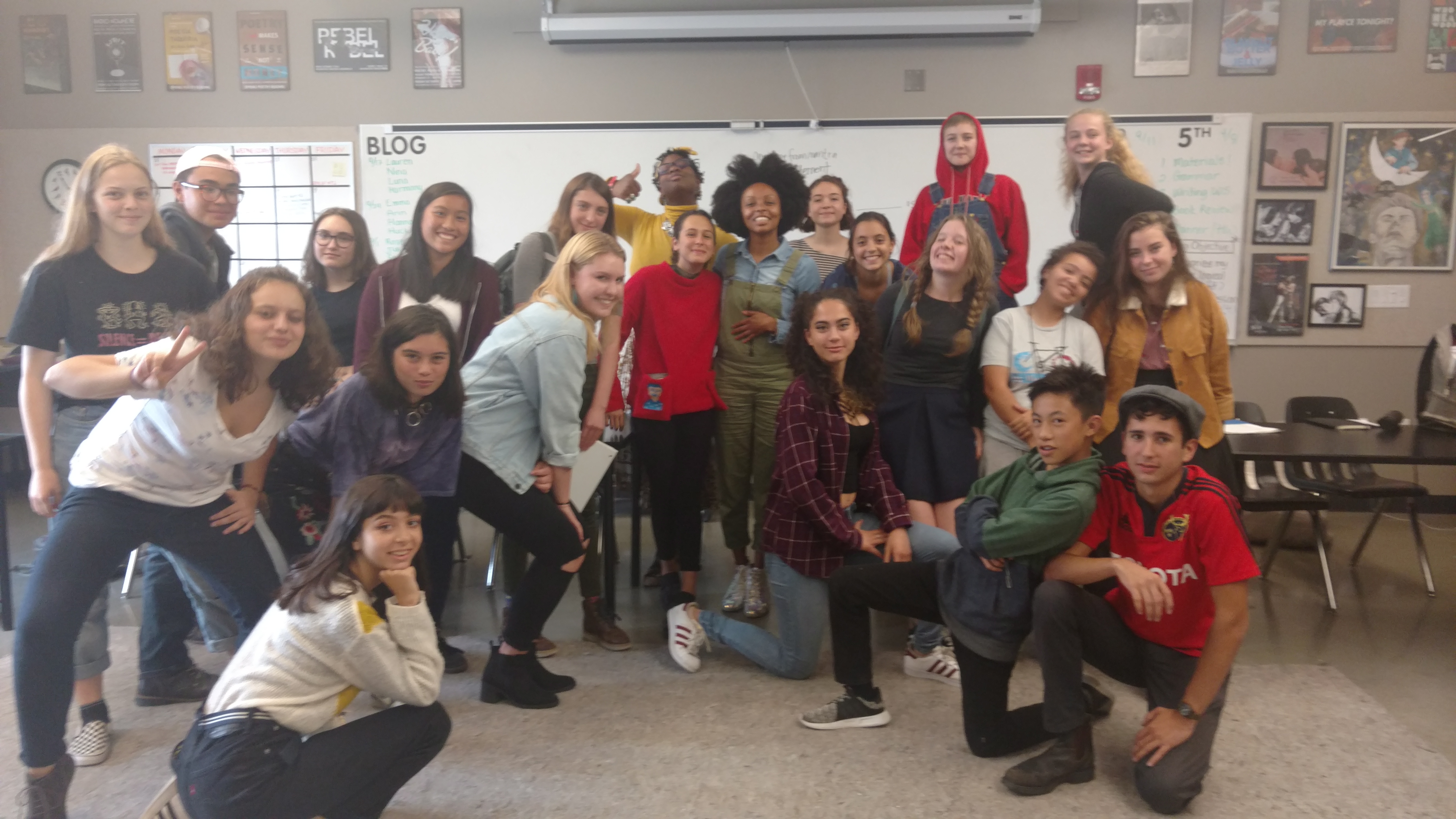
CW alum Tanea Lunsford (class of 2009) returned to SotA this week to teach a class on “Writing Magic” using examples and exercises from science fiction writer Octavia Butler!

-
Earlier this month the Sophomore CW class invited the Freshmen to an afternoon teach to welcome them to the department!

-
-
Nowadays when I sit down to write anything, I can only tell a true story and more specifically one that has happened to me. And it is this that I’ve learned most importantly this year, that, for me, the best way to write a good story is to experience it. For that reason I am excited that the whole of the Creative Writing department will be going to New Orleans, Louisiana next month. It is important that a writer draws inspiration from certain aspects of the world and has something good to say about it or else it’s useless and the best way to practice this is by going into a different city or place and writing from what you see and learn there.
We have been talking a lot in class about this as preparation for the trip and in designing our itinerary, which has academic agendas like learning more about the literary history of the city, but also has other more random seeming adventures like boating in a swamp. And when I’ve sat here and thought about it I do think the most creative work I’ll be able to produce will be from these random excursions. It is a writer’s job to transcribe the weirdness of the world and to put it in a little text which I do think is a very hard job but it is suddenly made much easier when you find yourself in a much newer place and somewhere as crazy and Hellish as a damp Louisiana swamp!
I think it is important that we take this trip to New Orleans not only to learn about writers who have worked there but also so we can write about the boozers and ghosts and the broad majestic Mississippi river that are found in that part of the country. It isn’t stressed enough I don’t think how important it is that a writer gets out of his or her house and takes a look at something and uses it to write about. I went to Spain this summer which I find to be a very crazy and weird place (as is New Orleans!) and have in response written about 80 percent of this year’s work about the hills and villages of that area.
I did not realize how important it was to travel as a writer until I decided that it was just about impossible for me to sit at my desk and write a story completely pulled from the banks of my mind, because there’s nothing about a clean classroom that inspires me in any way or triggers any sort of crazy story like a big wooden steamboat might. And so I do think it is important to spend time reading the classics and the great writers of the history of the world but I also think it is equally important to find something new to look at and to use the world’s funniness as an inspiration for your writing and so I am pleased to be boarding a little plane this March and going down to the dirtiest swamps and rivers of Louisiana!
Liam Miyar-Mullan, class of 2018
-
“Make America Great Again!TM” is an newer rendering of Ronald Reagan’s 1980 campaign slogan, “Let’s Make America Great Again,” and was Donald Trump’s successful campaign slogan in 2016. Trump patented the phrase, so it technically bears a trademark. It has appeared on campaign posters, shirts, buttons, and most notably the iconic red trucker cap. The phrase has been repurposed for the sake of parody and satire, such as on political commentator John Oliver’s television show (“Make Donald Drumpf Again”). Activist movements and individuals have coined the phrases “Make America Think Again,” “Make America Gay Again,” and “America Was Never Great.” Donald Trump created a distinguished popular culture phenomenon by using hubris, nostalgia, and populist diction to raise the collective spirit of millions.
First and foremost, Trump uses hubris to create an impression of American dominance the world economy and political scene. The definition of hubris is “excessive pride or self-confidence.” Trump’s slogan contrasts that of Former President Obama’s campaign slogans “Hope,” “Yes We Can,” and “Change We Can Believe In” as well as Former President George W. Bush’s “Yes, America Can,” and “Moving America Forward.” Trump’s slogan is distinctive in that it lacks the ideas of change and forward movement, concepts that are central to most normal campaigns. Rather than suggest positive, modernist change, Trump is suggesting that America’s greatness lies in what it used to be, and that is what made him such a distinctive candidate. This idea of America having been “great” in the past reflects a certain amount of hubris on Trump’s part. Trump has pride in what his country used to be. He holds confidence in the perfection of Reagan’s trickle-down America and also believes that he is the only candidate that can achieve that sort of utopia. All candidates, regardless of ideology, have to hold themselves in some sort of high esteem in order to consider themselves worthy of office. Most, however, try to communicate a certain amount of humility in order to identify with the general public. Barack Obama, for instance, in using the slogan “Change,” bluntly admitted that America was flawed and had room to grow in many areas. He suggested himself as the best candidate to achieve that sort of growth but never acted like America had ever been perfect. George W. Bush was less humble in his use of “Moving America Forward” but still acknowledged that America could improve in a few respects. Trump, on the other hand, uses hubris by blatantly not admitting America’s problems, both past and present, instead promising to return the country to its former utopian state. The phrase also demonstrates Trump’s idealist notion that America should be the utmost dominant world power and deserves to be the ultimate decider of geopolitics, trade deals, and social change (or lack thereof).
Another vital device that Trump utilizes is populist diction. Each word in the phrase “Make America Great Again” appeals to those who feel as though America used to be great, has somehow wronged them in its lack of “greatness,” and is the only country that can and deserves to be so. The word “make” communicates assertiveness and duty. The message of the phrase is not up for debate- “make” demonstrates that Trump’s supporters are ready to change their America by any means necessary. It is a call to action, an obvious assertion that something has to be done, and now. That call to action points towards the most obvious course of action, which is electing Trump. The next two words “Great Again” especially attract working class whites who believe that their “greatness” has been stolen by immigrants and refugees. The idea of America having to be “great” entices patriots who believe in “America first” values-people who don’t believe in a global, symbiotic economy, but rather in one that involves America mostly exporting and not importing, an economy in which America reaps most of the benefits.
Lastly, Donald Trump utilizes a tone of nostalgia. He has been cited to point to the “late ’40s and ’50s,” during which “we were not pushed around, we were respected by everybody, we had just won a war, we were pretty much doing what we had to do,” as America’s golden age. Trump, in saying “Make America Great Again!” is both admitting that America is currently in decline and proposing that he is the only candidate who can turn things around. Trump has raised controversy in believing that the ‘40s and ‘50s were a great time-while the economy was thriving, women and people of color were still being denied their basic human needs and rights as citizens. Trump champions the working white man. He plays on working class people’s ever-present insecurities and appeals to their sense of nostalgia. Most Trump supporters are working class whites who wonder why they work so hard and never achieve the American Dream promised to them. They wish to return to the Golden Age of their parents’ and grandparents’ lives, a time when the laboring white person was applauded for just being such; when people of color and working women hadn’t yet infiltrated their predetermined social strata. Trump plays on these insecurities, these “us versus them” ideals, by using the word “again” to connote an American golden age of white male supremacy.
Donald Trump used populist diction, a nostalgic tone, and aggressive hubris to create a popular culture phenomenon while simultaneously raising the collective spirit of millions. He uses diction and nostalgia to demonstrate that America must return to its former greatness, and that he is the only candidate who can achieve that. He also uses hubris to convince supporters that America is the only nation capable and worthy of becoming an almighty, reigning world power. His campaign threw out the rulebook of traditional politics and transformed the trade into a firebrand race to victory by way of “alternative facts;” ugly, uncivilized debate, and unfounded policymaking. Most impactful of all, perhaps, Donald Trump’s campaign successfully divided a country of 318.9 million people that had formerly prided itself on being “united.”
Stella Pfahler, class of 2019
-
I love procrastinating. I do it all the time. I bet that everyone does it, excluding those mutants who have the willpower to finish their project as soon as they get the assignment. Procrastination is the action of delaying or putting off with something. For example, waiting til the last day to start a five page story that you had two weeks to do.
The way I rationalize putting homework off is through deciding how easy/useless/tedious the homework is. If I think the homework is tedious and won’t help me in any sort of way, I procrastinate. If I think the homework is easy then I will either do it right away of it’s in front of me, or I’ll save it for later. For example, when I put off my spanish homework due the night before, I immediately start to think about when I would have the time to do it before I have that class. I start to think in my head things like: “Let’s see, I can do my homework at breakfast, no it’s too early for that. I can do it in Physics class because we’ll have a sub… Oh! I can do it at the break. Yeah, I’ll have twenty minutes to do it. Alright back to YouTube”
Procrastinating sprouts when people begin to rationalize the amount of time it takes to complete a certain task. And we normally think about the minimum amount of time it would take to accomplish this task. Knowing that the task we have to do takes a small amount of time, we end up choosing to do something we want to do, over what we have to do; thinking that we can do both.
Kenzo Fukuda, class of 2020


 CREATIVE WRITING