CREATIVE WRITING

at the Ruth Asawa School of the Arts in San Francisco

Welcome! CW develops the art and craft of creative writing through instruction, collaboration, and respect. This blog showcases STUDENT WRITING and how to APPLY to Creative Writing.

  • As May 1 draws closer, the imminent final thesis deadline for Creative Writing seniors is rapidly approaching. This final manuscript should be the culmination of everything we have created as part of this department and during our time at SOTA, a reflection of how we have matured as writers and as people. Though I have spent hours, weeks, months to ensure I am presenting my proudest work to the audience who will read it and to my future self when I look back on it, this is a lofty goal. In a perfect world, I would have had time to produce stories of all of my most blissful experiences, my most beautiful days, my most memorable memorable moments, and I would have had months to spend on each to do them justice. This is not my reality. In my reality, I am spread thin across the pages of my thesis. I exist in each of my stories, I am imbued with life within them, but the passion I have for the subjects I write upon is not bursting from the pages as it should be. I am subdued in some verses where my voice should startle. However, there are still some pieces where I come through strongly, where my words ripple through the pages. Below is one such piece, one that I am proud inhabits my final thesis, passionate, pulsing with energy.


    The Burning Barn

    She’s licking the oak body like I used to lick crimson lollipops on sugar-saturated summer afternoons, tongue writhing over its burnt candied paint that peels and falls like dead skin. I can’t remember how the earth looked when it wasn’t smoking like the end of a hand-rolled cigarette, caught between those flushed cherry lips. The wind smells of tree sap and charcoal. Ash settles with my tongue deep in my throat, but she’s kissing my skin with such a delicate warmth… All the glass windows seem to have shattered. They rest on the charred grass where she concludes her devourment, reflecting the cool blue sky in a way that is almost comically naive.

    How did we get here? We can wonder. I thought I killed her when I left her on dirt, rubbed raw and cold with the sole of my shoe. She caught that sweltering spark of life again, probably somewhere in the wind, and it carried her back to me. I was always told about the revenge of women, how their wrath could blaze you blistering even in the dead of winter, how they would raze a whole village in their rage. I can feel that now as she holds the old oak structure between her yellowed teeth, when she bites down, and with a scream, it falls.


    Anna Geiger, class of 2018

  • In contemporary poetry, roman numerals are a common method of adding underdeveloped depth. The employment of these little symbols can be meant mirror the progression of time, or allude to a partial narrative, but most often they are merely thrown around carelessly. For the senior thesis, I worked around this literary strategy, for the reasons listed previously, and also according to my own personal preference. (Although I refrain from using numerology liberally, I’m not completely against sparing utilization of the device, in the case of an index or perhaps the occasional piece of poetry).

    I believe the most likely culprit of this device is trying to portray a series – so I will express the disadvantages of this technique. My thesis consists of several series, with continuing characters and themes, and thus the pieces blend together without strict instruction. I find that, if I were to use numerology in this context, the six or so pieces would feel redundant and elongated like that of an ancient epic poem. In almost every circumstance, roman numerals weaken the content of each stanza.

    In fiction, an alternative is the usage of various short titles which divide the sections of narrative. “When They Came To Us” by Debbie Urbanski is an example of this strategy. Urbanski’s short story, which is a piece of speculative fiction, avoids constructing unnecessary vagueness by introducing brief section titles. The vignettes are thus braided together… with a brief and nonrestrictive indication of time progression.

    Rose Palma, class of 2018

  • I had never written a full length play before starting the playwriting unit. At first it was short plays that had a theme, chosen by our Artist in Residence, Nicole Jost. Then we had to write our final play that would be looked at and possibly chosen to be put in the playwriting show. I had to write a play for which I had to consider an audience. As well as what would be realistic for an actual production. I’d never done that before.

    The process of writing a play was both stimulating and agonizing. It was hard trying to start because I didn’t have an idea that I was incredibly passionate about or excited to do. So, Heather Woodward (the department head) sat me down and helped me sort through my brain and pick it for ideas. We started with memories I thought of as interesting or fun to tell. From there I found tons of ideas and things that could be cool to write a play on. So, I started with just simple dialogue between my characters and from there decided how I was going to write it out. It started to become easier and easier, and before I knew it, I had my ten page first draft.

    After the plays that were chosen to be in the show were chosen, the casting time came. We had to figure out who would play who. The process didn’t take long and was over in a day or so. I was chosen to play the character Patrick in Max Chu’s play. I hadn’t had to experience or remembering lines, and then having to act them out. Remembering my poem for the creative writing performance was a much different thing than having to also remember things like cue lines. I didn’t want to bother any upperclassmen with my questions on how to remember lines and cue lines, so I simply went with my instincts. I started by repeating a line until I remembered it, then I would move on to remembering the second line. But I would repeat the line before the one I was learning, so there was an order to them. With that, I quickly remembered all my lines, but then came how I was going to know when to say my lines. So I gathered willing friends and family, and had them read the lines before mine. Before the process, I hadn’t realized that I was actually quite good at remembering lines.

    The playwriting unit taught me an array of different tools, such as how to construct a well written play, how to act, how to remember lines, and how to act.

    Emma Cooney, class of 2021

  • Playwriting is hard. As a perfectionist, I found it near impossible. The third large unit of CW’s academic year is playwriting, when the department comes back together (we split into CW 1 and 2 for fiction and poetry) to write plays and put on our second and final show of the year (S’il Vous Play happening April 13 at 7:30, you should come). I had never written a play before. I had read very few, most in anticipation of this part of the year. On the first day of playwriting, we shard hopes, fears and the upperclassmen gave the freshman advice. Almost all of them reminded us sleep was important. This I perhaps should have taken as a sign.

    For our big project of the unit, every member of Creative Writing composes a ten-minute play. I, however, wrote three. The first was contentless. The characters didn’t have names, there wasn’t a setting, there wasn’t a plot, or a title, or a purpose or anything being communicated. I turned it in for working shopping, and most of the feedback was something needs to happen. It was Waiting for Godot without an ounce of Samuel Beckett’s genius. I had my science teacher read it (she’s also a playwright) and she told me to delete all but half of a page out of the ten I had written. I decided I might have to start over.

    Having ideas is hard. I always loved writing, however before SOTA, I wrote when I had an idea, when I wanted to. Having ideas was never something with a deadline attached to it, and though it is clearly imperative to have a functioning creative writing department, sometimes pressure, for me, can get in the way of allowing my brain to come up with something. I was stuck. I spent the better part of a week of classes scribbling in a notebook, trying to come up with a plot.

    Finally, I had a halfway viable idea. But I was also getting on a plane to France in 48 hours. I frantically got my friends to promise me to read drafts for me, and pounded out one of the most atrocious pieces of writing ever to ooze from my brain to the page. On the plane, I attempted to edit, but soon, exhaustion and distraction and the anxiety of being alone heading to a foreign country where I do not speak the language took over, and I gave up.

    I was on a climbing trip, and every day came home physically exhausted from scaling boulders, and mentally exhausted from dealing with toddlers. It was an interesting state to try to write in. I snapped at people who asked my how my play was going. I also wanted to talk about it all the time to figure out what on earth I was writing. When I finally created a draft I could show my closest of friends without being absolutely mortified, I immediately did so.

    They told me to rid myself of one of the two characters. Basically, write a new play. I had two days until the due date. The first night I organized, as this unit clearly laid out for me, playwriting is more technically complicated than poetry or fiction. It doesn’t work (generally) to just start writing without an idea of plot, that’s how one ends up with a contentless scene (see my draft #1). The second night I spent in the home of an elderly Parisian family friend. I was able to disappear for a few hours, edit, freak all the way out, be calmed down by the same friend that I’m choosing to wrongly blame for causing the stress, and then reappear for a European-timed dinner. They wanted to know how the play was going. I said great. Then I went back into my room, sighed, and turned it in.

    It might have been an awful play, but one of the things I love most about Creative Writing is it doesn’t matter if it’s your favorite kind of writing, you still do it. That’s how one learns. Playwriting is probably never going to be my favorite thing, or the thing that comes most naturally to me, but in six weeks struggling with it has taught me about dialogue, plot and character far more efficiently than fiction, which was a more comfortable experience. And I lived, I’m excited to write a play next year and fully intend to spend an entire year thinking of an actual idea.

    Hannah W Duane, class of 2021

  • On Bicycle Thieves by Kenzo Fukuda

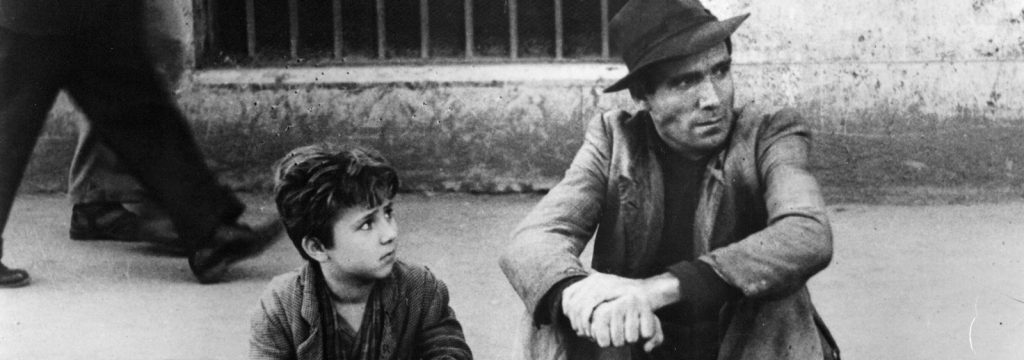
    We recently watched Vittorio De Sica’s Bicycle Thieves in Cine CLub with San Francisco Art & Film for Teenagers. The film follows Antonio Ricci, a poor father who is desperate to find his stolen bike because otherwise he would not be able to keep his job. The film displays the economic crisis of post-World War II Italy, specifically in Rome, through the eyes of Ricci and also his son Bruno Ricci. This leads to a juxtaposition in the view of their situation, between a father trying to provide for his family and a young boy who is forced to mature due to the circumstances.

    At the start of the film, Antonio Ricci is portrayed as prideful, and a man of dignity. This is evident in the scene where he and his wife, Maria Ricci are in a fortune teller’s apartment and Antonio declares that he does not believe there is higher power, especially a sketchy fortune teller. But after his bike is stolen, he slowly begins to lose his pride and dignity because of what that would mean for his family and himself. It would mean failure to his wife, after his she sold their bed sheets to re-buy the bike, and action that showed faith to him. But because of the circumstances and the lack of opportunity, Antonio is forced to betray his own values in gestures of a worrying desperation. This is shown, through the fortune teller again, when Antonio and his son Bruno visit the her after a long afternoon of searching for the bike thief. The fortune teller tells them, “Either, you’ll find it now or you never will,” Antonio acts on these words and becoming a hypocrite to his own claim.

    Bruno, on the other hand, is portrayed at the beginning of the film as innocent and oblivious. For example, when Bruno is cleaning the bike, he notices a dent and tells his father. Antonio brushes away his comment saying it will have to make due. Bruno responds by exclaiming that he would have told the man at the pawn shop so he could have it fixed. But what Bruno does not realize is that Antonio does not have time to have the bike fixed, it could cost him his job, and especially if the damage is something that can be managed without the cost of money and time. Later in the film, Bruno’s innocence and obliviousness slowly begin to deteriorate. He begins to realize this in the scene where Antonio takes him to an expensive restaurant out of guilt for hitting him earlier. The table next to them had a wealth family and a boy who was also Bruno’s age. The wealthy boy looks down on the way Bruno is dressed, the way he eats his food, and the way he acts. Bruno begins to realize that his family is not high in social standing. He begins to realize why his father is so desperate to recover the bike and they should not be at this fancy restaurant because the cost of the meal is detrimental to their situation. When Bruno realizes this, he stops eating, only for his father to insist that he finish his food. This is also where Bruno realizes his father is being a bit irresponsible, further shifting their dynamic.

    The penultimate sequence that changes the father-son dynamic between the Antonio and Bruno is when Antonio steals someone’s bike out of desperation in front of his son Bruno. Several men catch him before he can get away and they sorely let him go because they did not want to arrest him in front of Bruno. The movie ends with Antonio holding Bruno’s hand for support; Bruno being forced to console his father, something that normally occurs the other way around. This final scene shows Antonio reduced to someone low enough to steal a bike, even though he was out of options. Had he not stolen the bike, he would have held pride and dignity but jobless. But if he successfully stole the bike, he would have job and could maybe scrape together some of his pride later. He was willing to sacrifice his own state of being to feed his family. In a time of survival, Antonio chose the short-term over long-term. Bruno’s innocence was lost in this entire ordeal. Witnessing his father become a thief right in front of him shattered any sense of good and bad morality that is easy to believe as a child. By the end of the film, Bruno is no longer a child because he is forced to carry this burden that his father failed to do.

    Kenzo Fukuda, class of 2020

  • Lucia Berlin: A Word for Word Production at Z Space by Eva Whitney

    Recently, The Creative Writing Department gathered at Z Space on the edge of the Mission to watch a Word for Word Performance of Lucia Berlin’s best short stories. We crammed ourselves in the small theater, eagerly watching the stories be presented as plays. It was a new experience for most of us to watch a story be performed theatrically, and to be performed word-for-word. This is the reading reflection I wrote in response to the performance:

    On Thursday, the eighth of March, the Creative Writing Department attended a Word for Word production at Z Space. Word for Word is a performing arts company whose mission is to tell stories theatrically. The event consisted of five stories from Lucia Berlin’s A Manual For Cleaning Women, a collection of her best works. Nestled in the outer edge of San Francisco, Z Space theater proved to be an excellent location for a theatre production as its small size allowed for an intimate relationship between the audience and the performers. The performance was unlike any other reading I have ever attended as it was both a new take on theatre and in reading stories.

    A Manual For Cleaning Women, published in 2015, eleven years after Berlin’s death, compiles the best of her work. The collection has gained massive popularity in the years after its publishing, something unfamiliar to Berlin during her lifetime. The stories in A Manual for Cleaning Women are all connected by the person who tells them and who has experienced them. Nearly all the stories are told in the first person, but, when third-person protagonists appear, they are a version of the first-­person narrator. What each story shares is their theme of extreme suffering. In “Here it is Saturday,” Lucia’s character visits her student in his prison cell, describing the cell with its “‘window broken, rain coming through. [It] stinks. The cells are so small and dark.’” In each story, the characters individually suffered, be it from imprisonment in a cell, imprisonment in alcoholism, or imprisonment in their life.

    The Word for Word production was an entirely unique experience to me. The ensemble performed the stories word for word, hence their title. From reading the actual texts, it was apparent that they did not skip a single word. Characters would often refer to themselves in the third person, state the actions that they did, and, sometimes, a whole group of actors would say something simultaneously. While I appreciated how avant-garde the performance was, I found the odd way of speaking actually took away from the theatricality of the pieces. I was constantly being drawn out of the plot itself, hearing the men say “the men all laughed” as they laughed. Perhaps it is because I am used to seeing theatre productions where characters do instead of say, but the idea of performing the story word-for-word did not add anything to the actual production for me. It felt as if someone was reading the story to me as I watched a silent play, explaining every action. Though I did not particularly enjoy the formatting of the Word for Word reading, it introduced me to the many ways stories can be read and performed.

    An aspect of the Word for Word performance that I enjoyed was the minimal use of props. A few boxes were used, laid out to make a bed, stacked to create a table, or set out individually to make seats. There were simple costumes and projections on the back of the stage that signaled where the setting was. I do enjoy elaborate sets, but I found it interesting to see how the group was able to create such a sense of place with so few materials. This proved to me how plays can be produced with a low budget and still be as vivid as intended to be.

    As I watched the Word for Word production of five of Lucia Berlin’s stories, I felt my knowledge of readings grow. Never have I attended a theatrical reading of work before, and certainly not a play-like production that is done word-for-word. Though my immediate reaction was one of dissatisfaction, afterward, I recognized my feelings toward the production came only from a place of uncertainty from seeing something unlike anything I’ve ever seen before. While I may not use the word-for-word element in my own theatrical productions, I could appreciate the new take on readings and how it opened my eyes to genre-blending between prose and plays, a realm unexplored by me.

    Eva Whitney, class of 2020

  • Recently, Eva Whitney and I were invited to teach a lesson at 826 Valencia in the San Francisco Mission district. The building is well-known as a pirate-themed gift shop, but that is only a front: tucked away in the back room is a student outreach and tutoring program. The goal was to pack the young attendees full of poetry over a two-day period, and therefore make poetry more accessible and less daunting. We began a feverish hunt online, looking for poems that would clearly demonstrate one of six crucial literary devices: metaphor, simile, personification, form, repetition, alliteration, and rhyme. The irresistible allure of our lesson lay in the theme of San Francisco, which tied all the poems together. We hoped this would help the students identify with the content of the pieces, which we then hoped would lead to interest in the devices used therein.

    As we crawled through countless poetry websites like starving men across a desert, it became apparent that very few poets write a poem with a literary device as their inspiration, as we planned to have the students do. When we got to the lesson with our jumbled bag of poems in hand, shifting from one foot to the other, it was easy to believe nothing we said would make any sense at all. In Creative Writing, much of the learning we do is analytical, zooming in on each word. I wondered: would any of my yammering make sense to people who are not exposed to this three hours a day and five days a week?

    Whether or not the students will take the literary devices we introduced to their graves, I believe we reached our objective: everyone wrote an interesting poem or prompt. It was captivating to hear writing that was pristine, that just spilled out of the tops of the students’ heads, written very quickly and with little warning. The students were not huge talkers, but I found that I could learn more about each person through the prompts that we forced them to share. Even if the technicalities of poetry did not impress the students, I think that writing it left them with confidence about poetry, and maybe they’ll even come knocking at the door of Creative Writing during high-school application time.

    Rae Kim, class of 2020

  • On February 28th, 2018, I attended the EPA hearing at the Main Public Library alongside my fellow Environmental Club.  The hearing was organized so that EPA representatives could hear the word of the people of the Bay Area, in reference to the recent announcement that the Clean Power Plan would be repealed. The people of the Bay Area who were dissatisfied with this ruling came to make their voices heard, including the students of SOTA. Below is the speech I delivered at the hearing from students at SOTA. The activists at this school inspire me.

    ___________________________________________________________________________

    Hello, My name is Max Chu, and I am a 16 year old student. Today, I am here to bring to your attention one very specific idea that I find important and want to share with you, and that is a seed vault. A seed vault is a place where lots and lots of different types of seeds are kept, and in the event that some one of the species kept in the vault goes extinct, scientists can go into the seed vault, replant that plant, and the species is saved. These vaults actually exist, and the one that is most popular and the one I would like to bring to your attention is the seed vault in the archipelago of Norway called Svalbard. The vault is nicknamed the “Doomsday Vault” due to the fact that if the world were to ever need the vault, we would be in or past the point of “Doomsday” and would need the seeds in the vault to reestablish society. This vault is encased in 120 meters of sandstone and chilled in permafrost. What I would like to tell you is that the permafrost is melting. This idea of frost that would never melt, hence the suffix perma-, is melting. The vault is about 800 miles from the north pole but the north pole was 60-70 degrees warmer than normal this last winter, and so the permafrost is melting around the vault, the seeds are at risk, and so when “Doomsday” comes, we’ll have no contingency plan. What I ask of you, EPA representatives, is that in light of this hope of the vault under threat of being extinguished, I ask that you give us some semblance of hope that we are trying to stop this. That we are working against the “Doomsday” and not with. Thank you.

    Max Chu, class of 2020

  • The morning of my first in a series of near-chronic migraines, someone had taken to an add for discounted Clipper Cards outside the Rockridge BART Station with a sharpie. Black marker blurred over the black type on bold yellow paper with a question, simple in its phrasing but complex in its meaning: WHAT DO YOU WANT? It was underlined twice, the lines crossing sloppily towards the end. You could tell it was written in a hurry. Beyond the throbbing in my temples and the twisting of my empty stomach, I thought of what it was that I truly wanted. I was to take the SAT in a month– a clinical symptom of my college diagnosis– and I had already visited two college campuses, so it isn’t as if my future has not been called into question. It’s all been more about expectation than want, however. Necessity.

    I cannot picture a life in college, or how I would be making a living after, but it is without a doubt the path that my life is going to go down. I have modest expectations. But since the discovery of this rushed my transit existentialism, I have begun scribbling my desires down where I can: candle wrappers, cafe receipts, lipstick price tags, the corners of my library copy of In Cold Blood, teal-stained post it notes. Here is a list of what I have comprised so far, but in this process I have discovered is that what I want most of all is to grow up satisfied with what I have. 

    WHAT DO YOU WANT?

    • I want small and tiled kitchens and the ability to sustain plants.

    • I want coffee boiling on my stove and fresh nectarines on my table.

    • I want the sun on my collarbones and I want the wind in my hair.

    • I want the orcas outside my window and the museums preserved.

    • I want the Venus di Milo to never go out of style

    • I want my grandchildren to know the ocean as I have.

    • I want mud in my boots.

    • I want to have enough regrets to not wreck me.

    • I want gilded frames and Milan and neon lights and Tokyo.

    • I want my mother to stop worrying and I want my brother to be happy.

    • I want malt milkshakes and French cinema, rainwater and tapioca.

    • I want a thousand lives, each one with more time than the last.

    • I want more than I deserve.

    Charlotte Pocock, class of 2019

  • We are one week into our playwriting unit. The unit is taught by Nicole Jost and, unlike the fiction and poetry units, it includes both Creative Writing I (freshmen and sophomores) and Creative Writing II (juniors and seniors). So far, we have had in-class activities and discussions, read various plays, and written scenes for our own plays based on prompts Nicole has assigned. Each class is usually focused on a particular aspect of playwriting such as monologues and status between characters. Our assigned homework and reading is based on what we explored in class. For example, before discussing the idea of “character status,” we read “Left to Right” by Steven Dietz, a short play with complexly interconnected characters who have distinct status among each other. For the homework assignment, we were told to write a scene involving two characters in which one character has a higher status, but by the end of the scene, the other character manages to achieve the higher status.

    This prompt caused me to reflect on how status plays into various relationships and how I might portray that in my writing. I struggled for a while in front of an empty screen, trying to come up with a status-based relationship that would have natural dialogue between the characters, but wouldn’t be too typical and boring. Over dinner, I discussed the assignment with my mom. She offered a few ideas, but I wasn’t drawn to any of them, and our discussion escalated into an argument. Finally, my dad suggested that I write about the conversation my mom and I were having right then about the prompt. I realized that was perfect. Our disagreement had a definite element of status with my mom having the higher status. And as I rejected each of my mom’s ideas, it could have been in an attempt to gain a higher status for myself. After dinner, I returned to my computer and recaptured the banter between my mom and me:

    SANDSTORM
    By Nadja Goldberg

    CHARACTERS
    ELLA, freshman in highschool.
    BETH, Ella’s mother.


    SCENE 1

    ELLA and BETH sit at a small, round dinner table with emptied plates of lasagna.

    ELLA (frustrated)
    I still don’t have an idea.

    BETH (also frustrated)
    Just write whatever comes to mind. You just need to get this done.

    ELLA
    Write whatever comes to mind?! Nothing’s coming to mind!

    BETH
    Didn’t we just come up with an idea? You can write the play about a student asking a teacher questions about the class material, and after the teacher explains, the student says something about the topic that reveals they actually know more about it than we think.

    ELLA (in a sarcastic imitation)
     That would just be like: I don’t get it.” “Well here’s what it is.” “Oh, actually I get it more than you do. Boo-yah!”

    BETH
    Well I’m sure you can make it more interesting than that.

    ELLA
    Exactly!

    BETH
    Ella, the focus is not on writing a masterpiece. It’s just on completing the assignment so you can get to bed.

    ELLA
    But I can’t write something I’m not invested in.

    BETH
    Sometimes you have to. That’s just how it is with school work.

    ELLA
    I have to write three to five pages! And there’s no possible way if I go with that topic.

    BETH
    Just write two and a half and get it over with.

    ELLA
    Two and a half pages is not acceptable for an assignment that requires at least three! And I’m not going to dive into writing a play with a plot I’m not engaged in, because it will be boring and tedious and that’s no way to write!

    BETH
    Fine, fine… How about the one with the car salesman who is trying to sell a fancy car to a man, and the man, in order to get a good deal, tries to hide how much he loves the car.

    ELLA
    Eh. I know just about nothing when it comes to cars. And I don’t think I have time to do enough research to convince my teacher otherwise.

    BETH
    Look. I know both options don’t seem so fantastic, but you just have to pick the one that speaks to you more and get on with it.

    ELLA
    Pick one of those?! That’s like choosing between eating a rotten tomato or a rotten avocado. Both will be equally mushy and disgusting, but “just go with one that might be a little less so.”

    BETH
    Ella, I’m just trying to help, okay? You have an assignment that you have to submit tonight at midnight and you just need to get it done. The more you worry about it, the less time you have to work on it, and the more frantic you’ll be later on.

    ELLA groans.

    ELLA
    I’m sick of homework.

    BETH
    I know, but you still have to do it.

    ELLA
    I know that. I just wish it would come less frequently and in more manageable quantities. It’s crazy: I’m expected to spend more than seven hours at school and on top of that, do bucket loads of homework. And I have a segment of a play due in three hours and the only two ideas I have are duds!

    BETH
    I hear you Ella. And I know it’s hard. But I think what you need right now is a positive outlook.

    ELLA
    Well I think what I need right now is an idea for my play.

    BETH
    And that’s not going to come if you continue to grumble about it. That’s just the truth.

    ELLA (upset)
    I’m sick of homework.

    BETH
    Ella, that’s beside the point. You have homework to do, and you need to do it. We can talk about your feelings later.

    ELLA
    Well I can’t write a play without an idea for a play. It’s simple.

    BETH
    Well obviously, I’m not helping. So you need to just come up with an idea. It doesn’t have to be brilliant. Just an idea to get started on a rough draft.

    ELLA
    My mind is blank! It’s like an endless desert full of blazing frustrations, and the only ideas are sparse, patchy clouds that drift by.

    BETH
    What the hell do you mean, “you don’t have any ideas?” Likening your mind to a desert— that’s incredible!

    ELLA
    I mean… I guess.

    Lights fade.

    End scene.