
Below you’ll find informal musings by the C-Dubs on such topics as advice for new 9th graders, chapbook-making, what we’re up to in class, field day, dreams, reading, and of course, writing.
Read student work from our most recent show: Rebel Rebel Fall 2014
I am graduating from high school in less than a week so I think I’ve accumulated a bit of wisdom about how to go about dealing with school from the approximate ages of 14 to 18. Now it may not be much, however, it’s all still fresh in my mind, and thus it might be slightly relevant. So here is a list of things that I advice highschoolers to do (keep in mind that I have not done all of these things but I wish I had):
- Do your homework. It’s so much easier than rushing to make it up at the end of the semester
- Show up to class.
- But it’s OK to sometimes not show up.
- Be nice to everyone. As much as people suck in high school, most people are going through some crazy and horrible s*** and you don’t want your rudeness to add to their sadness and anger.
- Find at least one person (student or otherwise) that you completely trust and feel comfortable with because it will make everything a whole lot less lonely.
- Participate in things you’re interested in. Join a club and if none of the clubs interest you, make your own.
- If you have a crush on somebody, do something about it. You’ll regret if you don’t, and take it from someone who got rejected from all her top colleges, rejection really isn’t as bad as it seems
- Peer pressure is super easy to avoid if you simply say “No.” Don’t be dramatic about it, don’t make other people feel bad for their decisions, just be super casual and say “no” and no one will bother you about it, trust me.
- Along the same lines as #7, if there is something you really want to do, even if it upsets your parents, do it, as long as you are safe! Seriously.
- Be happy. One of the most important things I learned while in high school was that happiness is a choice and no matter what is going on, your outlook is all that really matters. And honestly, it does take some effort, but after you get the hang of it, positivity is pretty great.
There is definitely more to add (a lot of things not appropriate for this blog) but, no matter what you are doing, just have fun! It’s clichéd but it is not overrated.
A Visit From Lorin Stein, Editor of The Paris Review
by Amelia (’13)
 As a Creative Writing senior, I’ve had my fair share of rejection emails from publications I submit my work to. Without fail, they open with a seemingly cheery “Thank you Amelia!” before the ominous “but,” and to polish it all off, “we could not accept your work at this time.” I remember feeling enraged at the fact that a stranger could not see the genius (or potential, mostly potential) my classmates saw in my work. I imagined magazine and literary journal editors as stodgy old men who read the first three words of my piece before laughing maniacally at it and sending it straight to junk mail.
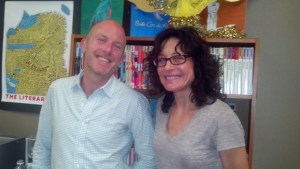
Lorin Stein of The Paris Review is no such editor. First of all he’s not old, or stodgy, and I can’t imagine him laughing at the efforts of a fellow literary mind (with a few exceptions I’ll keep within the department). His humility and appreciation for the contributions of writers like myself are both a huge relief and reassuring for someone who is interested in entering the publishing and editing field. What the department anticipated as a lecture became a two hour discussion about personal history, ambition, the turmoil of self-interest and the interest of the magazine and the art of translation. How wonderful it is to have no preconceived notions of a literary figure and discover he is very much a man doing what he loves for the pleasure of other people. umläut is sending him a care package of our own editing expertise, for good measure of course. I find myself eager as a freshman to dole out the next round of pieces to the next round of journals and zines, in the hope and confidence that like Lorin Stein, they’ll feel bad about saying no.
The seniors are leaving. Each one of them is such a unique individual and yet they manage to work together so well. They treat each other with respect and kindness. At this point they’ve grown up together; the trauma of high school has brought them all together. They understand each other, and although they may or may not admit it I think they all love each other a little bit.
At SOTA, high school doesn’t just make friends. It makes families. It’s a small high school to begin with, so everyone vaguely knows each other. Then you mix in the griefs and losses each grade itself undergoes, and you find yourself leaning on your classmates for comfort. Even if you don’t like some people, what you both experience bonds you. I know the seniors, as freshman, lost both a student and a teacher, along with the tough but common cases of kids missing school or dropping out because of drugs, mental health and ED outpatient programs. As a result this senior class is one of the bravest, most vibrant, creative, funny and kind group of individuals any of us will ever encounter. Their talent by far surpasses that of the class before them, and their charm and sincere interest reach even to the freshman.
You know how close classes get. Take it to a departmental level and you’re looking at some people who’ve spent over two hours together for five days a week for four years of their lives together, give or take. I’ve written about how close I personally feel to my class. If I take that and double it I can only imagine the depth and level of empathy our seniors must feel for each other.
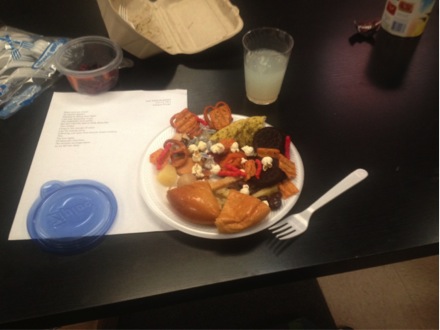
Today Creative Writing had our form of a Seder, which Maia dubbed a “C-dub-der.” We each brought in a food that somehow portrayed freedom to us, and combined them to create our own Seder plate (shown below). The rationales ranged from genuine to comical. Colin came up with a separate metaphor for each kind of snack in his bag of Munchies™, which I will not attempt to recite (you can thank me later).
The food was accompanied by two pieces of writing per writer: one piece written during the Haggadah unit, and one piece written by another artist. Giorgia sung a capoeira thingy (Hymn? Chant? Just song?) in Portuguese. The readings, though we only got about halfway through, rounded off the C-dub-der nicely. Overall, a pleasant ritualistic feast and poetry recital. Also, I got Swedish fish out of it, and we all know that’s what really matters in the end.
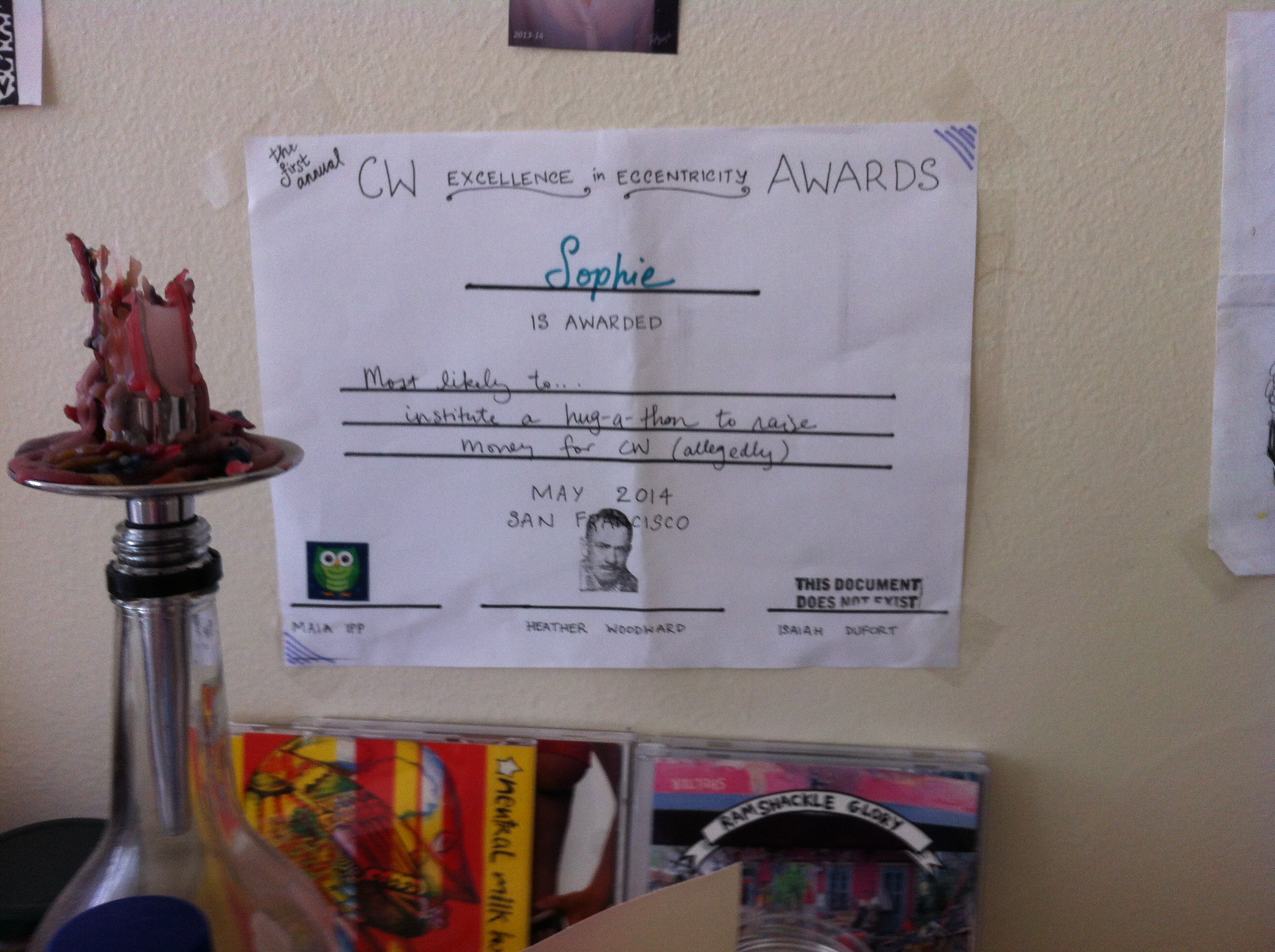
This past Friday, a new tradition was born. It was kind of a bittersweet day, with many of us feeling not only the dull relief of finishing our final finals, but also the pain of the impending loss of our amazing and irreplacable seniors. When we walked into the CW room and were greeted by the sight of a podium at the front of the classroom, we weren’t sure what to expect. Was there another guest speaker? Were we going to have to make impromptu speeches for the seniors? Wrong and wrong. Some twenty minutes later, after Isaiah Dufort made a dramatic, smartly dressed entrance, we learned that that the CW room was now the site of the first annual Excellence in Eccentricity Awards, curated by Heather, Maia, and Isaiah. Everyone in the department recieved an official paper signed by Maia, Heather, and Isaiah certifying their unique affinity for something or other and an accompanying gift from the dollar store. I was awarded Most Likely To Institute a Hug-a-thon to Raise Money for CW (Allegedly). The award came with an adorable pink stapler since according to Isaiah, I’m always trying to steal Heather’s. I have no idea what he’s talking about.
The ceremony continued with more spot-on, strangely specific awards and gifts. After it was all over, we drifted to the carpet for a compliment circle to appreciate our lovely seniors. Fond memories were shared. Tears were shed. An entire box of tissues was used. We’re all going to miss the seniors. It’s going to be weird starting the new school year without them. Friday’s class was a mixed bag of emotions, but having our awards ceremony was an excellent way to acknowledge the awesomeness and uniqueness of every single person in the department. I, for one, am in love with this new tradition. Long live the EE Awards!
Giorgia and I are writing poems for our own graduation ceremony—which is a mere few days away (!?!). Our mission, as I have interpreted it, anyway, is to be creating something that will be both meaningful to and easily understood by everyone in the auditorium. Something that both preserves our authenticity, and conveys our classmates’. Something not overly cynical. Plus, I found out that I would be writing this poem with only a week or two to spare. I only turn out four or five poems per year that I’m completely proud of, and most of those take me at least a month to finish. In other words, this might be the craziest assignment I’ve ever been given.
I’m reminded of the process of writing a college essay. This is more fun, of course, but some of the elements are the same. The guidelines are, if not strict, at least clear; you’re writing to a very specific group of people; you’re writing to them for a prescribed reason. That doesn’t mean you have no freedom, or that whatever you write will be contrived. But every so often, I catch myself becoming dangerously skeptical about the purpose of writing this poem. Does graduation have any intrinsic meaning, or is this all just pomp and circumstance?
Since this kind of thought tends to occur right after I’ve been writing irritably for half an hour with no results, it’s pretty easy to put down to momentary crankiness. Yes, graduation is meaningful. And not just graduation as a moment in time—graduation as the event that the school puts on and that we’re all obligated to go to in slightly silly-looking hats. One of the reasons it will be meaningful is that the seniors get a final chance to show off our art: to write poems for the occasion, and play music, and dance, and do all the stuff that has been of ultimate importance to us for the last four years.
In recent weeks, I’ve had to go through the process of emptying my childhood bedroom. We’re selling the house, and we’re fixing up my room with new furniture and a coat of paint on the walls, so it can look nice when it’s staged. I’ve packed a lot of books and clothes, and said good-bye to a lot of things. Some of the things that ended up as garbage were stupid trinkets, not worth putting in a box; others, were things like trophies, awarded for “participation” and received with spite. Mostly though, the now-lost thing that makes me sappy and wistful, are the quotes written on my walls.
Here are some of them:
“That was it. I’d never understood before. It was full of money—that was the inexhaustible charm that rose and fell in it, the jingle of it, the cymbal’s song of it. . . High in a white palace, the king’s daughter, the golden girl. . .”
-The Great Gatsby by F. Scott Fitzgerald
“One generation passeth away, and another generation cometh; but the earth abideth forever… The sun also riseth, and the sun goeth down, and hasteth to the place where he arose… The wind goeth toward the south, and turneth about unto the north; it whirleth about continually and according to its circuits… All the rivers run into the sea; yet the sea is not full; unto the place from whence the rivers cometh hither they return again.”
-Ecclesiates
“Under the terrible burden of destiny laughing as a young man laughs”
-“Chicago” by Carl Sandburg
The writing of quotes on my walls was a project I undertook in eighth grade, after reading Franny and Zooey by J.D. Salinger. In the book, there’s a scene where Zooey walks through his brother’s old room, and looks at all the quotes he had written on one of the walls. His brother, Seymour, is dead.
I think part of my decision was inspired by the fact that I was reading a lot of good books at the time, and I didn’t want any part of anything I was reading to be lost. Also, the vague notion of dying, and someone walking into my room, and seeing all my accumulated knowledge, struck me as romantic.
Here are some more quotes, for entertainment:
“Tiger got to hunt, bird got to fly; Man got to sit and wonder ‘why, why, why?’ Tiger got to sleep, bird got to land; ‘man got to tell himself he understand.’
-Cat’s Cradle by Kurt Vonnegut
“All you need is love”
“Let it be”
“Ahh, look at all the lonely people”
“We all want to change the world
But when you talk about destruction,
Don’t you know that you can count me out”
-The Beatles
It took a lot of effort to say good-bye to the walls, and the quotes on them. It meant a lot to me, my 13 year-old self, holding open a book, and very carefully inscribing words onto the wall with a thin, black Sharpie pen. Even if they weren’t my words, or my ideas, someone shared them with me through their writing. Letting it go was a strange, incomplete process.
A lot of it was surrendering to my brain to do its best to remember, a terrifying thing to do. There’s no magical box in the head, where everything remains perfectly intact. The brain has to recreate every detail of an experience in order to remember it. It’s a fragile system that always brings up a lot of troubling questions, like: What if I trip, hit my head, and get amnesia? What if the cells in my brain that hold all my memories just die? What if I start to misremember? What if I die?
Still, I hope that it transcends that. I hope that after spending years in the room, surrounded by the quotes, some of it may have stuck. In my day-to-day life, taking a minute out of every day to read a quote, recognize it as mine in a way, and appreciate its truth. Hopefully some of it has stuck in a way that transcends brain synapses or death.
The one that I hope will stick, the only one written on the white plank directly above my closet:
“Hello babies. Welcome to Earth. It’s hot in the cold and cold in the winter. It’s round and wet and crowded. At the outside, babies, you’ve got about a hundred years here. There’s only one rule that I know of, babies—’God damn it, you’ve got to be kind’
-God Bless You Mr. Rosewater by Kurt Vonnegut
I’ve recently been thinking about dreams. I have always been an active dreamer – I usually remember my dreams, and I love to pick apart their meanings. One of my favorite things to do is to keep a dream journal, but with school every day and having to wake up early, I rarely have time to write in it. So, most of the dreams I write down occur over the summer or other breaks. Writing down my dreams can range from a few words to four or five pages, but either way, my goal is to capture the lingering feeling I have after waking, and the significance of the dream.
I love to trace what I’ve just dreamt about to things that happened the day before, or what I was thinking about when I fell asleep. For example, a few years ago, I had a dream about riding in a subway car up the length of the Koelner Dom, a famous cathedral in Germany. The driver turned against us and crashed into something. When I woke up, I realized that dream came from walking up the stairs to the top of the cathedral that day, and taking to subway back home. Another time, I dreamt about taking an ibuprofen, and when I woke up I had a headache. Once, I dreamt I has joined the swimming team at SOTA, but didn’t know how to swim – the next day, I went swimming. I think my fascination with this comes from the fact that I hate not knowing why I feel a certain way – even if I’m sad, knowing the reason makes it easier to deal with. Also, sometimes I can analyze myself from my dreams, or figure out something new. I am a firm believer in the magic and truth of dreams.
I am making a promise to myself: write down my dream every morning, if I can remember it, even if it’s only one word. We’ll see where I take myself.
For my final blog post of my CW career, I’m supposed to be writing a testimonial to bring all you crazy blog-readers who are not already convinced of the value of CW over from the dark side. Obviously, there’s not enough space in one post to give a full brief, so I’m going to have to choose just one aspect of CW to talk about: Heather.
Today, I went into Heather’s office to consult with her about a poem (the one I’m writing for graduation) for the last time. This felt more final than any of the other events of the day—more so than attending my last high school English class or bringing my cap and gown home or even being part of the “senior appreciation circle.” I have the impulse to frame my enthusiastically-scribbled-on poem and hang it on my dorm room wall.
Working with Heather has been a defining part of every senior’s time in CW. “Working with Heather” may have included any of the following and more: sleeping on her couch; calling her at all hours of the night; eating her food; being showered with ego-boosting compliments; sometimes, grading her papers. Perhaps most importantly, hearing her explain something about your poem—some clever syntactical choice or meaningful image—that you hadn’t even consciously considered. Any CW knows how pissed off I get at apathetic teachers. Heather is the opposite of apathetic, and her complete generosity with her time, energy, and love is unearthly. She wins the Nobel prize for life-changing teaching.
Prospective parents reading this? If you think your kid can find a teacher like this at any school, you are wrong. Prospective CWs? If you have ever felt like you didn’t fit in, or like nobody understood you, the chances are that Heather will be able to fix that. Along with teaching us to write, it’s what she does.
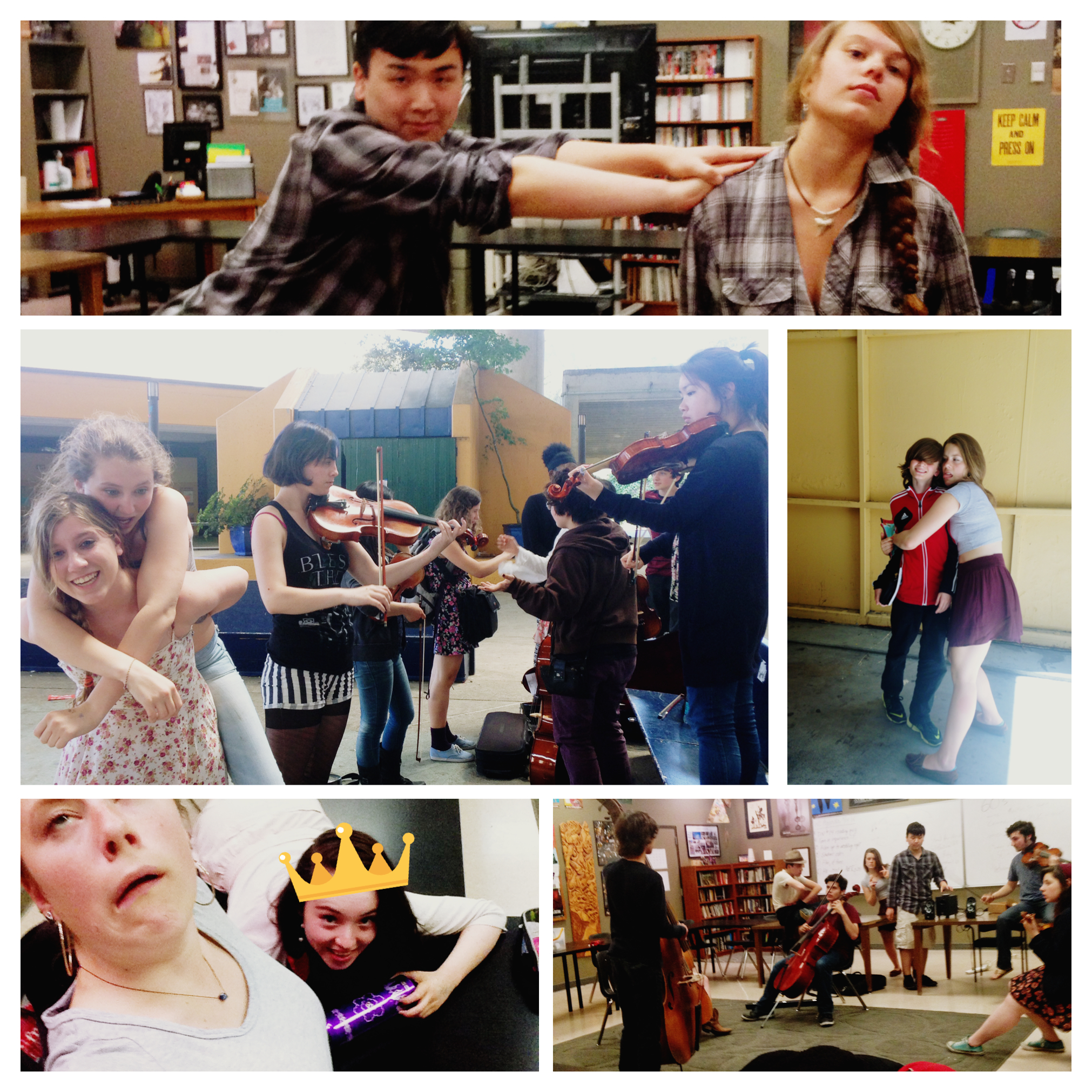
Well, it took us a couple minutes to learn to love it. When the always adventurous Maia told us that today we would be working alongside another department, most of us were a little reluctant. It’s not that we don’t thoroughly appreciate the talents of the Instrumental Music department or the merits of working together, but I (and I’m sure many other CWers can attest to this) experienced a sudden onset of social anxiety. It meant we would have to SPLIT UP and it’s so HOT OUT WHY would they make us MOVE out of the CW room and what if they DIDN’T LIKE US and what if they JUDGED our poetry?? But, with the urging of the always wise seniors and Maia, all fourteen of us trudged on over to Orchestra room. We were then split up into groups (one or two CWers alongside three to five musicians), and assigned decades from which to compose a musical piece and a written piece to accompany it. My group, assigned the 1920s, wrote a short piece that begins: “Speakeasy, hold my secrets….” So you know there’s going to be some pretty good flapper drama going on in ours. Anyway, as I looked around to all the other CWers and musicians, working side by side to create their own beautiful, original pieces of art, I realized something: collaboration is scary, but its rewards enormously outweigh those few seconds of social anxiety. Interdisciplinary collaboration is so valuable and important in instituting a real feeling of community in the school and an appreciation for other art forms outside of your department, and I really hope that this day sets us on a path for collaboration between all departments in the future.
Below are pictures of our collaboration day:
In Psych, we talk about intrinsic vs. extrinsic motivation, extrinsic being stuff like money or good grades or AP test scores, intrinsic being “I want to.” This morning, my friend saw me reading Pride and Prejudice and asked why I was reading it after the AP Lit test. I said because I want to, and I realized that I really did want to, and I haven’t felt this way about reading a “classic” book in a long time.
There’s the uncomfortable stigma around “canon” books, that they’re school literature, that they’re boring, etc. And that’s not even getting into the “they’re mostly written by dead white guys” argument. Books like East of Eden and Shakespeare plays get groaned about a lot in this context.
The last book we read in Euro Lit was Wuthering Heights, and I started out hating it. I did not like a single character, and the writing style was so effectively claustrophobic and turbulent that it all just aggravated me. I still don’t like any of the characters, but now I love the book— and I don’t know why? I didn’t feel this way about The Stranger or Heart of Darkness. Maybe it’s because I finished it just as I took the AP test, and with that extrinsic weight off my shoulders, I actually properly enjoyed it to my own benefit.
(And it’s somehow such a comfort to know that I’m still capable of enjoying literature without a class or a test to pressure my comprehension of it— I don’t know how, but somewhere along the line I forgot that I can read “school” books for myself, as well.)
The thing about CW is, we don’t distinguish the readings we do as “school” reading— otherwise, I don’t think I’d enjoy T.S. Eliot the way I do now. It seems like the stories and novels we talk about in CW have some sort of immunity; I’m reading Giovanni’s Room, after being introduced to James Baldwin in CWII. It’s nice.
So now, I’m going to read all of Austen, because while I find myself enjoying the writing from that period, I can’t take another book like Wuthering Heights right now. Without the pressure of school, I’m at a really good place with books right now.
The door of the Creative Writing room has little posters with various words like “alliteration” and “metaphor” and “conceit” and “irony”. If we continue from the door, counterclockwise about the room, we see the copy machine. The only person who knows how to use the copy machine is Justus, even though it’s really just pressing a green button and doing something with the paper. Nobody can ever quite remember what that something is, so we always hunt down Justus before copying something.
Next to the copy machine is the water heater I bought for the CW room so that we can make tea during lunch. There’s something seriously wrong with this water heater, though, and it has yellow duct tape on the edge where we attempted to mend it. It sits on a heap of folded paper towels because water inevitably leaks out of the electrical socket while it’s heating; nobody has been able to figure out why or how this happens.
Then we reach a bookshelf in which Umläuts and other weird literary magazines live. Next, we pass a gray statue of a lion, which sits regally on its shelf. We then approach Heather’s desk in the corner, a square solid wooden thing, cluttered with papers. Behind Heather’s desk are her swivel chair, and a tall shelf on top of which sit an owl (nailed to the shelf by Isaiah, presumably so nobody steals it) and a gargoyle head.
Continuing past the whiteboards, we reach the triangular prism, a green thing with black outline which nobody really understands. By the whiteboards is the little carpeted book corner, with two bursting bookshelves forming a 90 degree angle. On the bottom shelf of the right bookcase is a veritable archive of Chem lab books, extending back to Creative Writers from days of yore.
Then we reach the bulletin board, on which people have posted an assortment of things over the past ten years: a naked lady, a picture of Creative Writers all decked out in yellow Field Day gear, Mykel’s collage of Leonardo Di Caprio looking shocked. Finally, turning a corner, we see the mural: a yellow and brown dirt path meandering next to a field of grapes, which serves as a surrogate window.
If by any chance you have found yourself in the general vicinity of me visiting my locker this past week, you have probably heard me grumbling about 30-pound dictionaries and bus commutes. Friends, I am not muttering to myself because I am angry (well, actually I probably am because there’s one month of school left and I am so unbelievably burnt out at this point.) Anyway, hear me well: I am not angered by any dictionaries. I am delighted by these dictionaries.
I’m proud to announce the arrival of two new members of the Aineb clan! They’re twins, and they are named Oxford Shortened Edition and Oxford Complete Edition. Recently adopted from the kind Nick Hoff, these two guys have been parked out in my and Clare’s locker. (Yes, they were so big that I had to borrow some storage from Clare. Thank you, Clare.) Unfortunately, I can’t really take them home at the moment because it would absolutely suck to carry these bad boys on a crowded 44 bus. But believe me, as soon as they make their way to my house, the badly bruised and battered meager Random House Dictionary sitting on my shelf will be incinerated. Mwah ha ha. Long live Oxford.
Us freshmen recently finished reading Emerson’s “Self-Reliance,” which we have been toiling away on for 7 weeks!!! Phew. This essay probably changed my life, but at the moment, I don’t want to look at again for quite a while. As a gift for all our hard work and many discussions on Hitler, Nick, the notorious book dealer on SOTA’s campus, brought us some books! As said, I got the dictionaries, Clare got the Chicago manual on editing, Emma E. got a book on etymologies, Emma B. got…er…something else that I can’t remember (sorry!), Isaac got a book that shall not be named for secret reasons, and the victorious Sophie got the most coveted book that she shed tears for: a selection of Emerson’s work in a prettily bound fabric cover. The six of us are very content with our belongings….
Sadly though, Freshmen Seminar has reached a close. If only it could last forever… Honestly, CW seems so intent on breaking us freshmen apart and forcing us to socialize with other classes (which is definitely important, I agree). But it was still nice to have a day set aside to hang only with Maia and those five other goofballs, CIEES. Ah well. The next generation of freshmen will have to carry on the many traditions we started this year: adventures with Tom the mug rack, an infinite amount of sidetracked conversations, being too loud in the library, slipping under the table and tying Amina’s shoelaces to her chair, and singing NMH’s “Airplane Over The Sea” and MCR’s “Na Na Na.” So long and goodnight, Freshmen Seminar.
It’s a cold Thursday, the fog outside is drifting past my window, and the trees are bending in the wind. All I want to do after a tiring day of school in this weather? Curl up in my bed, with a HUGE mug of tea and listen to my favorite podcast: The Moth.
First, let me say podcasts are great. Free and usually amazing, they are great for us writers. All I lack in life experience, the podcasts I listen to make up for. Currently in my queue are Night Vale, BBC Global News, This American Life, Fresh Air, and The Moth. All these podcasts are so different and I highly suggest checking them out.
The Moth is especially inspiring for me. Each episode is a collection of true stories, told live at a Moth event. They are usually held in big cities like New York, Chicago, and our very own San Francisco. Many of the stories are told by writers, or people involved in the literary community. Some Moth participants are famous, like Mt. Everest World Record holders or Saturday Night Live cast members. Each story told is unique and unforgettable.
You can go to a Moth event and see each story told live. I listen to the stories. It’s such a powerful experience being able to listen and hear each unique voice. Usually the stories told are intensely personal, and having no visual of the storyteller makes it easier for me to connect with the story. Hearing just a voice makes the experience more personal.
I first started listening to The Moth about a year ago, as something to do on my morning bus ride to school. At first, I couldn’t get into the stories. I couldn’t concentrate on them. Then, one day, while riding BART, I listened to a story that turned me into a Moth addict and would change my life. It is a story I have never forgotten.
The story was told by Susan Kent, who when she was nineteen got pregnant. She lived in Southern Georgia, and upon realizing she was pregnant distanced herself emotionally from the ‘thing’ growing inside her. Upon having the child, she gave it up for adoption. While signing away her rights, she realized that on the paper it said “Baby Girl”. Up until that point, she had never thought of the child growing inside her as anything other than a ‘thing’. Now, there was something attached to it. She still gave the baby up for adoption, but she kept her records open and has yet to hear anything from the child. The baby girl turned 22 in December.
I was in tears, on BART, listening to Susan tell this story again and again. There was so much emotion in her voice, in the way she told the story. And there are so many others just as remarkable and amazing like Susan’s. There are stories about children growing up in drug-addled homes and fathers who lost their daughters to rape and abuse and husbands meeting their wives. Each story has an ending result of forgiveness, of love, clarity, hope.
I hope to have a story I can one day share on The Moth stage. If you are interested in hearing the podcast, and trust me you should be, you can subscribe for free on iTunes, or visit the website: http://themoth.org/
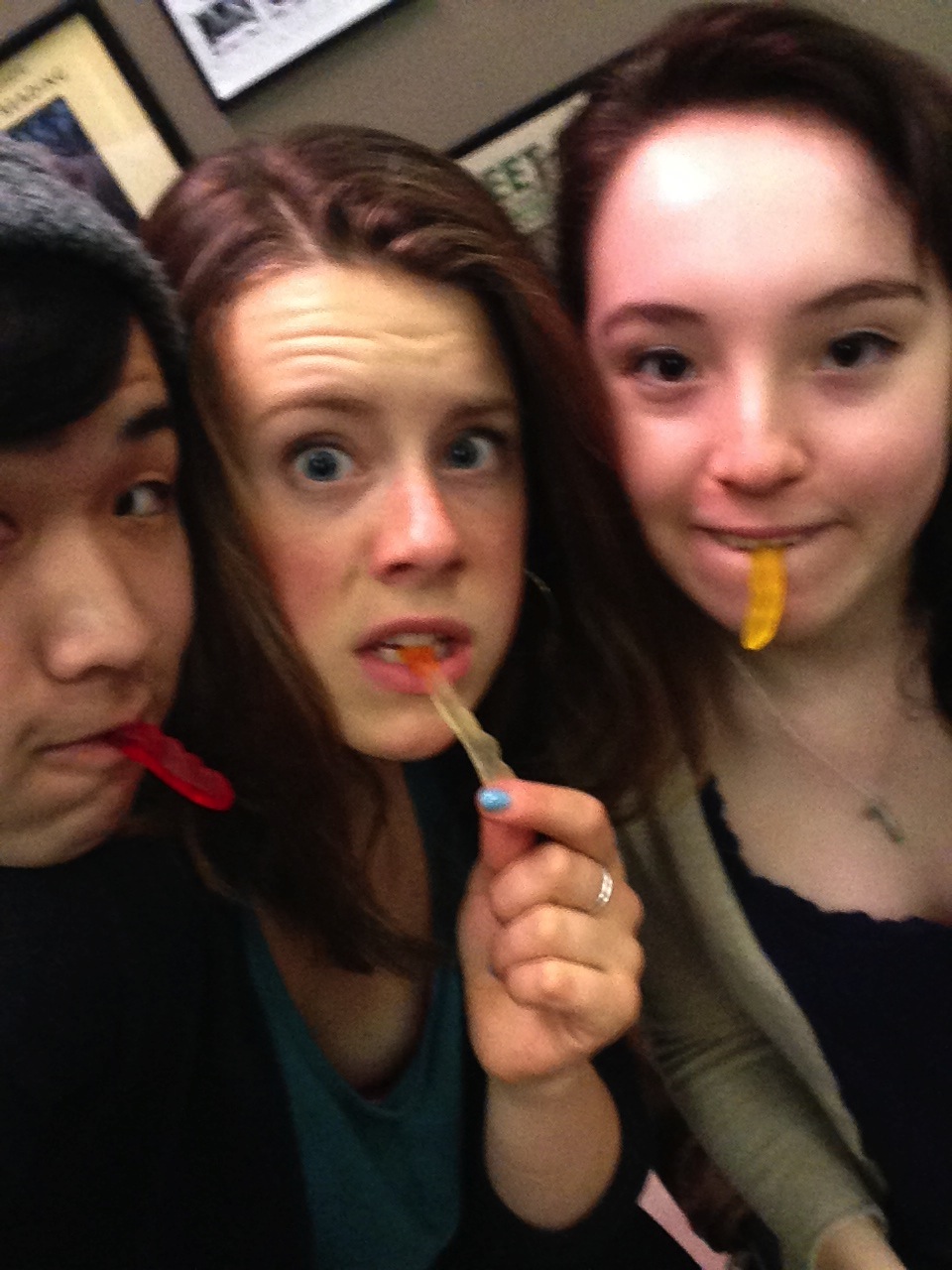
The picture, completely separate from my blog post, is of Colin Yap, me, and Noa Mendoza, (the Sophomore class (minus Olivia Weaver)) eating some very good gummy worms.
- a chapbook can be any length
I’m quite a fan of planningprior to execution, especially for something as final-seeming as the chapbook. As my thesis is a fragmented novella, I’ve been working under the assumption that I could only puta portion of my thesis in; thus, I wouldn’t needto be FINISHED finished with my thesis by the time we’re making chapbooks. Now that I know I can put my whole thesis in, though, I want to. The chapbook would lack without every bit of the story. So the deadline for the thesis is actually a lot earlier than I had previously thought. Yay.
- formatting is done in InDesign
As this list goes along, I’m realizing this isn’t so much an “Insider’s Look” as a “Hey, If you’re like me and get really freaked out if you don’t know what’s going on in any process, here’s some information!” I’ve encountered this program before, but I would’ve fiddled around on it more in preparation, had I known, I think. The marvelous Julie Glantz is currently helping the seniors through chapbook formatting on school computers, so this isn’t as much of astressor as it could’ve been.
- you have to make aesthetic decisions
Somehow this has never struck me. I always assumed just put the words on a paper, print, and bind. But no. Given all the options thatInDesign made available, I can choose the font, the size… everything, basically. The Tyranny of Choice is very real. I’m about to spend an afternoon formatting my chapbook. Wish me luck.And finally, one more thing I have to figure out:
- binding machine? paper?
Julie is coming back in tomorrow to answer our SOS. I’ll keep updates.
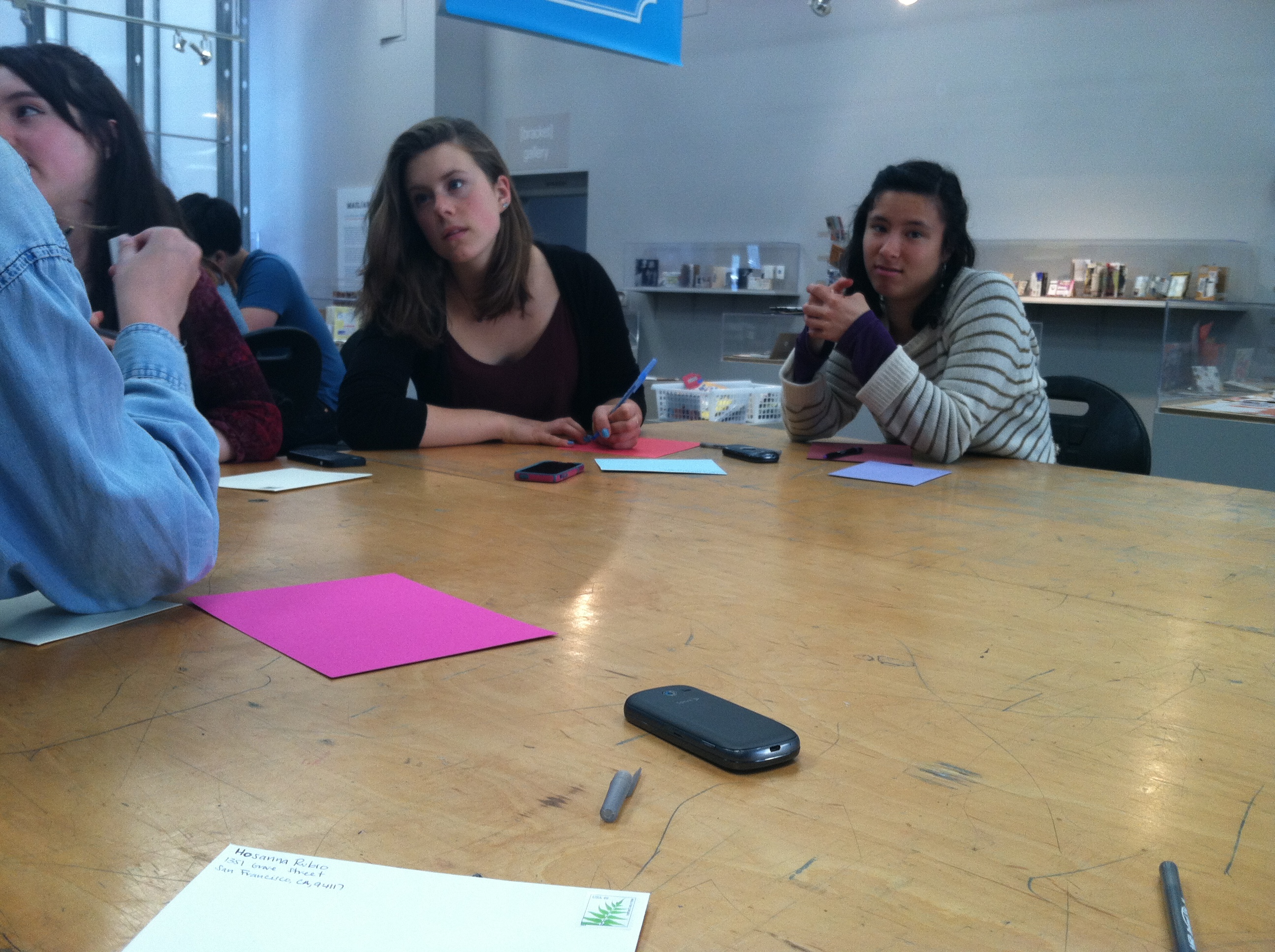
Today we went to the the San Francisco Center for the Book and checked out the old school way of print making. There were various printing machines, each looking particularly dangerous and enticing. I stayed toward the back, just in case one of the machines gained a life of its own. While in the vicinity, the class was given a small tour of the mail exhibit, housing over three hundred pieces of artistic mail. There was one piece of mail that was a jar (who knew jars of liquid were allowed or safe to send?) of water from the Mississippi River, and clunking around in the grimy goop was what appeared to be a bunch of tightly bound paper. Seeing the thing from a distance, I assumed someone had the audacity to leave a fish floating around in a jar, a little something something for the receiver. Once again, my imagination took me too far. All in all, the trip highlighted the art of printing and significance of paper, its long journey that’s quickly fading into the ether.

In CWI, we recently read, “Where Are You Going, Where Have You Been?” a short story by Joyce Carol Oates. It’s an excellent story, full of witty name puns (Arnold Friend = an old friend), questions about our ability to make choices, and a character representing Satan (if he was a smooth, greasy-haired human, instead of a red, horned, demon-guy). Furthermore, it’s dedicated to Bob Dylan, because the girls that he writes about also end up where they are because of the choices they make.
What I kept thinking about as we discussed the story, though, was how prolific Joyce Carol Oates has been. In the anthology we’re reading from, it notes that she has already published 35 novels, 25 short story collections, and she might just keep going. Since her first book was published, a short story collection called By the North Gate, in 1963, she has not stopped writing, and she has not stopped having her books published.
What kills me about it though is that I will probably never be like Joyce Carol Oates. Maybe that’s what’s getting to me: I’m not Joyce Carol Oates. But I’m also never going to be Hemingway or Fitzgerald or Vonnegut, and I’m not writing about them right now. I think I’m very self-conscious of the fact that what I write is not always good, and that it might be a waste of time to the world to read it. Even now, as I write this blog post, I’m very conscious of someone who might read it and say, “Eh.” I don’t want to be a sad-sack, but I also don’t want to be the cause of waste of man-hours.
Still, I want to write. Not every hour of every day, and certainly not solely in my life. But if I can just keep living and writing things that interest me, and have the opportunity to interest other people, I’m going to try to do it. What I like about Oates, when I think about it, is that she stuck with it. I don’t know about her own insecurities of vanities, but she just keeps throwing manuscripts into the void, and I can get behind that.
CW2 Fiction Unit by Midori
Two words: James Baldwin.
It’s not the first thing we read, but it was the first thing that completely blew me and several others away.
We had our first workshopping session on Friday, and something Maia’s told me over and over again about my thesis came up. “Have confidence in your readers,” she says. “Trust they’ll make the connections you want them to make.”
Baldwin’s short story, “This Morning, This Evening, So Soon,” made Maia’s words so abundantly clear to me. That’s how you do it. I’ve reread the story twice now, and plan on reading it again, because it inspires confidence in me. I can follow in his example.
Frances actually said she doesn’t like reading amazing things before she writes, and that’s so interesting to me. Last year, in Sarah Fontaine’s unit, we wrote a piece about our personal writing style, and I wrote about how easily it changes and is influenced by whatever writer I am, at the time, inspired by. And how much I didn’t mind. It feels like, given a convoluted math problem, someone showed me the shortcut equations to get to the answer. Then, using that, I come up with my own questions and my own twists on them. It’s so reliable and fun.
Our first assigned piece of fiction is the “Unlikable Narrator” story, though it doesn’t have to actually be the narrator. The prompt struck me with its brilliance over the weekend, because it’s such an intense balance to maintain. In order to write a genuine portrait of any real character, the author must empathize with them to some degree, but in order to write an unlikable character, that means we empathize with someone unlikable? It’s also vulnerable, I think, because to some extent, it reveals what the author considers unlikable, perhaps about themselves.
That’s definitely the case for me. I wrote my short story Friday evening, and it didn’t actively trouble me. But if I were pressed to go back and analyze it for parts of myself, I think I would definitely be able to tell that, perhaps, the part of me that I find most unlikable is my sometimes-bad relationship with my sister. I do like the story, though, and I feel like I understand the characters in it, which is the point of the assignment.
And I think that vulnerability applies for the reader, too, because a successful portrayal of a character means the reader empathizes to some degree as well. So the reader is then put into a position of vulnerability, which feeds back into the author. That’s a hell of a lot of trust we need to keep going (which, luckily, we have).
In conclusion, I’m super psyched for this unit, and I’m learning more about myself throughout it. A.K.A. nothing’s new in CW.
 CREATIVE WRITING
Leave a comment